
The short answer
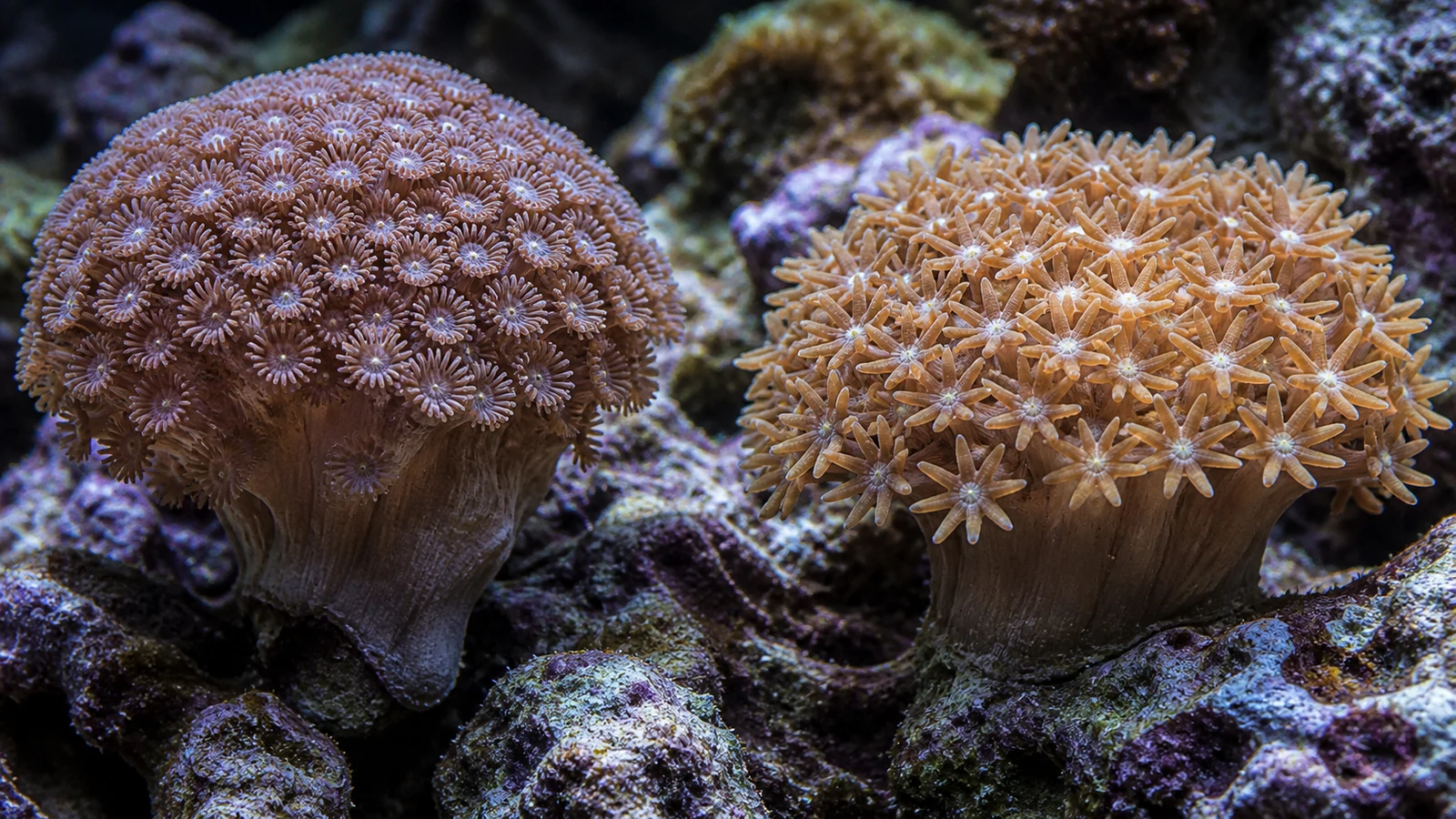
Goniopora and Alveopora are stony corals with long, flower-like polyps. The fastest practical distinction is tentacle count: a fully extended Goniopora polyp normally has 24 tentacles around the mouth, while Alveopora has 12. Alveopora often looks more open and delicate, with blunt or knobbed tips, but color, polyp length, and sales names are not reliable identification by themselves.
Alveopora has historically been considered easier because many of the Goniopora entering the hobby were wild, large-polyped species with a terrible record in aquaria, especially Goniopora stokesi. That comparison is not a controlled scientific rule across every species. Some Goniopora are durable and now widely aquacultured; some Alveopora decline. Source, species, colony condition, transport, feeding, flow, light, and tank stability can matter more than the genus printed on a tag.
The story that Goniopora was almost banned in the United States has a real policy-adjacent root, but this review did not find a formal species-specific federal ban proposal. Around 2001, aquarium-industry participants publicly worried that a Marine Aquarium Council “Unsuitable Species” designation could influence the U.S. Coral Reef Task Force and eventually restrict imports. At the same time, all stony corals were already regulated under CITES Appendix II. The distinction matters: there was a genuine industry ban scare built around terrible mortality, not proof that Congress or a federal agency had a Goniopora ban ready to enact.
They look related, but evolution says otherwise
For years, both genera were placed in the family Poritidae because their long polyps, colony form, and skeletons looked similar. Molecular studies changed that view. A 2014 phylogenetic analysis confirmed that Alveopora is genetically distant from the poritids and closer to the Acroporidae, while Goniopora remains tied to the poritid lineage.
That makes the resemblance a useful warning against care-by-silhouette. Two corals can extend similar flower-like polyps without being close relatives or sharing identical tolerances. It also explains why a store label such as “flowerpot coral” is not enough information for a purchase decision.
How to tell Goniopora from Alveopora
Wait until the coral is fully extended, photograph it straight on, and count the ring around the oral opening. Check several polyps because retraction, damage, overlap, and image blur can hide tentacles. If the count is unclear, do not force the identification from color or a vendor nickname.
Bernardpora adds another wrinkle. The coral formerly called Goniopora stutchburyi was moved into Bernardpora by the same molecular study. Retail naming often lags taxonomy, so a colony sold as “short-polyp goni” may not be Goniopora in the current scientific sense.
Use several open polyps and, when possible, skeletal features. One damaged or partly closed polyp can mislead you.
| Feature | Goniopora | Alveopora |
|---|---|---|
| Tentacles per polyp | Normally 24 | Normally 12 |
| Overall flower shape | Often finer and denser | Often more open and daisy-like |
| Tentacle tips | Variable by species | Frequently blunt, rounded, or knobbed |
| Skeleton | Generally denser with 24 septa arranged in three cycles | More porous and delicate, with 12 septa |
| Modern family placement | Poritidae | Acroporidae based on molecular work |
| Color as an ID tool | Unreliable | Unreliable |
Why old-school Goniopora had such a terrible reputation
The classic failure was cruelly slow. A newly imported green flowerpot could expand beautifully for weeks or months. Then extension shortened, patches stopped opening, tissue receded, algae colonized exposed skeleton, and the colony died after the easy return window and long after the purchase felt successful.
The most commonly traded form was often Goniopora stokesi, a free-living or ball-shaped species with long polyps and a poor historical aquarium record. In a detailed 2002 husbandry review, Julian Sprung wrote that long-term success with G. stokesi was reportedly rare while noting that other Goniopora species had survived for more than five years. The genus-wide label “impossible” grew from a real problem but flattened important species differences.
Early reef systems also created a difficult mismatch. Powerful skimming, low suspended food, limited understanding of particulate feeding, unstable chemistry, rough collection, and long transport could leave a coral with light but not enough usable nutrition or recovery capacity. Because the decline was delayed, import and retail losses were easy to underestimate.
Why Alveopora was considered easier
Aquarists and experienced coral writers repeatedly reported better long-term survival from many Alveopora than from the common G. stokesi colonies that defined the flowerpot reputation. Alveopora was therefore recommended as the more forgiving way to get the same waving, daisy-like effect.
The most defensible explanation is a difference in the animals being compared, not a proven universal mechanism. The trade was comparing one set of Alveopora species and sources with large numbers of a particularly troublesome wild Goniopora. Hardiness could reflect species biology, collection habitat, colony form, transport tolerance, condition on arrival, or nutritional compatibility with aquarium food and plankton.
There is not enough comparative experimental evidence to say that 12 tentacles make a coral easier, that Alveopora is simply “more photosynthetic,” or that one trace element explains the outcome. Modern experience has also narrowed the gap because aquacultured Goniopora lineages, smaller healthy fragments, improved food, and better flow and light control are not the same starting material that built the old reputation.
Feeding is not optional background detail
Photosynthetic symbionts supply energy, but these corals are also heterotrophs. A controlled feeding study on Goniopora columna documented ingestion of microalgae, yeast, and formulated feed and measured changes in tissue composition. That does not prove one commercial powder is mandatory, but it does reject the idea that light is the whole diet.
Offer small suspended foods that the polyps can capture. Suitable choices may include fine zooplankton, microalgae, appropriately sized frozen foods, and a nutritionally complete coral food. Begin conservatively, observe whether particles are captured rather than merely coating the colony, and increase only if nutrient export can handle it. A cloud of uneaten powder is an algae plan, not coral nutrition.
Target feeding can help a weak colony receive food without flooding the tank, but blasting the oral discs with a pipette can cause retraction or tissue damage. Stop pumps briefly if needed, deliver a gentle suspension upstream, allow capture time, then restore circulation. Watch the coral’s response over weeks through extension, tissue coverage, growth edge, and new polyps, not through one dramatic feeding video.
Light: acclimate the coral you actually bought
Goniopora and Alveopora occur across different habitats and depths, so a universal PAR number is false precision. A controlled Goniopora columna experiment found that light spectrum affected growth, digestive enzymes, and photoacclimation, confirming that “it has zooxanthellae” is not a complete lighting plan.
Place a new colony in moderate light relative to the source system and acclimate slowly. Ask the seller where it was held and, if possible, for a measured PAR range. A coral shipped dark and placed directly under a concentrated high-output fixture can bleach or remain closed even if that intensity might have been tolerated after acclimation.
Use the colony as feedback. Persistent paling can signal excess light, insufficient nutrition, or both. Browning and extreme extension can occur under low light but are not a diagnosis by themselves. Change one variable at a time and give the coral time to respond.
Flow: broad movement, not a pressure washer
Long polyps need water movement to exchange gases, deliver food, and prevent waste from settling, but a narrow jet can fold them over the skeleton and abrade tissue. Aim for broad, indirect, variable flow that keeps the colony moving without pinning every polyp in one direction.
Watch the base and the spaces between polyps. Detritus collecting around the tissue margin can create chronic irritation, while a colony whipping violently may stay retracted. Move the pump or coral in small increments. The best setting is observed at the colony, not inferred from a pump percentage.
Stability matters more than chasing a secret element
Maintain reef-appropriate salinity, temperature, alkalinity, calcium, magnesium, nitrate, and phosphate with as little abrupt movement as practical. These are calcifying corals with living tissue extended far beyond the skeleton. Alk swings, salinity errors, temperature spikes, nutrient starvation, and tissue abrasion can compound quickly.
Iron and manganese are frequently discussed in flowerpot-coral care. Trace elements are biologically real, but dosing them blindly is not a substitute for food, stable major chemistry, suitable light and flow, or a healthy starting colony. If a trace-element deficiency is suspected, use a reputable analytical method, confirm the result, follow a measured product protocol, and track the response. Do not turn one struggling coral into permission to dose an unmeasured metal cocktail.
Placement and neighbors
Give the fully expanded colony much more room than the skeleton appears to need. Long polyps can contact neighboring corals, and the colony needs clean flow around its complete perimeter. Set the base securely so snails, fish, or maintenance cannot roll fleshy tissue against rock.
Clownfish sometimes adopt flowerpot corals as substitute hosts. The behavior may look charming while repeated diving, biting, and rubbing keeps the coral closed or damages tissue. If the coral loses extension after hosting begins, separate the interaction rather than assuming it will adapt.
Avoid placing a fresh import in the brightest, highest-flow show position. Start where observation and feeding are easy, then move only for a reason. A stable “good enough” location is usually safer than a weekly search for a perfect one.
Wild colony or aquacultured frag?
An aquacultured fragment with a documented history in captive systems is usually the stronger starting point. It has already survived cutting, healed its margin, and grown under aquarium light, flow, food, and microbes. It also reduces demand for repeated removal of large wild colonies that may have poor survival after export.
Aquaculture does not make every frag indestructible. Ask how long it has been healed, what light and flow it received, how it was fed, and whether the parent colony has years of captive growth. A freshly cut wild colony sold as aquacultured is not the same evidence as a multi-generation captive line.
For a wild specimen, inspect the entire tissue edge for recession, brown jelly-like material, boring organisms, damage, algae on recently exposed skeleton, and areas that never extend. Quarantine and observation protect the display and give the coral a quiet recovery environment.
Was Goniopora almost banned in the United States?
There was a real scare inside the aquarium trade, but this review found no formal U.S. federal proposal that specifically banned Goniopora because aquarists were killing it. The strongest documentary trail points to certification policy and the fear that it could become import policy.
In a public aquarium-business discussion from the early 2000s, an industry participant objected to the Marine Aquarium Council creating an “Unsuitable Species” list. Goniopora was the central example: it was described as the third most imported coral, with the vast majority dying near six months. The writer worried that if MAC excluded it from certification, the U.S. Coral Reef Task Force might later use the list to support an import ban. That is close enough to explain an experienced importer remembering that Goniopora was “almost banned,” but it records a feared pathway, not an enacted rule or located federal proposal.
First, all stony corals were added to CITES Appendix II in 1990. NOAA explains that Appendix II is regulated trade, not a commercial-trade prohibition: an exporting country can issue a permit after legal-acquisition and non-detriment findings. U.S. Fish and Wildlife guidance likewise describes the export documentation required for Appendix II trade.
Second, coral-trade mortality and sustainability became major public issues. A U.S. Coral Reef Task Force report warned that improper transport, handling, and husbandry could produce high mortality and unsustainable trade. Goniopora was among the abundant live corals in international trade, while its aquarium record was notoriously poor.
Third, responsible hobbyists, authors, and retailers argued that the common flowerpot should be left in the ocean unless its needs could be met. That produced both an informal ethical boycott and a plausible fear of formal restriction. Export bans in countries such as the Philippines and temporary broader coral-trade restrictions elsewhere may also have blended into the memory.
The fairest conclusion is therefore not “the ban was made up” and not “the U.S. nearly outlawed Goniopora.” It is that catastrophic captive survival put Goniopora into an unsuitable-species debate, and people inside the trade feared that certification exclusion could become an import restriction. That distinction preserves the warning without converting a documented concern into a law that this review could not locate.
How modern Goniopora changed the old advice
Today, many reef keepers grow and fragment Goniopora successfully. Scientific work has maintained Goniopora columna in controlled culture, tested feeding, light, temperature, and salinity, and demonstrated that the genus is not biologically doomed in captivity. The retail trade also contains aquacultured lineages with years of captive history.
That does not make the old losses imaginary or every current colony easy. “Goniopora” still covers multiple species and retail identifications are imperfect. A hardy red aquacultured frag and a large newly imported green G. stokesi should not receive the same risk label simply because both extend flower-like polyps.
The modern purchasing question is therefore specific: What is the species or best-supported ID? Is it captive grown? How long has the fragment healed? What conditions grew the parent? Does the tissue cover the skeleton completely? Is the keeper prepared to feed and maintain stable, measurable nutrients? Those answers predict more than the common name alone.
A practical care checklist
- Identify from multiple fully extended polyps: normally 24 tentacles for Goniopora, 12 for Alveopora
- Prefer a healed aquacultured fragment with a known captive history
- Inspect the full tissue margin and decline damaged or receding colonies
- Match the seller’s light and flow first, then acclimate gradually
- Provide broad, indirect flow with no detritus settling at the base
- Offer small appropriate foods conservatively and confirm capture
- Keep salinity, temperature, alkalinity, calcium, magnesium, nitrate, and phosphate stable
- Leave room for full extension and prevent clownfish or neighbors from battering the colony
- Photograph the same angle over time so slow recession cannot hide behind daily extension
Which one should you buy?
For a first flowerpot coral, a healthy, healed, aquacultured colony with a documented parent is a better choice than selecting by genus alone. If all other facts are equal and the options are a wild Goniopora of uncertain identity and a long-established captive Alveopora, the Alveopora is the more conservative purchase. If the choice is a proven aquacultured Goniopora frag versus a freshly imported, receding Alveopora, choose the healthy Goniopora.
The old shorthand that Alveopora is easier contains useful history but not a guarantee. Buy evidence: captive growth, complete tissue, repeatable husbandry, honest provenance, and enough time to show that the fragment is not merely surviving the sale.