
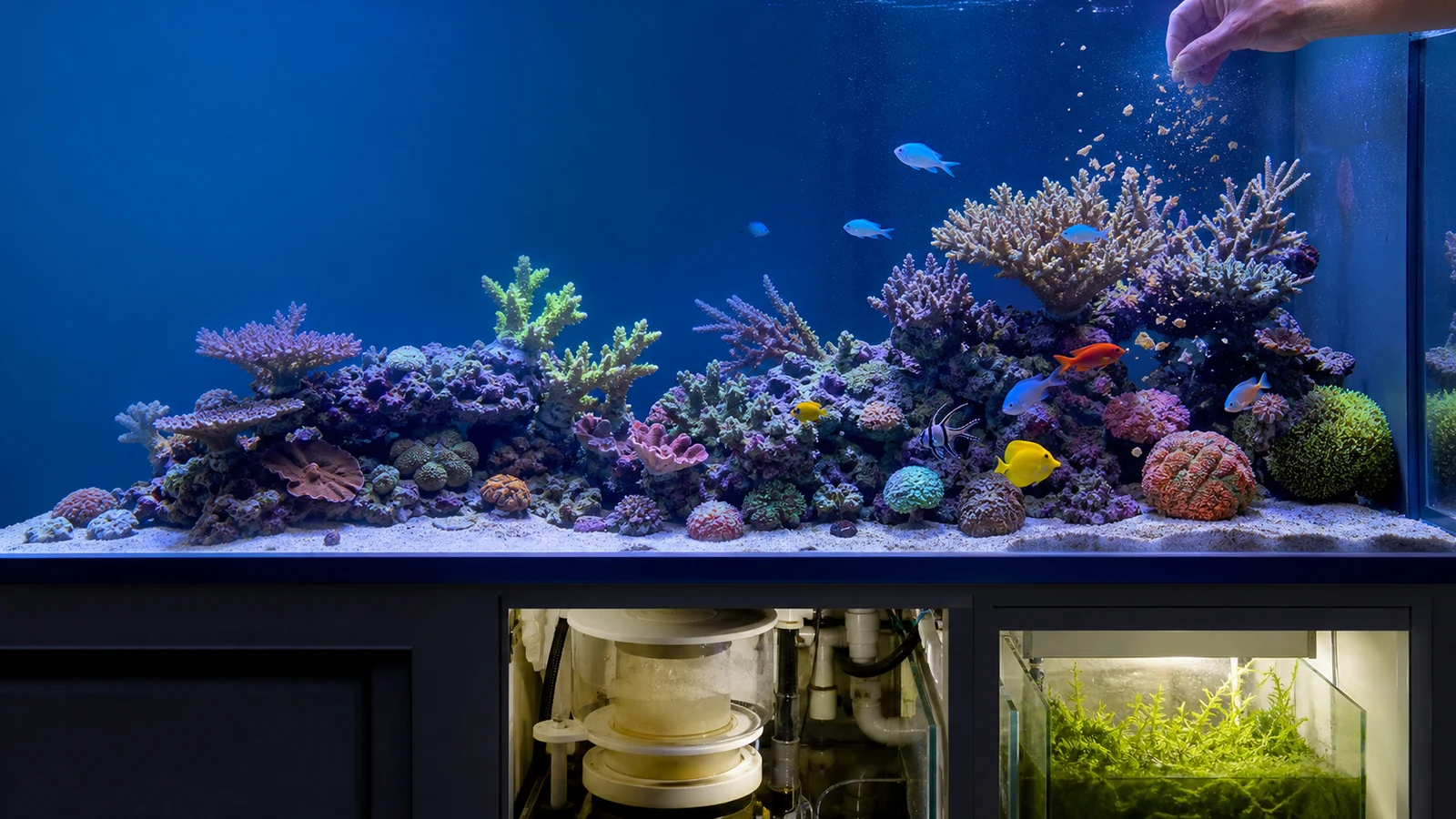
TL;DR
Nitrate and phosphate are not dirt. Nitrogen and phosphorus are required by living cells, including coral hosts, their photosynthetic symbionts, microbes, algae, and the food web around them. Excess can still contribute to nuisance growth, altered coral physiology, and reduced calcification under some conditions. Deficiency can also impair coral and symbiont function.
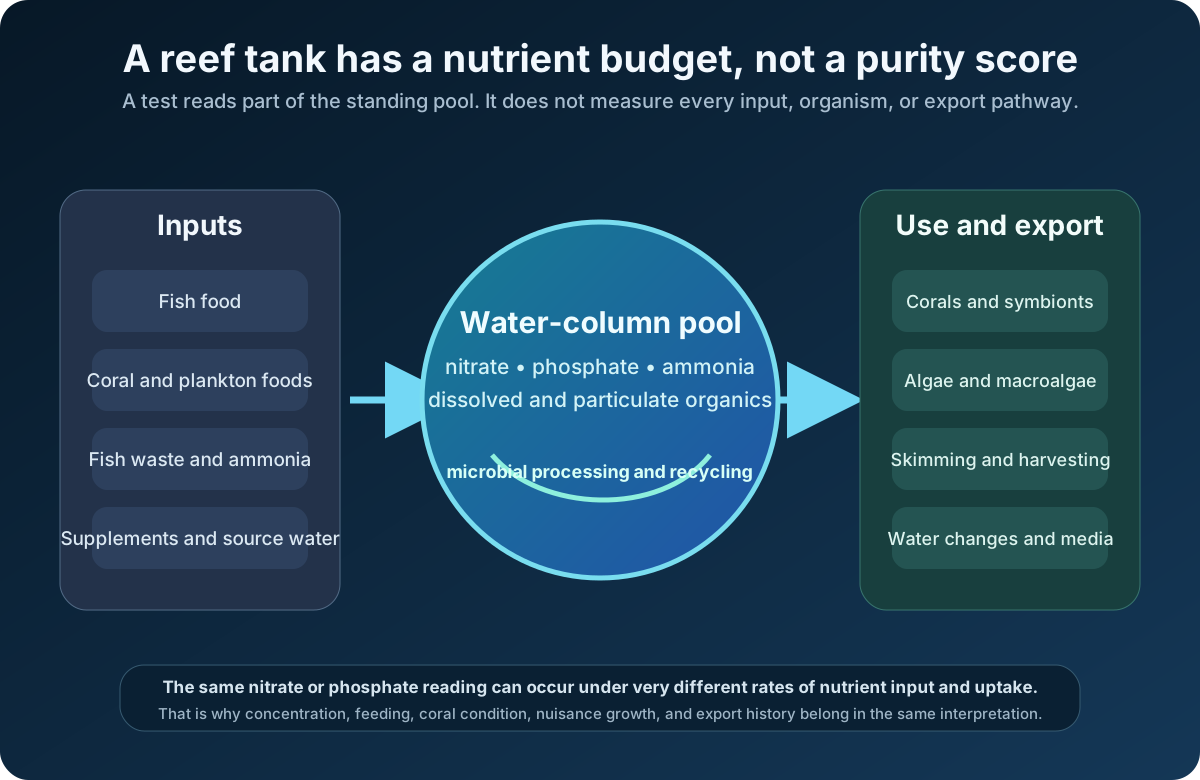
A hobby test measures a standing concentration at one moment. It does not measure total nutrient input, uptake rate, ammonia, amino acids, urea, particulate food, organic phosphorus, microbial recycling, or how much export occurred before the sample. Two tanks can show the same nitrate and phosphate while operating at very different nutrient fluxes.
There is no scientifically universal nitrate and phosphate pair for every reef aquarium. Use a range as a guardrail, then judge trends beside coral condition, feeding, nuisance growth, stocking, light, alkalinity, and export. Confirm a surprising result and change one lever slowly.
Why “nutrient” is the wrong word for one test result
Reefers use “nutrients” as shorthand for nitrate and orthophosphate because those are the forms most commonly tested. Biology is broader. Fish release ammonia and urea. Food carries proteins, nucleic acids, phospholipids, and particles. Corals capture prey and microbes. Bacteria transform and recycle compounds. Macroalgae and turf move nitrogen and phosphorus into tissue that can be harvested.
The water-column reading is the amount left in one measurable pool after those processes compete. A low residual concentration may reflect weak input, rapid biological demand, strong export, or all three. A higher residual may reflect heavy feeding with healthy export, declining uptake, insufficient export, stored phosphate returning from surfaces, or a recent disturbance.
This is why “my nitrate is 2 ppm” is not yet a diagnosis. The useful version is “nitrate has fallen from 12 to 2 ppm over three weeks while feeding stayed constant, macroalgae doubled, phosphate is unchanged, and two corals became pale.”
The case for ultra-low residual nutrients
Ultra-low systems try to keep dissolved nitrate and phosphate close to natural oligotrophic reef-water concentrations while supplying coral nutrition through fish waste, ammonia, particulate foods, bacteria, or direct feeding. Strong skimming, organic carbon dosing, zeolite methods, refugia, turf scrubbers, and phosphate binders can all be part of that approach.
The appeal is understandable. When dissolved nutrients are genuinely growth-limiting to nuisance algae and the desired corals receive enough nutrition by other routes, the display can remain visually clean with high water clarity and vivid contrast. Experienced keepers can run exceptional reefs this way.
The risk is a narrow margin. Export can continue after available nutrition has fallen below demand. A phosphate binder can pull faster than expected. Carbon dosing can change bacterial demand and oxygen conditions. A colorimetric zero may mean “below this method’s useful resolution,” not absolute zero, but it can still leave too little safety margin for the specific tank. The method works best when feeding, microbial inputs, coral response, and export are deliberately coordinated.
The case for deliberately measurable nitrate and phosphate
The measurable-nutrient camp values margin and observability. A reading comfortably above the test’s floor makes it easier to see direction before the tank bottoms out. It also provides dissolved inorganic nitrogen and phosphorus without depending entirely on a particulate-feeding or microbial pathway that may differ among coral species.
This does not mean more is always better. Higher residual nutrients can support nuisance algae when light, grazing, surfaces, iron, and other needs permit it. Chronic enrichment can change coral-algal symbiosis and reef-community function. Rapidly moving a long-adapted system from high to low values can be stressful even when the destination looks reasonable on a chart.
The strongest argument for measurable nutrients is not that 5 ppm nitrate or 0.08 ppm phosphate has magic biological power. It is that a stable, testable reserve can reduce the chance that the least available essential nutrient becomes the hidden bottleneck.
What coral research actually says
Peer-reviewed research does not support the slogan that all enrichment is poison or the slogan that only zero is dangerous. Responses depend on nutrient form, absolute concentration, balance, coral species, light, temperature, feeding, exposure time, and which biological outcome is measured.
Wiedenmann and colleagues showed that elevated dissolved inorganic nitrogen combined with limited phosphate increased susceptibility to heat- and light-induced bleaching in their experimental corals. Rosset and colleagues later documented phosphate-starvation signatures in symbiotic dinoflagellates under strongly imbalanced nutrient conditions. Those studies show that an apparently “low phosphate” system can become physiologically risky when nitrogen supply and light drive demand.
At the other extreme, Shantz and Burkepile’s meta-analysis found context-dependent and sometimes contradictory effects of nitrogen and phosphorus on coral growth and photobiology. Field and community experiments also show that nutrient pollution can alter calcification, primary production, algae competition, and wider reef processes.
Recent work on coral nutrition adds another important layer. Corals do not merely wait for nitrate and phosphate to diffuse from the water. Hosts can acquire nutrients from captured food and from their algal symbionts. That helps explain why a heavily fed reef with low residual nitrate can perform very differently from a lightly fed reef with the same test result.
Do not turn an experiment into a universal aquarium threshold
A laboratory concentration is not automatically a hobby target. Experimental studies usually control a small number of species, nutrient forms, light levels, temperatures, and feeding conditions. Reef aquariums contain mixed species, organic and particulate inputs, complex microbiomes, surfaces that bind phosphate, and measurement methods with limited resolution.
The correct use of the research is directional. Avoid starving one essential nutrient while driving demand with another. Avoid assuming that elevated residual nutrients are harmless because one famous aquarium thrives at an extreme. Avoid rapid corrections. Use the animal response and the system history to decide whether a number is functioning as a warning in this tank.
Randy Holmes-Farley’s newer targets are deliberately broad
In his 2025 essay on nutrient target ranges, reef chemist Randy Holmes-Farley emphasized that successful aquariums exist across very different nutrient levels and that the same tank may not perform equally well at both extremes. For a mature mixed reef as he would personally run it, he offered a broad working range of 5 to 50 ppm nitrate and about 0.06 to 0.3 ppm phosphate, with gentle export inside the range and more attention outside it.
Those numbers are notably higher and wider than many traditional hobby targets. The most important part of the essay is not copying the endpoints. It is the explanation: species differ, microbiomes differ, particulate and dissolved nutrition differ, and nitrate or phosphate concentration can be a poor stand-in for total bioavailability.
Treat that framework as an expert’s reasoned operating range, not a scientific law or a Reef Trak prescription. A low-residual system with heavy feeding and thriving corals may not need to be raised to it. A mature system adapted to higher readings should not be stripped down quickly merely because another chart uses lower values.
How to translate a nutrient result into a question instead of an automatic correction.
| Observation | Question to ask first | Safer first move |
|---|---|---|
| Both results near the method floor, corals look strong, feeding is heavy | Is rapid uptake keeping the residual pool low while nutrition remains adequate? | Hold steady, confirm the methods, and keep watching growth and color |
| Phosphate repeatedly undetectable while nitrate rises | Is aggressive phosphate removal creating the limiting nutrient? | Reduce the phosphate-specific export gradually and confirm the trend |
| Nitrate and phosphate rising together after export changed | Did feeding, stocking, skimming, harvest, or water changes change first? | Restore the missing export or input discipline without a sudden crash |
| High stable readings with healthy animals and little nuisance growth | Is the tank adapted, or is a slow cost appearing in growth and calcification? | Review long-term trends and change slowly only for a defined reason |
| One surprising test with no matching tank change | Could the reagent, range, vial, unit, timing, or sample be wrong? | Repeat carefully before changing the aquarium |
The Redfield ratio is not a reef aquarium recipe
The Redfield ratio describes an approximate elemental carbon-to-nitrogen-to-phosphorus relationship associated with marine plankton and ocean biogeochemistry. It was not proposed as a target ratio between nitrate and phosphate hobby-kit readings in a glass box.
Aquarium advice often compounds the mistake by comparing nitrate and phosphate as a simple mass ratio, even though the original relationship is elemental and molar. It then assumes that matching the ratio prevents algae, cyanobacteria, or dinoflagellates. A tank can match a ratio while both nutrients are far too low, far too high, or unavailable to the organism of concern.
Holmes-Farley’s 2026 explanation points reefers toward the limiting requirement instead. Growth stops when an essential need is least available relative to demand, and that need may be nitrogen, phosphorus, iron, light, carbon, or something else. The idea is useful because it asks what is limiting. It is not a promise that a single water-column ratio can identify the answer.
Measurement error matters most near zero
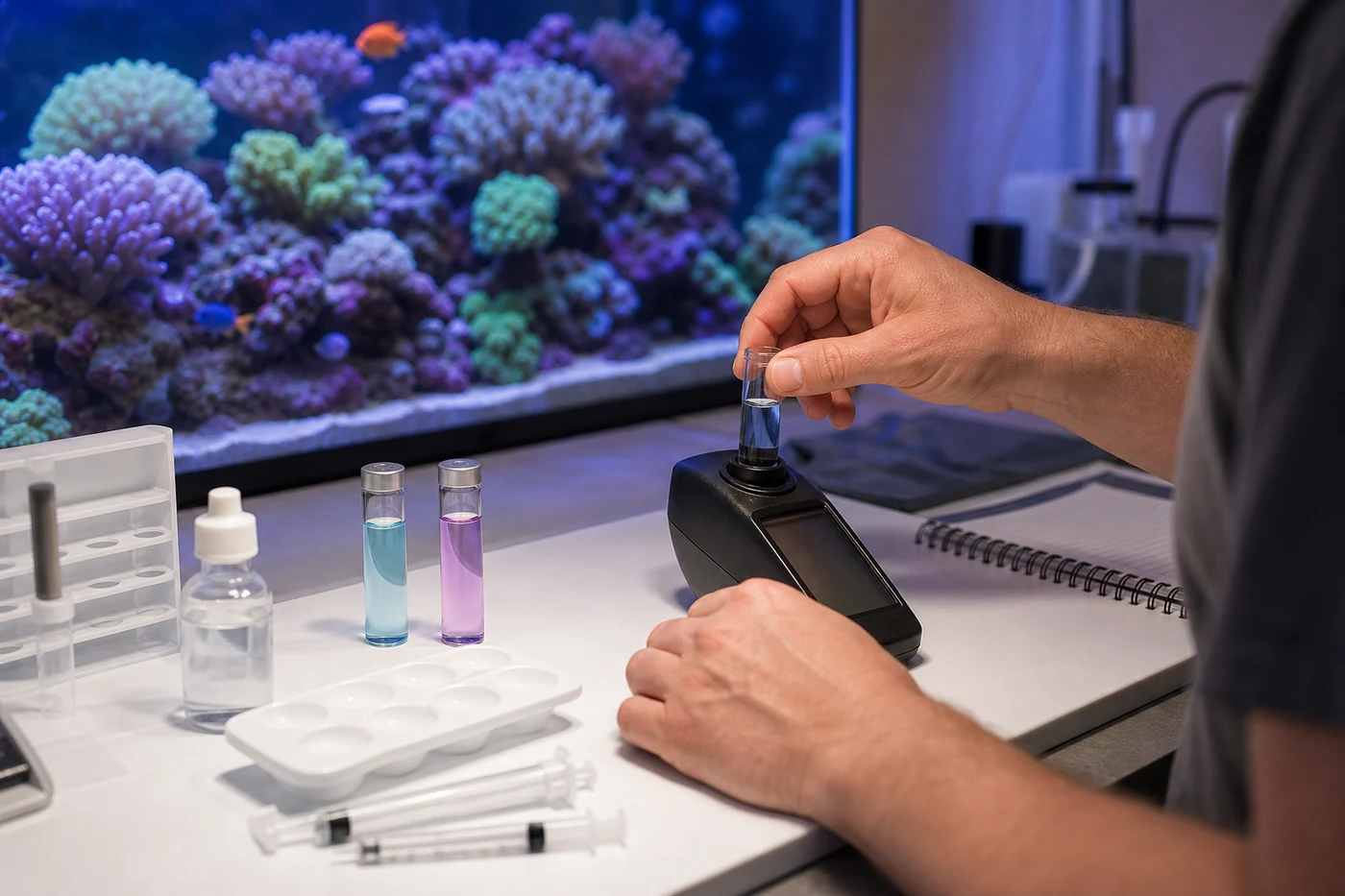
Every method has a useful range, precision, blank, interference profile, and human technique. Near the bottom of a color scale, small differences in lighting, vial cleanliness, reagent mixing, timing, fingerprints, or blanking can be as large as the change the reefer is trying to manage.
Use the same method and sampling routine when building a trend. Keep vials clean and oriented consistently. Follow mixing and reaction times. Confirm that the instrument reports phosphate or phosphorus and apply only the correct conversion. Use a higher-range method for a high sample and an ultra-low-range method only where its resolution is useful.
A single “0.00” should trigger confirmation, not an immediate nutrient dose. A single high result should not trigger a large binder change. Repeat the test, compare a reference or second method when practical, and inspect what changed in the tank before the number changed.
Use a controlled nutrient decision loop
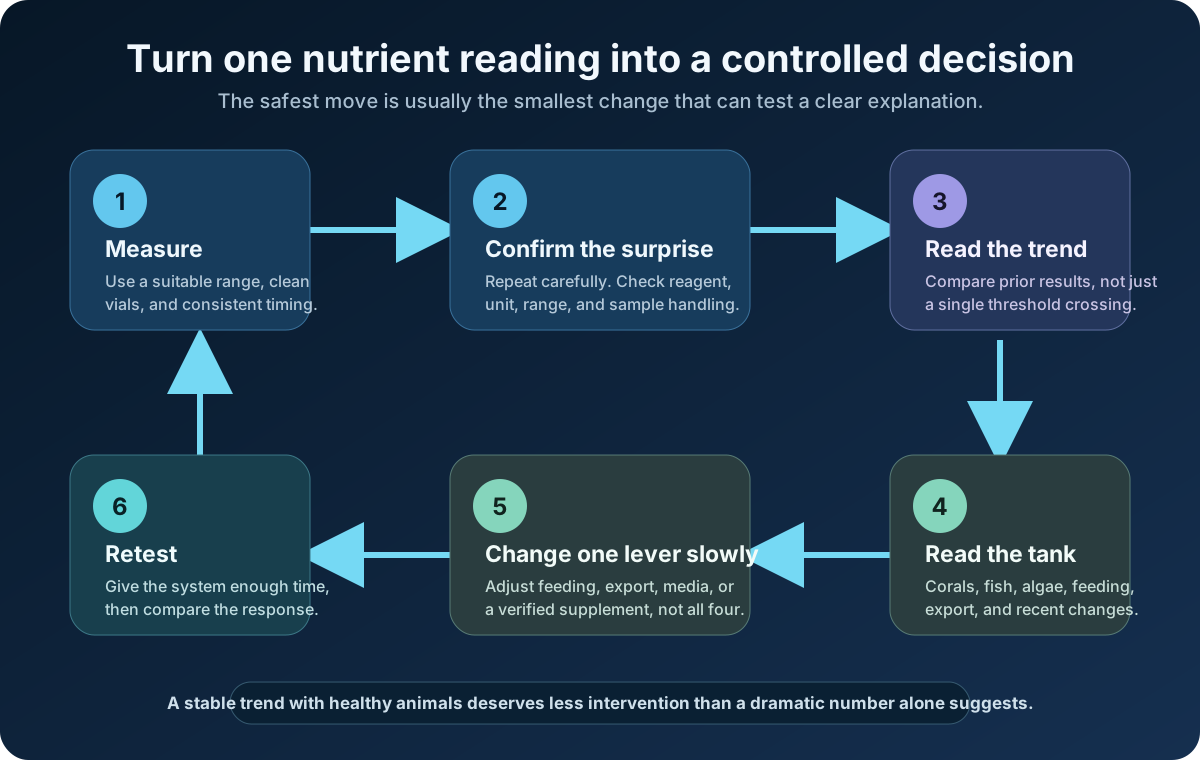
A stable nutrient strategy changes one lever at a time. Feeding changes both nitrogen and phosphorus in several forms. A refugium changes uptake, habitat, and day-night chemistry. Carbon dosing changes microbial growth and oxygen demand. GFO and other binders can move phosphate faster than the tank’s organisms can adapt. Each lever has more than one consequence.
Write the hypothesis before the correction. “Phosphate fell after I doubled fresh GFO” is testable. “The tank wants a different ratio” is not. Make the smallest adjustment that can test the explanation, give it enough time, and preserve the before-and-after record.
When low readings deserve action
- Nitrate or phosphate repeatedly tests below the useful range of a verified method
- The result is a sustained change from the tank’s own baseline, not one isolated test
- Corals become pale, growth slows, tissue condition changes, or a known export method has intensified
- One nutrient remains measurable while the other repeatedly bottoms out
- Feeding, fish load, direct coral nutrition, and microbial inputs are low enough that another route is unlikely to cover demand
Start by reducing the export that is driving the decline or by restoring appropriate feeding. Direct nitrate or phosphate supplementation can be useful, but use a verified product or recipe, actual water volume, small increments, and follow-up testing. Do not use a low nutrient result as the sole diagnosis for every case of pale coral or dinoflagellates.
When high readings deserve action
- Nitrate or phosphate is rising persistently rather than holding a long-adapted plateau
- Nuisance growth, declining water clarity, detritus accumulation, or reduced coral performance appears with the trend
- Feeding, stocking, harvest, skimmer performance, water changes, or another export path changed first
- The concentration is outside the operating range chosen for the livestock and method
- A high result is confirmed with the correct test range and sample handling
Correct the cause before stacking removal products. Restore skimmer function, harvest macroalgae, clean accumulated detritus, correct feeding, or resume a missed water-change rhythm. If a binder or carbon dosing is appropriate, lower the concentration gradually and monitor alkalinity, oxygenation, coral response, and the nutrient that may become limiting next.
The bottom line
Ultra-low and measurable-nutrient reefs can both succeed because the water test is only one part of nutrition. The winning systems align input, biological uptake, export, coral species, feeding, light, and measurement. The losing systems often copy the number without copying the pathway that made it work.
Do not chase zero. Do not chase a fashionable high number. Do not chase a nitrate-to-phosphate ratio as if it were a universal recipe. Choose guardrails, keep the method consistent, watch the trend, read the animals, and make slow changes for a named reason.
The best nutrient target is not the one that wins an argument. It is the range your reef can hold while corals grow, fish eat, nuisance organisms remain manageable, and the record gives you time to respond before either scarcity or accumulation becomes the crisis.