
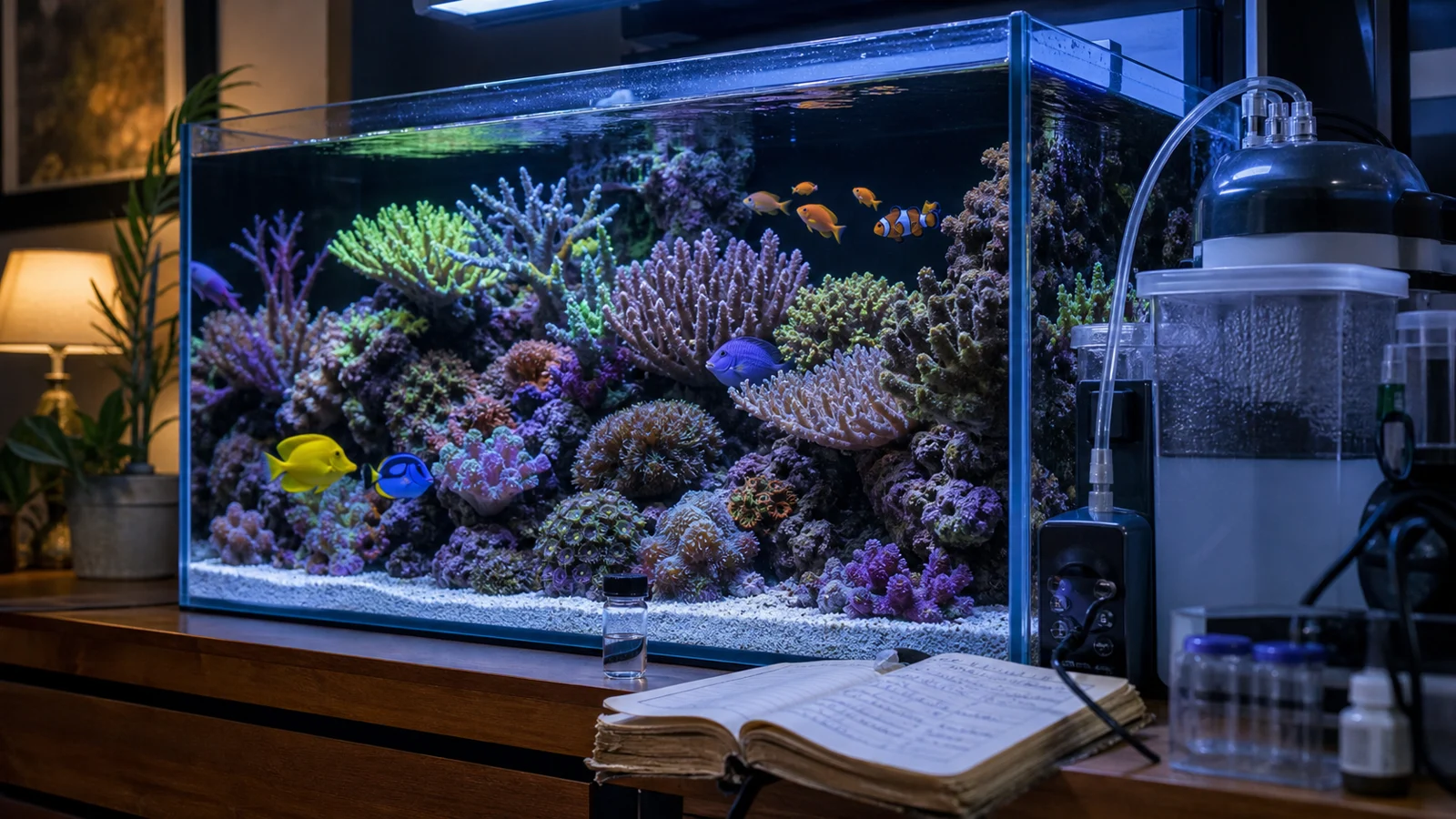
The single-test trap
You test alkalinity, see 8.3 dKH, and exhale. The tank is fine.
Maybe. But maybe alkalinity was 7.6 last week and 9.1 the week before. The single test result was correct. The tank was not stable. Coralline knows the difference. Acropora definitely knows the difference. The reefer often does not, because the only signal they checked was the most recent number.
What "stable" really means
Stability in a reef tank has two pieces. First, the average of a parameter sits inside a sensible reef range. Second, the parameter does not bounce far above or below that average from one test to the next.
You can have a tank with great average values that is still unstable, because the values swing. You can also have a tank running at slightly unusual values, like 7.8 dKH, that is genuinely stable because it sits at 7.8 dKH every week without drama. The second tank usually grows better corals.
The parameters where stability matters most
Some parameters tolerate movement. Others punish it. In rough order of how much a reef cares about steadiness:
- Alkalinity. Probably the single biggest stability lever in any reef tank.
- Salinity. Sensitive corals and inverts do not love swings between 1.024 and 1.027.
- Temperature. Daily swings are normal, but week-over-week drift causes problems.
- Calcium and magnesium. They tolerate broader values but should not bounce.
- pH. Daily cycle is normal, baseline shift is meaningful.
- Nitrate and phosphate. Stable low-but-detectable beats zero followed by spikes.
How to actually measure stability
Looking at your last reading is not measuring stability. Looking at your last three months is. A few simple practices give you a real picture:
- Test the same parameters on the same weekday with the same method. Comparability matters more than precision.
- Plot at least an eight-week window. Shorter views hide drift.
- Use custom reference ranges that match your tank, not generic ranges.
- Annotate any week with an unusual event: travel, water change skipped, new livestock, equipment swap.
- Look for the range, not just the mean. A 1.5 dKH swing is meaningful even if the average is fine.
How Reef Trak summarizes stability
Reef Trak includes a Stability Trak view that condenses the steadiness of your reef into a single readable signal. It looks at recent parameter movement for the parameters where stability matters and gives you a left-to-right rail showing whether the tank is sitting still or moving.
It is not a verdict on your reef. It is a fast read of how steady the system has been. The full per-parameter history is always there for the deeper question of why.
What you can change this month
Stability is mostly behavior, not gear. Reef tanks become stable when the reefer becomes consistent.
- Test on the same day each week.
- Make one dosing change at a time, then wait two weeks before changing anything else.
- Calibrate probes and reference solutions on a schedule, not when something looks off.
- Match your reef salt batch and your top-off water habits so weekly water changes are predictable.
- Track maintenance events alongside parameters so cause and effect are visible.