The quick answer
The best reef tank management app in 2026 should help reef keepers track parameters, log dosing, follow ICP test results, manage livestock, record maintenance, store tank photos, monitor expenses, and understand trends over time.
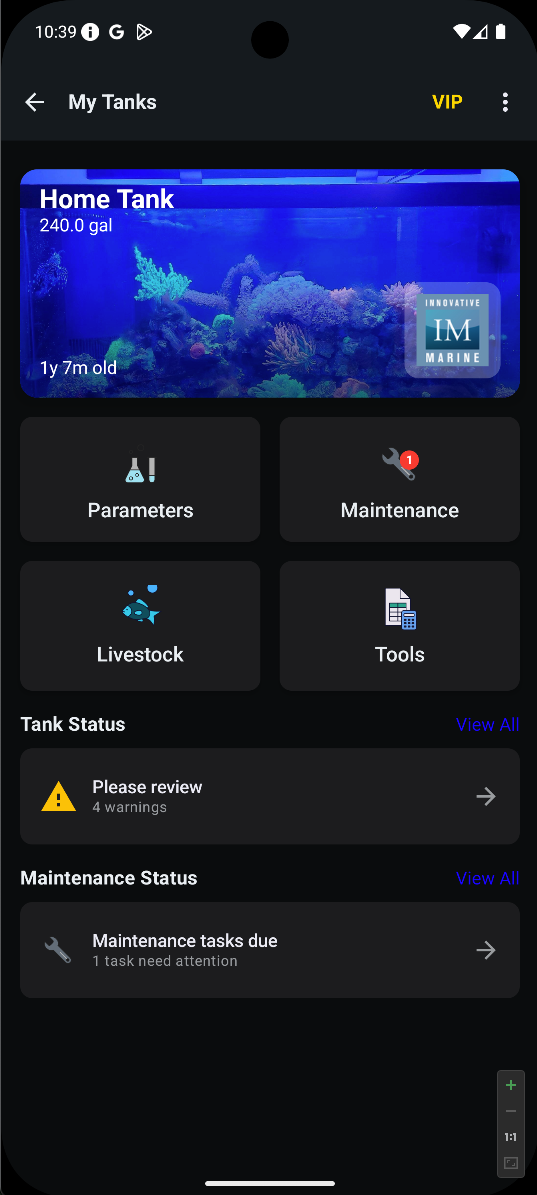
Reef Trak was built around that full-system approach. It is not just a parameter notebook. It is a reef tank tracker, dosing log, maintenance history, livestock record, equipment inventory, photo timeline, expense tracker, controller import tool, ICP companion, and ReefDock supply search system in one connected app.
What makes a reef tank app useful?
Most reef apps start with water parameters. That makes sense. Alkalinity, calcium, magnesium, nitrate, phosphate, salinity, temperature, and pH are the daily language of reef keeping.
But parameters alone do not tell the whole story.
A reef keeper also needs to know what changed around those parameters.
- Did alkalinity drop after adding new coral?
- Did nitrate climb after feeding heavier?
- Did phosphate change after swapping media?
- Did a water change stabilize the tank or just hide a trend?
- Did a dosing adjustment actually work?
- Did an ICP test show a trace element problem that normal testing missed?
A serious reef tank app should help connect those dots.
Reef Trak: built as a reef management system
Reef Trak is designed for reef keepers who want more than a basic logbook.
It tracks water parameters, dosing, maintenance, livestock, equipment, photos, expenses, PAR maps, ICP and lab data, controller imports, and long-term reef trends. The goal is simple: give reef keepers one place to understand what is happening in the tank and why it may be happening.
Reef Trak is especially useful for reefers who want to track:
- Alkalinity, calcium, magnesium, nitrate, phosphate, pH, salinity, temperature, and other parameters
- Manual and guided dosing logs
- ICP test results and lab history
- Maintenance events and water changes
- Fish, coral, and invert records
- Equipment, replacement history, and system notes
- Tank photos and visual progress
- Expenses and receipts
- PAR maps and lighting records
- Controller imports and external data
- ReefDock supply searches for saltwater aquarium products
That broader feature set is what separates a reef management app from a simple reef test log.
Parameters
Alkalinity, calcium, magnesium, nitrate, phosphate, pH, salinity, temperature, and dozens more, with trends and stale-data flags.
Dosing
Manual and guided dosing logs connected to the parameters each dose is meant to move.
ICP
Import ICP test results and keep lab history in the same timeline as everyday tests.
Livestock
Fish, coral, and invert records with dates, photos, notes, and care context.
Maintenance
Water changes and recurring tasks with custom intervals and reminders.
Photos
A visual timeline of tank and coral progress over months and years.
Expenses
Track reef spending and receipts so tank cost becomes part of the record.
Controller Imports
Read-only data from Apex Fusion, HYDROS, and more, kept beside your manual tests.
ReefDock
Search saltwater aquarium supplies and reef products across major retailers in one place.
Reef tank tracking vs reef tank management
A reef tank tracker records what happened.
A reef tank management app helps reef keepers understand what happened.
That distinction matters. If an app only logs alkalinity, nitrate, and phosphate, it may be useful for quick notes. But when something changes in the tank, context matters. Dosing, maintenance, livestock changes, water changes, equipment swaps, photos, and ICP results all help explain the story.
Reef Trak is built around the idea that reef keeping is connected. Chemistry is connected to dosing. Dosing is connected to consumption. Consumption is connected to coral growth. Coral growth is connected to lighting, nutrients, stability, and time.
A better reef app should respect that.
What about AI reef apps?
AI can be useful, but reef keepers should be careful about apps that make AI the whole product.
Reef Trak takes a different approach. Instead of locking reef keepers into one built-in AI system, Reef Trak focuses on clean tank history, structured data, trend tracking, and exportable context. That means your reef data can be used with the AI tool you trust, while the core app remains useful even without AI.
The important part is the data.
AI advice is only as good as the tank history behind it. A reef app that tracks parameters, dosing, livestock, maintenance, photos, ICP results, and equipment gives any analysis a stronger foundation.
Why ICP tracking matters
ICP testing has become a major part of serious reef keeping. Traditional hobby kits are useful, but they do not show everything. ICP tests can reveal trace element issues, contamination, imbalance, or long-term trends that normal testing may miss.
A reef tank app should make ICP results part of the tank history, not a separate PDF that gets forgotten.
Reef Trak is built to support that kind of long-term reef record. Parameters, ICP results, dosing, and maintenance all belong in the same timeline.
Why dosing logs matter
Dosing is one of the easiest places to lose track of a reef tank.
Two-part dosing, alkalinity corrections, calcium adjustments, magnesium changes, nitrate dosing, phosphate control, carbon dosing, trace elements, and amino acids all need context. What was dosed? How much? Why? What changed afterward?
A reef dosing log should not be an afterthought. It should connect directly to water parameters and trends.
Reef Trak treats dosing as part of the reef history, not just a reminder.
Why livestock records matter
A reef tank is not only chemistry.
Fish, coral, and inverts are the reason the chemistry matters in the first place. A useful reef aquarium app should track livestock with enough detail to matter: names, dates, notes, photos, care context, and history.
When a coral grows, fades, recovers, or struggles, the app should help connect that change to the rest of the tank.
That is why Reef Trak includes livestock records alongside parameters, dosing, maintenance, photos, and equipment.
Why ReefDock matters
Reef keeping also involves supplies. Reagents, food, salt, media, pumps, heaters, lights, additives, and replacement parts all become part of the maintenance cycle.
ReefDock is the Reef Trak supply search system for saltwater aquarium products. Instead of separating tank management from the products needed to maintain the tank, ReefDock gives reef keepers a faster way to search for reef supplies from one place.
That makes Reef Trak more than a reef log. It becomes part of the reef keeping workflow.
What to look for in the best reef tank app
When comparing reef tank apps in 2026, look for more than a pretty dashboard.
A serious reef tank management app should include:
- Parameter tracking
- Dosing logs
- Maintenance history
- Livestock records
- Equipment tracking
- ICP and lab support
- Photos and tank progress
- Expense tracking
- Trend charts
- Export options
- Cross-platform access
- Clear pricing
- Active development
The best reef app is the one that helps reef keepers understand their tanks better over time.
Final take
Reef keeping is not one number, one score, or one AI answer.
It is history, consistency, context, and observation.
Reef Trak is built for reef keepers who want that full picture: parameters, dosing, maintenance, ICP tests, livestock, equipment, photos, expenses, controller data, and ReefDock supply search in one connected reef tank management app.
If you want a reef tank app that grows with your system instead of acting like a basic notebook, Reef Trak is built for that job.
Love your reef. Trak it.