
TL;DR
Designer-coral lineage is a provenance claim. It says that a frag descends through documented asexual propagation from a recognized source colony or release. It does not guarantee that the coral will display the same color, fluorescence, branch thickness, growth rate, or overall appearance in every aquarium.
Appearance alone cannot prove or disprove lineage. Coral pigments and symbionts respond to light intensity, spectrum, nutrient conditions, temperature, injury, and other environmental factors. Cameras add another layer through exposure, white balance, orange filters, raw processing, saturation, and the exact spectrum used for the photograph.
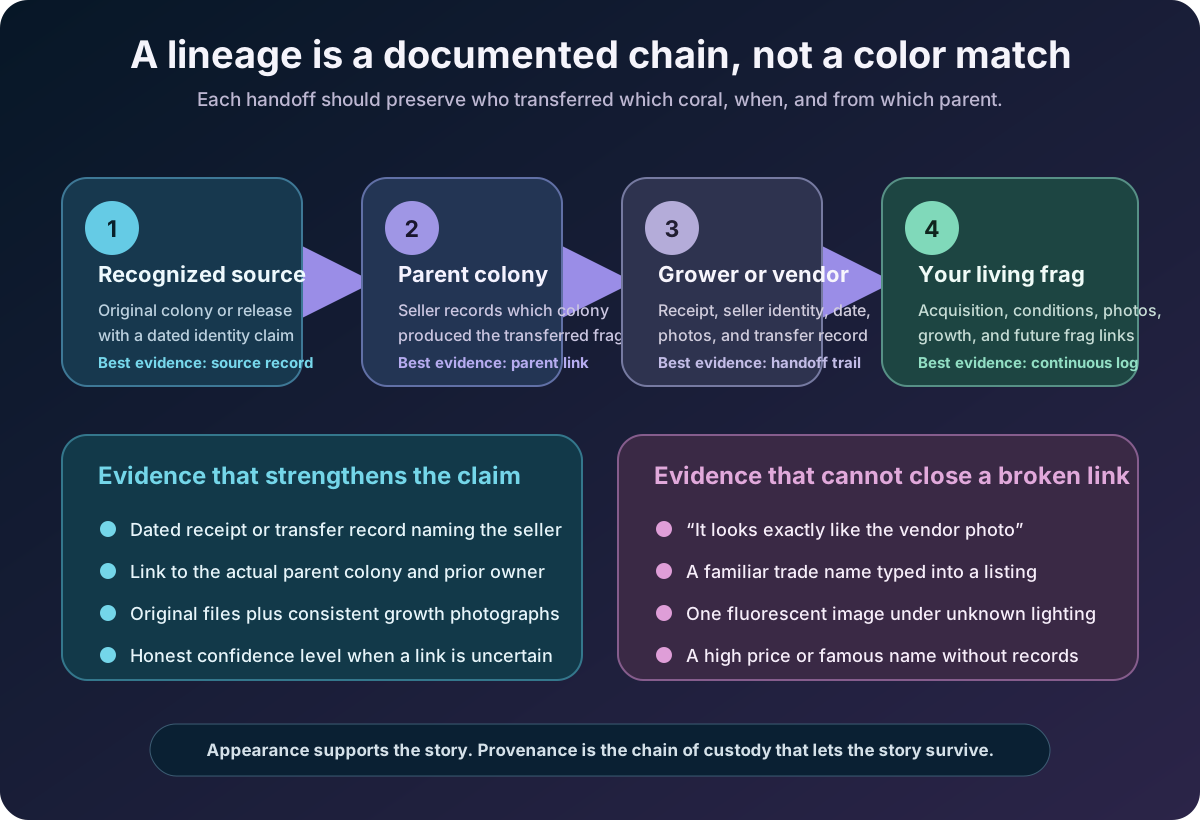
The strongest practical proof is a continuous chain: source or originator, parent colony, seller, dated transfer, and your living frag. Receipts, original files, parent photos, seller identity, acquisition details, and future frag records strengthen the claim. A famous name and one blue-light image do not repair a missing link.
My Walt Disney stopped looking like the show coral
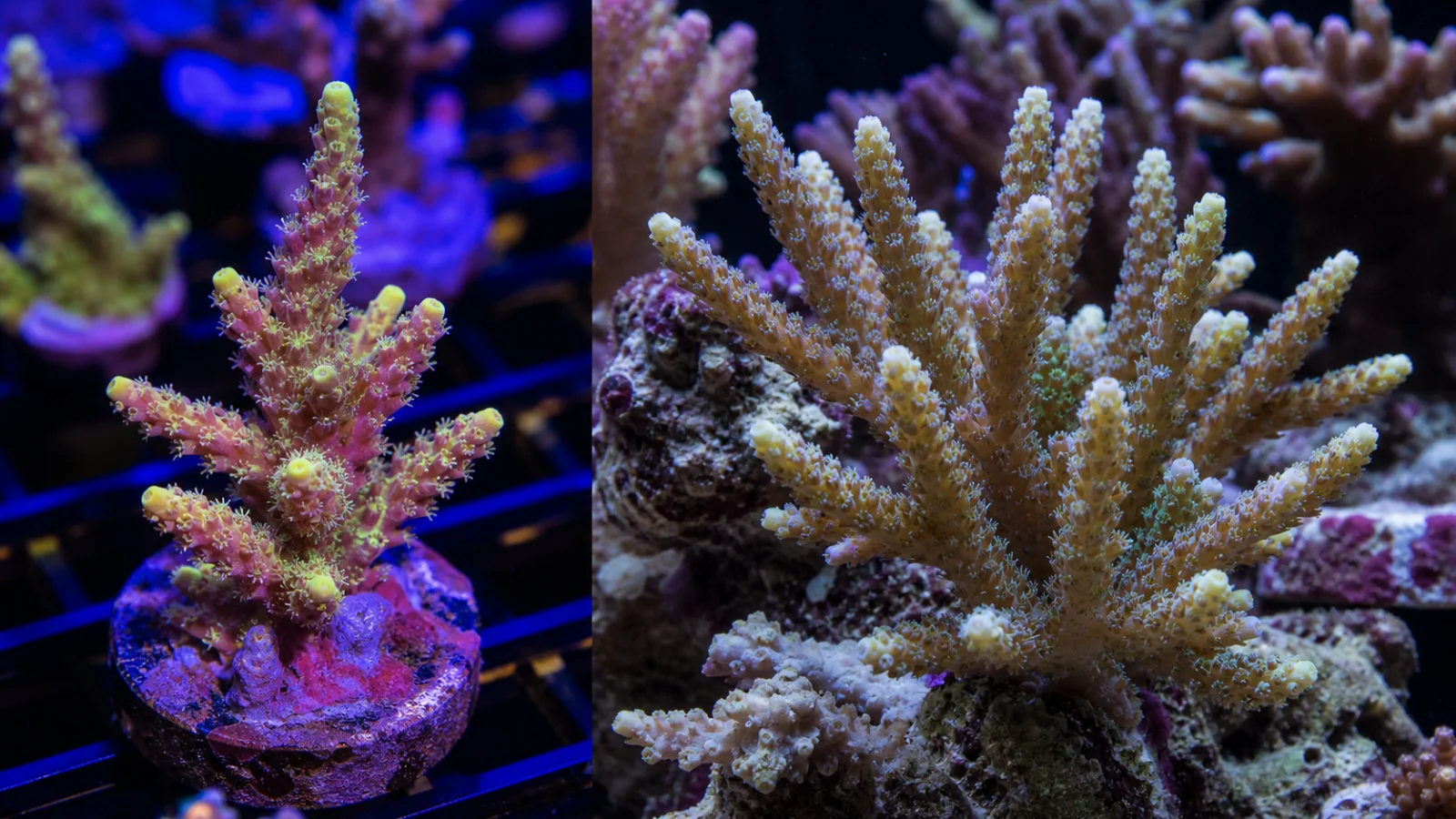
About six months ago, I bought a Walt Disney Acropora at a show. Under the show lighting it looked like the coral I expected: a bright, high-contrast tenuis with the familiar designer-coral presentation. As it has encrusted and grown in my reef, it has looked less and less like the Walt Disney photographs people recognize.
That creates the perfect lineage question. Did the coral change because my light, nutrients, flow, placement, camera, or acclimation changed its expression? Was the show presentation emphasizing fluorescence that my normal viewing spectrum does not? Was the original label wrong? From appearance alone, I cannot honestly choose among those explanations.
A genuine Walt Disney can look disappointing, brown, pale, green, yellow, pink, or simply different while acclimating or growing under another reef’s conditions. A visually convincing look-alike can carry the wrong name. The coral’s current phenotype is evidence about its current expression. It is not a complete family tree.
A coral can have three different identities at once
Scientific identity describes taxonomy: genus, species when it can be determined, and the uncertainty around that identification. “Acropora tenuis” is a biological classification claim. It does not identify one vendor’s colony or one named hobby lineage.
Lineage identity describes provenance: which source colony the fragment descended from and how it moved through parent colonies and owners. “Walt Disney,” “Homewrecker,” and other trade names operate in this layer when the community uses the name for a recognized propagated line.
Phenotype describes what the coral expresses now: color, fluorescence, tissue condition, polyp extension, branch form, and growth pattern under the present environment and observation method. A WYSIWYG image records one phenotype at one moment. These three identities can support each other, but they are not interchangeable.
The questions hidden inside one designer-coral name.
| Identity layer | Question it answers | What it cannot guarantee |
|---|---|---|
| Scientific identification | What taxon is this coral most likely to be? | A vendor lineage, named morph, or exact parent colony |
| Lineage or provenance | Which recognized source colony does this frag descend from? | Identical color and growth in every aquarium |
| Current phenotype | What does this living coral express under these conditions today? | An unbroken source and transfer history |
| Listing photograph | What did the seller’s camera record under one setup? | How the coral will look in your reef or to your eyes |
Most named corals are propagated, not “bred”
The usual designer-coral story is clonal. A grower obtains a distinctive source colony, names or releases it, and distributes fragments. Each surviving fragment grows by asexual propagation from that colony. If the chain is correct, those fragments share the source colony’s genotype even when their visible expression diverges.
That is different from crossing two parent corals and raising sexually produced offspring. Sexual breeding recombines genes and produces genetically distinct individuals. It can create new selections, but the children are not simply fragments of either named parent. A serious record should distinguish a clonal frag lineage from a seed-grown or deliberately crossed line.
If a grower such as Jason Fox obtains a distinctive source colony, develops it, names it, and releases propagated fragments, the valuable claim is not that every future piece will always match one photograph. The claim is that this living piece descends through a documented chain from that recognized source.
What a useful lineage chain looks like
A lineage record should behave like a chain of custody without pretending to be forensic certainty. It begins with a source claim, follows the actual parent colony through each transfer, and ends at the current frag. Each link records who is making the claim and what supports it.
Confidence matters. Direct purchase from a recognized originator with a dated record is different from “my local seller said it came from someone who bought it from the originator.” Both can be recorded. They should not be presented with the same certainty.
Modern lineage platforms are beginning to formalize this distinction. ReefBook, for example, separates scientific names from trade lineages and treats provenance as a claim with a verification status. That is a stronger model than trying to identify lineage from a photograph alone.
Why a genuine Acropora can change color
Coral color is produced by several interacting layers. The coral host makes fluorescent proteins and nonfluorescent chromoproteins. Symbiotic algae and their photosynthetic pigments contribute another visual layer. Tissue thickness, skeletal reflection, polyp extension, branch orientation, and the viewing spectrum change what reaches the eye or camera.
Controlled research on Acropora yongei found that green fluorescent protein concentration rose under higher light intensity and fell again under lower light during photoacclimation. Research on Acropora millepora has shown that fluorescent-protein color polymorphism can contain both inherited differences and strong environmental control. Studies of Acropora tenuis color morphs likewise show inherited morph differences alongside pigment-gene and stress responses that are not identical among colors.
This means genetics sets possibilities and constraints while the environment influences expression. It does not mean every color change is harmless acclimation. Browning, paling, bleaching, tissue loss, or a sudden shift can also signal inadequate light, excess light, nutrient imbalance, heat stress, pests, or declining health. Lineage should never be used to explain away a coral that is deteriorating.
Growth form also changes the visual identity
A fresh frag is mostly cut surfaces and a few branch tips. Six months later it may be encrusting, producing radial branches, shading its base, and placing new growth tips into a different light field. Flow direction influences where tissue receives food and how branches develop. Neighboring colonies change shade and turbulence.
The sales photograph may show the most fluorescent growing edge of a mother colony, while your view is dominated by older branch tissue. A macro lens may fill the frame with a one-inch fragment that the eye sees as a small tan branch from across the room. Both images can be honest and still feel like different corals.
Compare the same parts over time: new tips to new tips, shaded base to shaded base, and daylight view to daylight view. A changing colony is a poor target for a memory-based color match.
Blue light and orange filters are not automatically deception
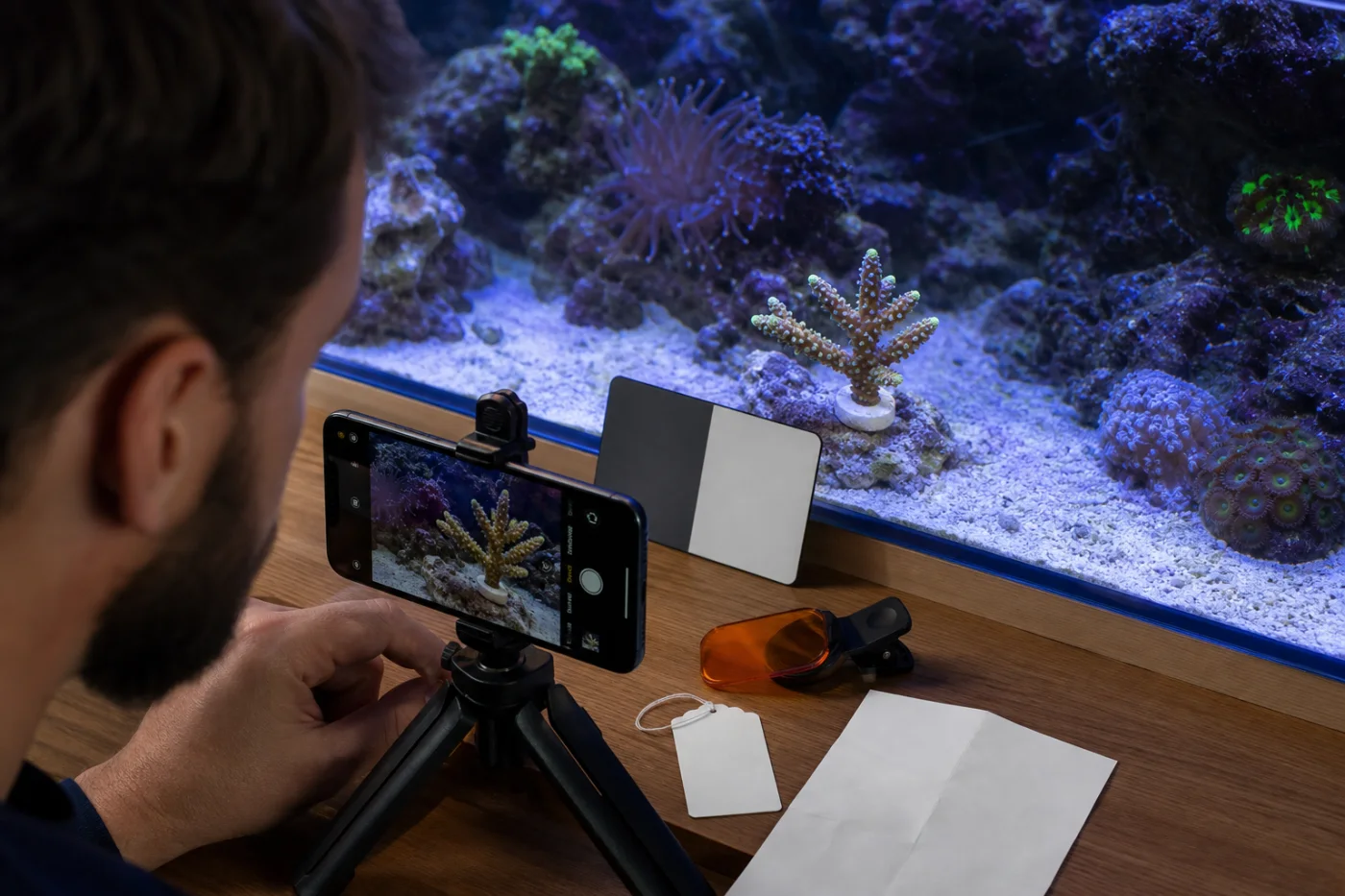
Reef aquariums often use blue and violet-heavy lighting because those wavelengths support photosynthesis and excite coral fluorescence. Phones can record that scene as an unusable blue wash. An orange filter or a white-balance adjustment reduces the dominant blue and can bring the photograph closer to what the viewer perceived through filtered glasses or an adjusted display.
Color correction becomes misleading when the method is hidden and the result implies a viewing condition the buyer will not reproduce. Extreme saturation, selective color shifts, crushed blacks, compositing, or presenting a fluorescence-only image as a daylight expectation can turn correction into sales theater.
A trustworthy listing can show both: the WYSIWYG coral under the seller’s normal display spectrum and a balanced white-light or neutral reference view. It should disclose important filters or edits and avoid claiming that the camera has captured a universal “true color.” Corals do not have one appearance independent of illumination.
Photograph for comparison, not maximum applause
A useful growth record keeps more variables stable than a social post. Use the same camera, lens, distance, angle, aquarium-light preset, exposure, white balance, and approximate time in the photoperiod. Include an occasional neutral gray reference under the actual aquarium lighting. Save the original file as well as the corrected version.
Record light changes, placement, PAR when available, nutrient trends, alkalinity, major feeding changes, and health events near the photo date. That context cannot make two cameras identical, but it prevents a color shift caused by a new light preset from being mistaken for a biological transformation.
What an honest designer-coral listing should include
The point is not to make every hobbyist seller produce a laboratory dossier. It is to separate what is known from what is inferred. A simple, honest “bought directly from the originator in 2024; parent colony shown; exact frag photographed under this preset” is more useful than a paragraph of hype.
Lineage and appearance deserve separate disclosures.
| Listing element | Strong disclosure | Weak disclosure |
|---|---|---|
| Name and taxonomy | Trade name plus best scientific identification and uncertainty | A famous trade name presented as a species |
| Lineage | Source, seller, parent-colony link, and confidence stated | “Lineage” with no prior owner or record |
| WYSIWYG identity | The exact frag is clearly identified | A mother-colony photo without saying the sold piece differs |
| Lighting | Spectrum or preset described; daylight view also offered when practical | Unknown deep-blue setting treated as universal appearance |
| Photo processing | Filter, white balance, and material edits disclosed | Heavy saturation or selective color changes hidden |
| Buyer expectation | Color can change with environment and acclimation | The frag is promised to reproduce the photograph in any tank |
How to preserve your coral’s provenance
- Record the scientific identification separately from the designer or trade name
- Save the seller’s name, website or contact, acquisition date, price, and original listing
- Ask which actual parent colony produced the frag and who owned it previously
- Keep the WYSIWYG image and the original file when the seller provides it
- Photograph the frag on arrival under a repeatable daylight-balanced setting
- Record placement, light preset, PAR when available, flow, nutrients, and alkalinity
- Link every future frag to the parent colony and the person receiving it
- Use a confidence label such as direct, documented transfer, owner-stated, or unknown
Reef Trak already gives a coral record room for the designer name, purchase details, notes, health, and dated photos. Use those fields as the living record behind the name. The most valuable proof is the information that survives after the show badge, sales post, and message thread disappear.
What to do when the chain is already broken
Do not invent certainty. Keep the coral, enjoy it, and describe it accurately. “Sold to me as Walt Disney; prior chain not documented” is honest and useful. “Confirmed Walt Disney lineage” is not justified by a familiar color pattern alone.
You can rebuild forward provenance from today. Record the current owner, photos, conditions, growth, and every future transfer. That does not retroactively prove the original name, but it prevents the remaining history from dissolving further.
If a seller can reconnect the chain with receipts, dated parent photos, or direct prior-owner confirmation, attach that evidence and update the confidence. Provenance should be allowed to improve without rewriting the uncertainty that existed before.
What is lineage actually worth?
A strong lineage can justify value because it preserves scarcity, history, expected genetic continuity, and trust between growers. It can help a buyer distinguish a documented propagated line from a look-alike sold under a popular name. It also helps the community preserve old captive lines after a source colony is lost.
The premium should be paid for evidence and confidence, not only for branding. A famous name without a chain is a marketing claim. A documented chain without attractive current color can still be real lineage. The buyer decides how much that history matters, but the seller should make clear which part of the price belongs to the living coral and which part belongs to the provenance claim.
Lineage systems become most valuable when they resist prestige bias. A direct transfer from a small garage grower can be better documented than a vague claim attached to a large vendor name. The record should follow evidence, not fame.
The bottom line
My Walt Disney Acropora looking less like a sales photograph after six months does not prove it is fake. It also does not prove the label was correct. It proves that appearance is a changing output, shaped by genetics, environment, growth, illumination, and the camera.
A designer name becomes meaningful when it points to an unbroken, honestly qualified chain. The coral’s photograph tells you what was visible under one set of conditions. The lineage record tells you where the living fragment came from.
Keep both. Photograph the phenotype honestly, document the provenance carefully, and leave room for uncertainty when the evidence does not reach all the way back.