
The trouble with a coral that looks fine until it does not
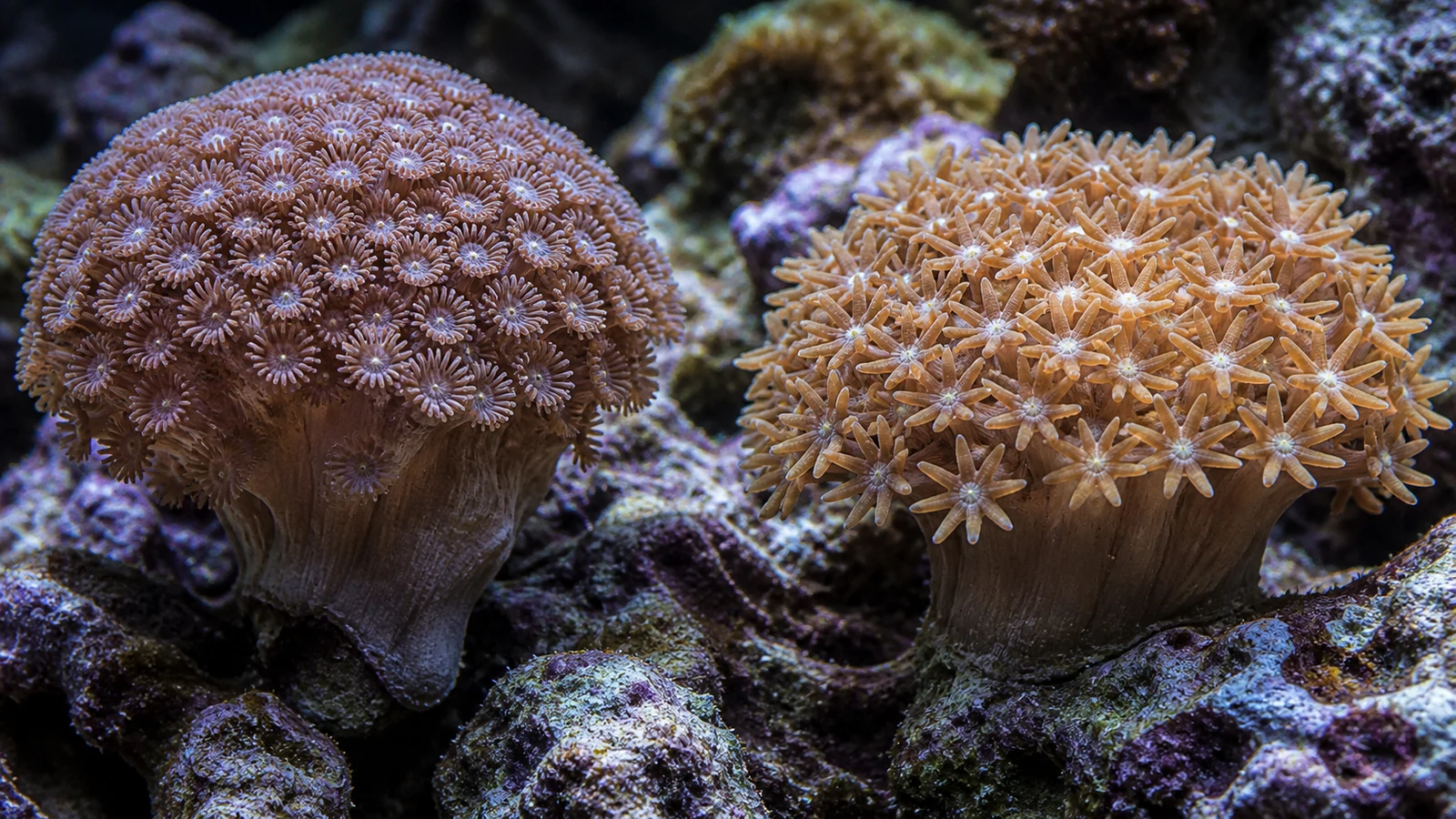
Few corals are as captivating as a fully extended Goniopora. That beauty can also hide trouble: long polyps make it easy to overlook a thinning tissue margin or a patch of exposed skeleton. A colony that opened yesterday can be closed today, and the visible collapse may be the first sign its keeper recognizes.
There are two different problems to investigate. One is gradual loss of condition over weeks or months. The other is active tissue destruction over hours or days. They can overlap, but they require different priorities. Neither is explained by the word “Goniopora” alone.
This guide brings together controlled research, published aquarium chemistry, and experienced coral-farm observations. Practical ranges below are starting points for a stable mixed reef, not experimentally established optimum values for every Goniopora or Alveopora species.
Goniopora versus Alveopora: similar flowers, different animals
Goniopora normally has 24 tentacles per polyp; Alveopora has 12. Count several open polyps around the mouth. Molecular work places Alveopora with Acroporidae and Goniopora with Poritidae, despite their similar appearance. Their shared “flowerpot coral” name does not establish identical biology. [2]
Alveopora has generally had a more forgiving reputation than the troublesome wild Goniopora that dominated early imports, particularly Goniopora stokesi. Julian Sprung’s 2002 account describes slow wasting in G. stokesi while reporting hardy Alveopora and other Goniopora kept for years. This is valuable husbandry history, not a controlled comparison proving every Alveopora easier. [3]
A healed, captive-grown Goniopora with a long-lived parent can be a better choice than a damaged Alveopora of uncertain origin. Ask about captive history, tissue condition, source lighting, and feeding before choosing by genus or color.
What Than actually said about the old survival problem
In his published Goniopora care guide, Than Thein of Tidal Gardens recalls discussion of it being “unethical to keep importing them” because survival was so poor. He describes wild colonies looking excellent initially, then closing after roughly three to six months and sometimes collapsing rapidly. These are farm and hobby observations, not a diagnosis of every loss. [1]
That ethical debate is the historical point we can substantiate from his guide. It does not document a proposed U.S. ban. Our earlier Goniopora versus Alveopora guide examines the wider import-policy story. Poor survival deserves attention without turning concern about importing a coral into an established legal claim.
Why a decline can appear sudden
The most useful question is “What changed before the first sign?” A reading taken after the collapse cannot reconstruct yesterday’s heater failure, an automatic top-off problem, or a week of excessive dosing. Equally, a long period of apparently acceptable numbers does not establish adequate nutrition.
Polyp extension is only one observation. Look for complete tissue coverage, a stable margin, new growth, sustained coloration, and a repeatable response to feeding. Compare photographs taken under similar light and from the same angle.
These patterns guide an investigation. Appearance alone does not establish the cause.
| Pattern | Possibilities to investigate | Useful next evidence |
|---|---|---|
| Less extension and shrinking tissue over weeks | Nutrition, chronic irritation, unsuitable conditions, or disease | Comparable photographs, feeding record, tissue margin, parameter trends |
| Closed after a tank change | Light or flow change, salinity error, temperature event, dosing incident | Timeline and independent measurements |
| Pale tissue still covering skeleton | Bleaching or loss of pigmentation; stress and nutrition need investigation | Lighting history, temperature, nutrients, close examination |
| Fresh bare skeleton, sloughing tissue, brown gelatinous material | Active tissue loss; infection is a concern | Urgent isolation where practical, photographs, microscopy or experienced assessment |
Water parameters: practical targets, with their limits
Use these as an initial operating plan when the source system’s successful conditions are unknown. Most major-ion ranges sit within Randy Holmes-Farley’s published reef recommendations; the narrower alkalinity and temperature choices favor a manageable mixed reef. His updated nutrient advice supports measurable nitrate and phosphate. Do not rapidly move a healthy established colony merely to match this table. [4, 5]
Practical starting targets, not genus-wide biological limits. Nutrient values refer to nitrate as NO3 and phosphate as PO4, in ppm.
| Measurement | Starting target | What to watch |
|---|---|---|
| Salinity | About 35 ppt; approximately 1.026 specific gravity | Calibrate for seawater near the working range; check top-off |
| Temperature | 24–26 °C / 75–79 °F | Verify with an independent thermometer; avoid overheating |
| Alkalinity | 7–9 dKH, held consistently | Consumption and dosing changes; verify surprising results |
| Calcium | 400–450 ppm | Maintain supply rather than chasing unusually high values |
| Magnesium | 1250–1350 ppm at normal salinity | Check salinity before correcting an apparent major-ion imbalance |
| pH | Aim around 8.1–8.3 | Daily cycle, calibration, and gas exchange; assess persistent departures |
| Nitrate | 2–10 ppm as a starting range | Repeated depletion or a rising trend; feeding and export balance |
| Phosphate | 0.02–0.10 ppm as a starting range | Repeated undetectable readings and abrupt removal |
| Ammonia | Undetectable with an appropriate aquarium test | Investigate a confirmed detection and its context promptly |
No particular nitrate or phosphate value guarantees success. These are general reef targets, and some established systems work outside them. Avoid treating zero as the universal goal or a nitrate-to-phosphate ratio as a dosing command. [5]
A 2022 eight-week Goniopora columna experiment compared 20, 25, and 30 °C across several salinities. Growth performed best around 25 °C and 30–35 practical salinity units. It supports attention to temperature and salinity, but does not justify lowering an entire mixed reef to 30 ppt or calling every Goniopora’s optimum settled. [6]
What the chemistry is doing inside the coral
Calcium and carbonate chemistry support the calcium carbonate skeleton. Alkalinity measures acid-neutralizing capacity, largely supplied by bicarbonate in seawater; it is not the same measurement as pH. Magnesium helps seawater resist unwanted calcium carbonate precipitation. High calcium cannot compensate for unstable alkalinity. [4]
Nutrients have a separate role. A controlled study in another reef coral showed that nitrogen enrichment combined with limited phosphate increased susceptibility to heat- and light-induced bleaching. That supports balanced nutrient availability; it does not establish a precise Goniopora nutrient ratio. [7]
Check measurement units before comparing reports. A phosphorus result is not numerically the same as phosphate, and nitrate reported as nitrogen differs from nitrate reported as NO3. Record the actual analyte and unit, not just a number copied from a screen.
Feeding: the evidence is stronger than “it has zooxanthellae”
Photosynthetic symbionts provide nutrition, but feeding adds another route. In an eight-week Goniopora columna study, researchers compared microalgae, yeast, a formulated feed, and an unfed control. The formulated food, rich in animal protein and polyunsaturated fatty acids, produced stronger growth and tissue-composition results. Food quality mattered. [8]
That experiment studied one species under specific culture conditions. Its feed percentages and formulation are not a home-aquarium recipe, and it does not show that every commercial powder, phytoplankton culture, or amino-acid bottle is equivalent. [8]
For practical care, offer an appropriately fine coral food conservatively, follow its instructions, and observe the colony. Deliver a gentle suspension rather than blasting tissue. Track nutrients as feeding changes. If circulation is paused, set a timer to restore it and retain adequate gas exchange. Increase food gradually only when the system can process it.
Do not judge nutrition from nitrate alone. Dissolved nutrients and captured food are different inputs. A tank can have measurable nitrate while a particular coral receives little suitable food.
Lighting and flow: avoid forcing an SPS placement onto a flowerpot
Tidal Gardens recommends roughly 75–125 PAR as a moderate Goniopora starting point, while reporting successful colonies outside that band. Match the seller’s measured conditions when available, then acclimate gradually. This is experienced farm guidance, not a controlled optimum for all species. [1]
A 2022 Goniopora columna experiment found that blue and violet light treatments supported growth and physiological measures under its feeding and culture conditions. Spectrum matters, but the experiment does not establish a universal aquarium intensity, photoperiod, or fixture preset. [9]
Sprung’s observations describe several flowerpot species doing well in diffuse light and moderate to low flow. Aim for broad movement around the colony, with polyps swaying rather than pressed hard against the skeleton. Keep the base clear of accumulating sediment. [3]
Leave room for full extension. Check for contact with neighboring corals, a shifting base, sand burial, or persistent fish harassment before changing chemistry. A local mechanical problem can affect one colony while the rest of the reef looks normal.
What ICP testing can help you find
ICP analysis measures elements in a submitted water sample. Depending on the laboratory and method, it can help investigate major-ion imbalance, trace-element depletion, or unusually elevated metals. Standard analytical methods describe elemental measurement and method-dependent sensitivity; a water sample still needs biological context. [15]
A practical investigation might compare an unexpected metal result with recent equipment changes, inspect wet equipment for damage, and test a plausible source. For an apparent major-ion mismatch, check salinity first. Tell the laboratory about recent dosing and follow its sampling instructions so the sample is meaningful.
ICP is especially useful when it narrows a question. “Is there an unusual accumulation of this element?” is answerable. “Why is my Goniopora dying?” needs biological observations, routine tests, and a history as well.
What a clean ICP report cannot tell you
ICP does not show whether a coral ate, whether tissue is infected, whether flow injured it, or whether a temperature excursion occurred last night. The elemental analysis itself does not measure pH, alkalinity, dissolved oxygen, or nitrate. A laboratory may offer separate tests for some of these; check the actual panel. [15]
An elemental phosphorus result also need not equal the reactive orthophosphate measured by a home checker. Different measurements can legitimately differ. “Zero” can mean below the method’s detection limit, rather than absent. Standard elemental ICP does not identify every chemical form or its biological availability. [10]
ICP-OES and ICP-MS have different capabilities, and laboratories differ in preparation, sensitivity, and reporting. Ask about detection and quantification limits for the element of interest. Do not automatically dose an undetected metal until a display turns green. [15]
A report is a snapshot from the sampling date. Keep home alkalinity, salinity, temperature, and nutrient checks going while it is in transit. A delayed laboratory result cannot replace an immediate check during active tissue loss.
Manganese and iron: real biology, limited Goniopora dosing evidence
Manganese participates in photosynthetic processes and antioxidant biology. A 2018 experiment on Stylophora pistillata found that manganese enrichment improved resistance to heat-induced bleaching under its conditions. Iron enrichment did not provide the same benefit and impaired some outcomes. That is evidence about a particular experiment, not proof that every closed Goniopora lacks manganese. [11]
An April 2026 Stylophora study adds an important refinement: manganese was associated with reduced superoxide in surrounding seawater and manganese-oxide production by symbiotic algae. The expected increase in manganese-dependent superoxide dismutase activity was not observed. Calling manganese simply an antioxidant supplement misses an evolving mechanism. [12]
Neither paper establishes a safe optimum manganese concentration for every Goniopora or Alveopora in a mixed reef. Another controlled study found adult Acropora corals harmed by sufficiently elevated manganese. Essential does not mean harmless at any concentration. [13]
When evidence supports supplementation, know the product concentration, actual water volume, and existing sources. Use a conservative, measured plan with an experienced adviser or laboratory. Watch tissue and extension over the following days; reassess if condition worsens. Periodic ICP confirmation complements observation. It is too slow to serve as the only safeguard against repeated overdosing.
Rapid tissue loss and the brown-jelly problem
There is direct experimental evidence for infectious damage in Goniopora. A 2021 study isolated the ciliate Philaster lucinda, exposed Goniopora columna to it, and observed tissue ulceration, severe polyp contraction, and brown gelatinous material over 72 hours. Antioxidant-enzyme activity changed as infection progressed. A colony can undergo a genuine biological crisis even when routine water readings look acceptable. [14]
Brown jelly describes an appearance, not a complete laboratory diagnosis. This study does not establish that every brown deposit or every rapid coral loss has the same organism. Bleaching, abrasion, and tissue loss also need to be distinguished by examining whether living tissue remains over the skeleton.
The researchers evaluated treatments under controlled conditions and found stress from peroxide exposure. That is a reason to take treatment selection seriously, not to reproduce an experimental concentration in a display reef. Seek help selecting an appropriate isolated treatment when infection is suspected. [14]
What to do when a Goniopora suddenly closes or loses tissue
Start with the whole system. If several animals are distressed, check temperature, circulation, gas exchange, salinity, dosing equipment, and possible contamination immediately. If one colony is affected, inspect its tissue margin, neighbors, base, and local flow. A brief closure with intact tissue is different from spreading exposed skeleton.
The following is a practical triage sequence assembled from those distinctions, not a validated cure or a substitute for identifying the cause.
- Photograph the colony and note when symptoms began. Inspect again for progression rather than relying on memory.
- Verify temperature and salinity independently. Check alkalinity, nitrate, phosphate, and ammonia as appropriate to the event; repeat an unexpected reading.
- Review recent light, flow, dosing, water-change, feeding, equipment, and livestock changes.
- For active sloughing or gelatinous tissue loss, isolate the colony in a suitable stable observation system if available. Shared display water is not full isolation.
- Avoid dispersing loose dying material with a powerhead. Handle the coral gently and seek experienced coral-health assessment promptly.
- Address a confirmed problem deliberately. Avoid stacking a new dip, large trace doses, aggressive nutrient removal, and a major lighting change without a clear reason.
- Use ICP to investigate a plausible elemental problem, while continuing immediate observations and routine testing.
Build a record that reveals the slow warning signs
A useful coral-health log ties readings to events: measured values and units, feeding, dosing amounts, maintenance, placement, photographs, and the first sign of recession. A weekly picture can expose shrinking tissue that daily viewing misses.
Reef Trak gives you a place to keep that history. Record the laboratory sampling date separately from the date you received the report, and record the action you took. Compare the coral’s condition before and after a change rather than attributing recovery to the last bottle added.
Modern testing improves visibility. Captive-grown stock, appropriate nutrition, stable chemistry, and careful observation improve the starting conditions. Goniopora is no longer a coral we should assume will fail, but success still comes from meeting the animal’s needs over time.