
TL;DR
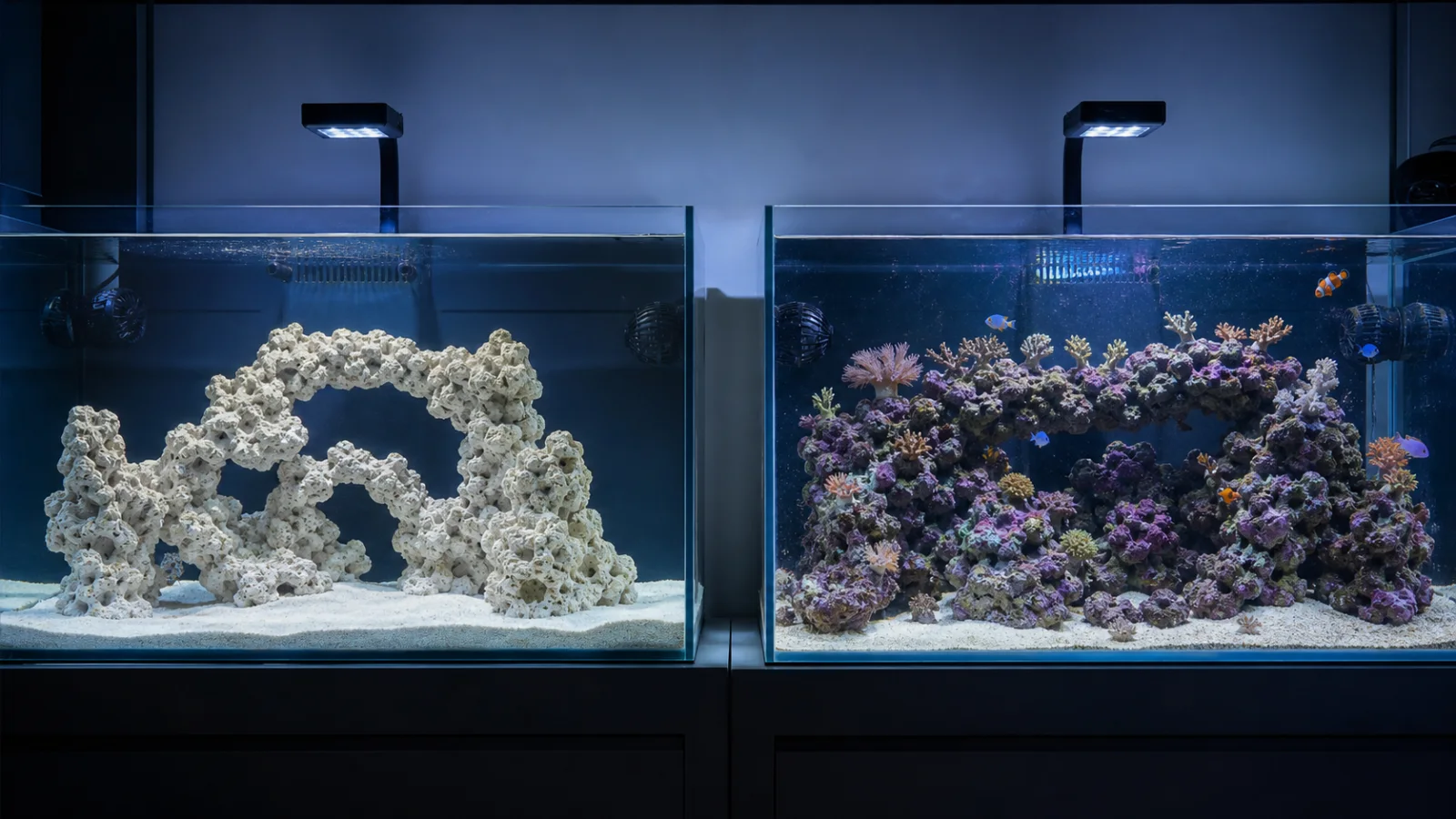
Live rock and dry rock can both support exceptional reef aquariums. Dry rock offers predictable structure, easier aquascaping, known sourcing, and a much smaller initial hitchhiker load. Genuine live rock imports established microbes and often algae, sponges, worms, crustaceans, and other organisms that begin filling ecological roles immediately. The same import can also include pests, predators, nuisance algae, or pathogens.
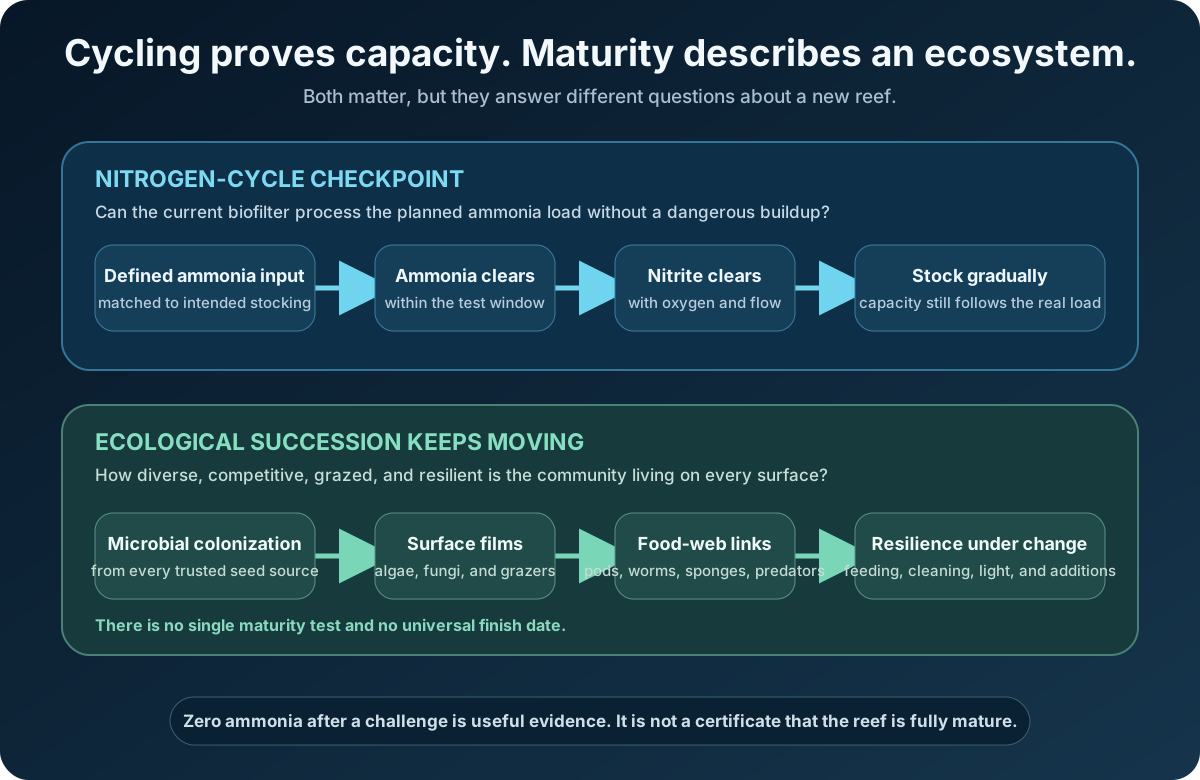
A completed ammonia cycle proves that the present biofilter can process a defined nitrogen load under the test conditions. It does not prove that the tank has a diverse food web, mature surface communities, stable competition, adequate grazing, or resilience after feeding, cleaning, lighting, and livestock changes. Cycling and maturity are related, but they are not synonyms.
There is reasonable evidence that live-rock additions can shift microbial communities and nutrient cycling in experimental saltwater aquaria. There is not strong controlled evidence that dry rock by itself causes dinoflagellate outbreaks or that live rock prevents them. The most honest conclusion is that the starting community changes the succession path, while nutrients, light, grazing, contamination, husbandry, and chance still help determine the outcome.
Why this debate feels different now
Many long-time reef keepers remember building systems with porous rock that arrived wet, smelled like the ocean, and produced months of surprises. Some surprises were wonderful: brittle stars, pods, sponges, feather dusters, coralline algae, tunicates, and worms. Others were expensive or destructive: mantis shrimp, predatory crabs, Aiptasia, nuisance algae, vermetid snails, or organisms that died in transit and fueled a curing cycle.
Modern dry-rock aquascapes solved real problems. A keeper can build arches outside the tank, avoid harvesting uncertainty, control the shape, and begin without an obvious inventory of stinging or predatory hitchhikers. Bottled nitrifiers and measured ammonia can establish nitrogen-processing capacity quickly and repeatably.
At the same time, many hobbyists believe that bare dry-rock starts suffer a longer, harsher ugly phase and more dinoflagellate trouble. That observation deserves investigation. It does not deserve to be converted into a universal causal law without controlled incidence data.
First define what “live rock” means
The label covers very different products. Ocean-aquacultured live rock begins as legally placed substrate at a permitted aquaculture site and returns carrying the organisms that colonized it. Imported natural live rock may be subject to different national collection and export rules. Rock cured for months in a dealer system may be biologically active but no longer carry the same diversity it had at collection. Established rock from another hobbyist may be mature, but it also shares that aquarium’s pests and disease history.
“Dry rock” is equally broad. It can be mined ancient reef limestone, cleaned natural carbonate rock, manufactured ceramic or cement structure, or formerly live rock that was dried and stripped. Porosity, trapped organic material, phosphate behavior, surface chemistry, and physical strength vary among products.
Rock becomes biologically active after immersion and colonization, but saying that dry rock eventually becomes live rock can hide the important question: live with which organisms, arriving from where, and over what period?
Common reef-rock starting materials are not biologically interchangeable on day one.
| Starting material | What it usually gives you | What still needs verification |
|---|---|---|
| Dry natural or manufactured rock | Control, flexible aquascaping, little visible life | Curing needs, nutrient release, seeding plan, and gradual stocking capacity |
| Dealer-cured rock | Established nitrification and some surface life | How long it was cured, which system it shared, and what survived |
| Established hobbyist rock | A functioning aquarium community and fast biological continuity | The donor tank’s algae, pests, medications, and disease history |
| Legally aquacultured ocean live rock | Marine microbial and visible-organism diversity | Permit or source documentation, curing, inspection, and hitchhiker tolerance |
An ammonia cycle is not an ecosystem maturity certificate
Nitrification is essential. Fish and decaying food release ammonia, and an aquarium must support organisms that oxidize ammonia and nitrite fast enough for the real daily load. Comparative aquarium research has identified nitrifying bacterial groups in seawater biofilters, and a controlled ammonia challenge can provide useful evidence that this function is present.
A reef ecosystem asks more questions. Which organisms occupy newly lit surfaces? Are there grazers for the first algal films? Are prey and detritivores available to support fish and corals? Are microbial communities stable after a large cleaning or feeding change? Does the system resist one opportunist dominating an open niche?
Those functions emerge through succession and repeated introductions. They do not all appear the day ammonia and nitrite first clear. A tank can be cycled enough for a modest initial bioload while remaining ecologically young for months.
What the aquarium microbiome research actually found
A 2019 mSphere study followed two newly established experimental saltwater aquaria for three months while measuring water chemistry and sequencing microbial communities in water and sediment. The researchers observed succession over time and reported that ocean-derived live-rock additions shifted the systems toward microbial assemblages more typical of conditioned saltwater aquaria while improving aspects of nutrient cycling.
That is directly relevant evidence, but its limits matter. Two experimental aquaria are not a survey of thousands of home reefs. The study did not compare modern commercial dry-rock recipes, every bottled inoculum, coral survival, or the incidence of named dinoflagellate species. It shows that live-rock perturbations can materially change aquarium microbial communities. It does not prove that one rock choice guarantees a beautiful display.
Separate coral-culture research has also found that coralline-encrusted live rock can harbor active nitrifying and denitrifying communities and help maintain water quality under experimental nitrogen loading. Again, a useful biological function is not the same as a promise that every imported organism is desirable.
The strongest case for live rock
The case for live rock is not merely that it cycles faster. Its real value is ecological compression. A legally and responsibly sourced piece can bring many surface communities, cryptic organisms, and trophic links into a system at once. Some are visible. Much of the microbial and microscopic diversity is not.
That imported community may occupy space and consume resources before a narrow set of opportunists dominates them. Pods and worms process detritus. Sponges filter water. Grazers work on films. Coralline algae covers carbonate surfaces. Predators and prey begin interacting before the display has a large coral population.
But “more biodiversity” is not automatically “more beneficial biodiversity.” A diverse shipment can contain organisms that do not survive the new temperature, light, food supply, or transport. Die-off can raise ammonia and organics. An unknown crab does not become reef-safe because it arrived naturally. Live rock replaces a controlled blank slate with a biologically rich set of known and unknown risks.
The strongest case for dry rock
Dry rock lets the keeper control structure, provenance, weight, placement, and the first major introductions. It can reduce the chance of beginning with a mantis shrimp, predatory crab, Aiptasia colony, nuisance macroalga, or a rock-bound organism from an unknown holding system. It can also avoid demand for poorly documented wild extraction.
The clean start is especially valuable when the aquascape must be assembled securely outside the aquarium or when the keeper plans a strict biosecurity program. Dry rock also makes it easier to remove, reshape, or replace a section before livestock fills every gap.
Control, however, is not the same as sterility forever. The first coral plug, snail shell, macroalga, sand sample, fish bag, wet tool, and hand can add organisms. A dry-rock system still develops a community. The keeper has changed the sources, timing, and diversity of those introductions, not eliminated biology.
Hitchhikers are a risk class, not a single verdict
A careful inspection should separate known beneficial or neutral life from organisms that require identification. Small brittle stars, copepods, amphipods, sponges, tube worms, and many bristleworms can be ordinary members of a reef community. Some crabs, predatory snails, anemones, worms, and algae require a different decision.
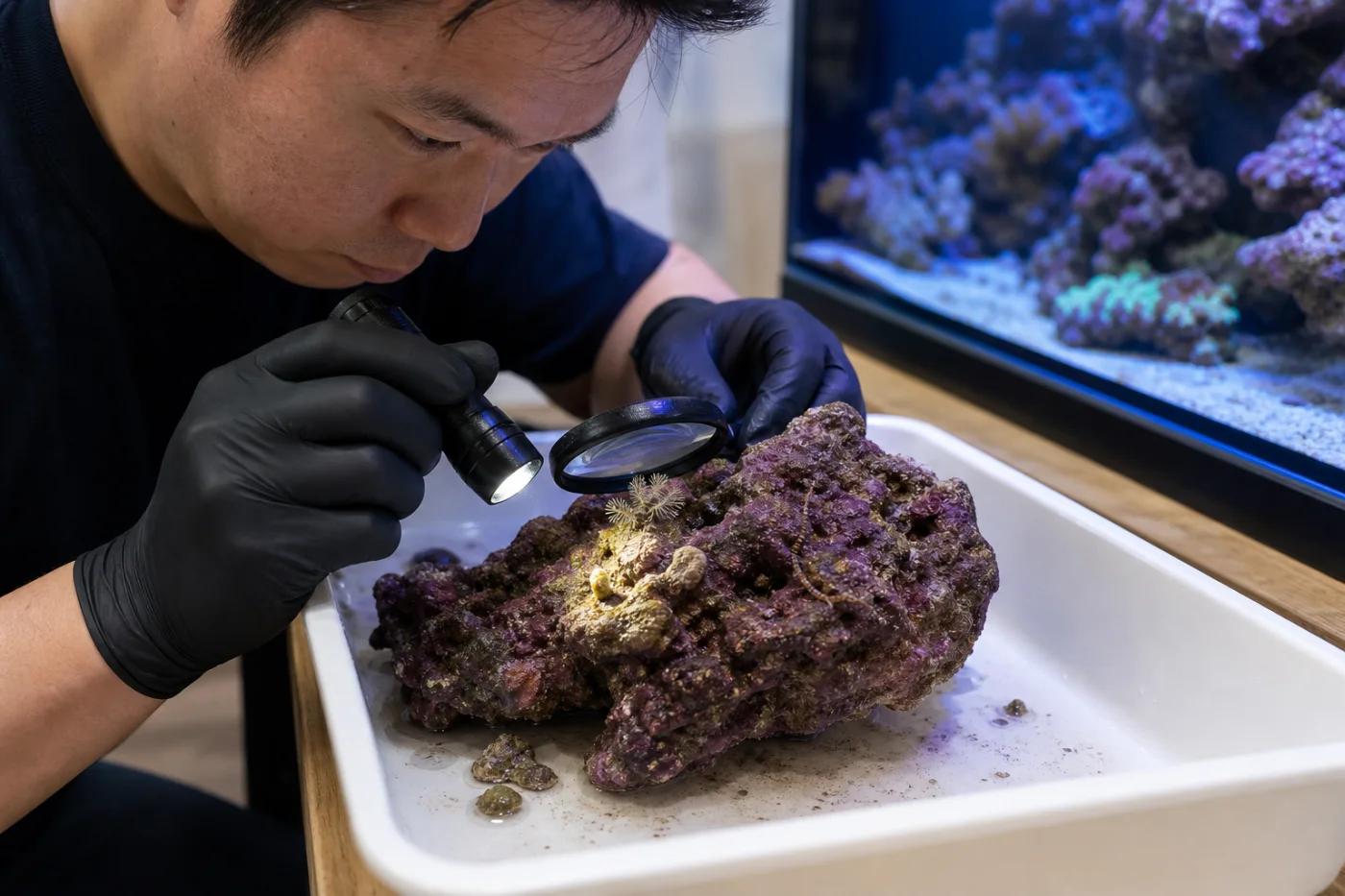
Inspect live rock in saltwater under white light. Check it again after darkness. Use a tray, flashlight, magnifier, and photos. Cure rock separately when the source or transit condition makes die-off likely. Do not expose the entire community to a destructive dip merely because one unidentified organism moved in a crevice. Identify first, isolate when necessary, and remove a confirmed problem deliberately.
Did dry rock cause the modern dinoflagellate problem?
The honest answer is that the claim is plausible as one contributing pathway and unproven as a general cause. A sparsely colonized surface community can leave ecological space open. Very low measurable nutrients, intense light, limited grazing, and abrupt export can also favor particular opportunists. Adding trusted mature material can change competitors and consumers.
But “dinoflagellates” describes a broad group, and aquarium blooms differ by organism and habitat. A water-column species, a sand-dwelling species, and a mucus-producing benthic species do not respond identically. Many dry-rock tanks never develop a severe bloom, and live-rock tanks can still experience dinoflagellates after nutrient depletion, disruption, contamination, or other changes.
Without a controlled study comparing outbreak incidence across matched home aquaria, dry rock should not be convicted by anecdote alone. The useful takeaway is narrower: a dry-rock start needs an intentional ecological plan, not only an ammonia-processing plan.
Source matters more than the word “natural”
Never assume that wet rock is legal, sustainable, or responsibly collected because a listing calls it natural. Rules vary by place and origin. Florida, for example, prohibits ordinary live-rock harvest and allows harvest from permitted aquaculture operations. NOAA advises aquarium buyers to choose ethically raised and legally collected organisms and to know their source.
Ask whether the rock is aquacultured, imported, dealer-cured, or removed from another established aquarium. Request the origin or permit context when appropriate. A documented aquaculture product and an undocumented piece removed from reef habitat should not receive the same ethical label.
Dry rock also has a sourcing story. Mined and manufactured products use material and energy, and some carbonate products began as ancient reef deposits. The goal is not to declare one word automatically sustainable. It is to know what was taken, where it came from, and which regulated or lower-impact alternative you are supporting.
The hybrid start is often the most rational compromise
A keeper can build most of the structure with dry rock, cure it, establish measured nitrification, and then seed the system with a smaller quantity of trusted live rock, established rubble, sand, macroalgae, or cultured microfauna from known healthy sources. The method preserves aquascaping control while widening the biological starting community.
A small seed is not a magic dose. Source diversity, surface area, survival, food, light, predators, and time determine what establishes. Adding five commercial bottles on the same day also does not create five mature ecosystems. Introduce deliberately, record each source, and allow one change to reveal its effect before stacking the next.
Biosecurity and biodiversity are not mutually exclusive. Trusted-source seeding, separate observation, pest identification, and gradual transfer can reduce risk without demanding that the display begin as a chemically cycled blank slate.
Choose the start that matches the risk you can actually manage.
| Your priority | A reasonable starting approach | The work you still owe the tank |
|---|---|---|
| Maximum aquascape control and strict pest exclusion | Mostly dry rock with defined nitrification and selected cultured seeds | Slow stocking, deliberate biodiversity additions, and patience with succession |
| Fastest ecological continuity from a trusted mature reef | Established or legally aquacultured live rock | Source review, curing when needed, inspection, and hitchhiker decisions |
| Balance of structure, control, and biodiversity | Dry-rock structure plus observed trusted live-rock or rubble seed | Document every source and avoid treating a small seed as instant maturity |
| Unknown used rock at an irresistible price | Separate curing and observation before any display transfer | Test for die-off and nutrient release, identify organisms, and learn the donor history |
Track the succession, not just the cycle date
Record the rock type, source, curing history, ammonia challenge, first livestock, first light, seed additions, nutrient trend, visible films, algae, dinoflagellate identification, grazer additions, and major cleaning events. A photo at the same angle and lighting every one or two weeks can show whether a bloom is expanding, changing, or being replaced.
This is where Reef Trak becomes more useful than a note that says “cycled.” Put tests, livestock, maintenance, equipment changes, photos, and observations on the same tank history. If the brown film appeared four days after lighting increased and two weeks after phosphate bottomed out, that timeline is more informative than the rock label alone.
Do not grade maturity with a single score. Use the record to ask whether the system is becoming more predictable under ordinary changes and whether interventions are producing the response you expected.
The bottom line
Live rock imports ecological history. Dry rock gives you more control over how that history begins. One carries a larger package of life and risk on day one. The other asks the keeper to build diversity and stability over time from selected introductions.
The modern ugly phase was not created by one product category. Dry rock, strong export, bright LEDs, sparse grazing, low nutrients, limited seed diversity, rapid stocking, and ordinary ecological chance can interact. Live rock can change that starting equation, but it cannot guarantee a pest-free, bloom-free, mature reef.
Choose the risk you understand, source it responsibly, verify the nitrogen cycle, seed the wider ecosystem intentionally, and preserve enough history to learn from what happens next.