
The short answer
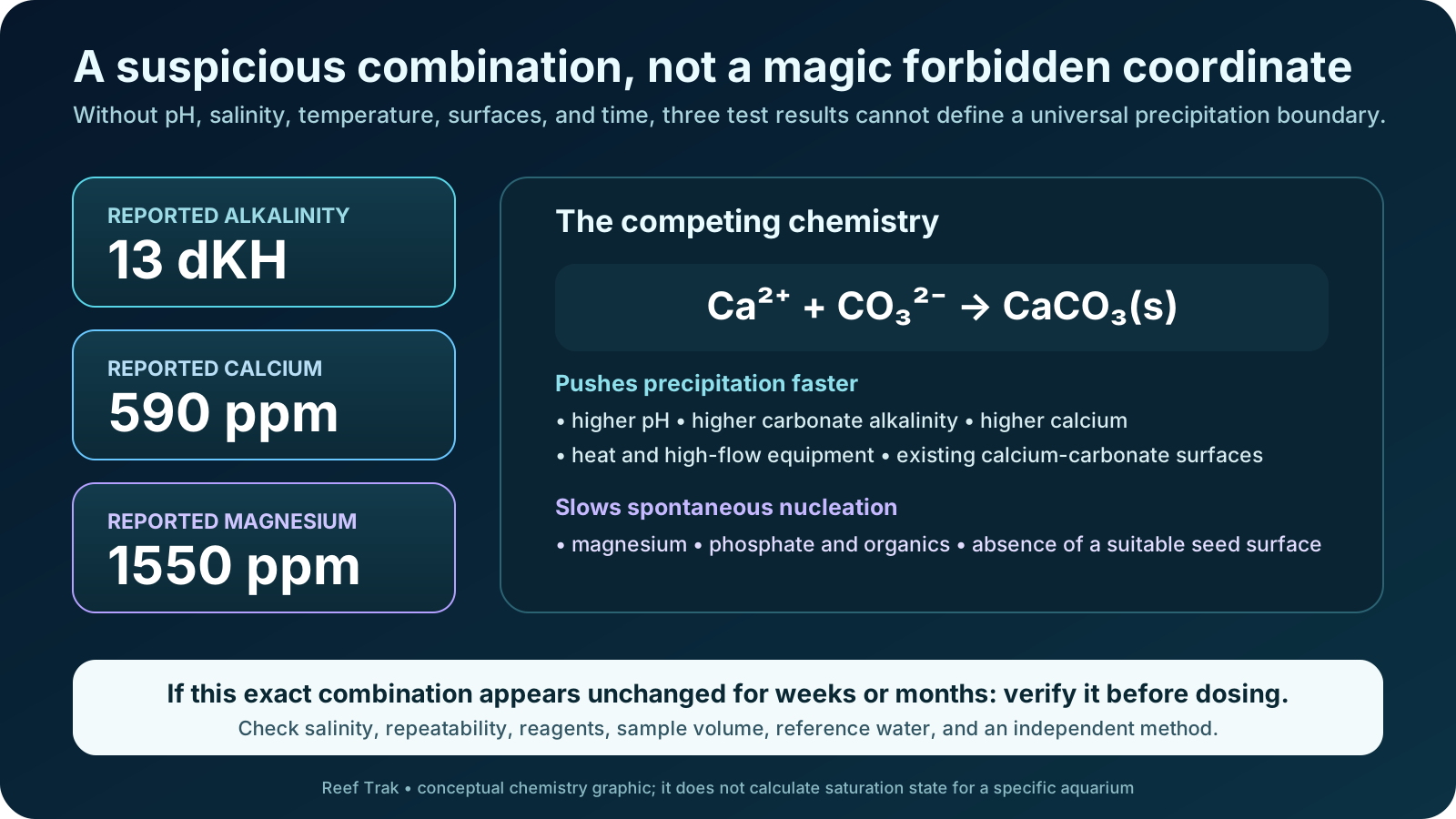
If a reef test reports 13 dKH alkalinity, 590 ppm calcium, and 1550 ppm magnesium, do not make a large correction from that one set of numbers. Stop, repeat the tests carefully, confirm salinity, and cross-check at least the surprising value with another method or a reference solution.
That combination is not mathematically impossible. Seawater is already supersaturated with calcium carbonate, and magnesium, phosphate, organics, and the absence of a suitable crystal surface can delay spontaneous precipitation. A tank can also be pushed above ordinary reef ranges temporarily. But very high calcium plus very high alkalinity creates stronger pressure toward calcium-carbonate formation, especially as pH rises. A claim that the same extreme values have sat unchanged for weeks or months is therefore a testable red flag, not proof of a uniquely powerful aquarium.
The gentle conclusion is not that every digital checker is bad or every owner used it incorrectly. It is that some methods are unusually sensitive to water purity, tiny sample volumes, clean glass, timing, and reagent condition. When the chemistry story and the tank story disagree, verify the measurement before treating the aquarium.
First, retire the word impossible
Reef chemistry does not contain a single lookup table that says 12.9 dKH and 589 ppm calcium can exist but 13.0 dKH and 590 ppm cannot. Precipitation depends on ion activities and kinetics, not only the three numbers printed by hobby kits. pH controls how much of the alkalinity is present as carbonate. Salinity, temperature, phosphate, dissolved organics, magnesium, and available crystal surfaces also change what happens and how quickly it happens.
The scientifically defensible wording is that the reported combination is highly unusual, strongly supersaturated, and increasingly prone to abiotic calcium-carbonate precipitation. The persistence claim is often more suspicious than the snapshot. One high reading after a dosing mistake is plausible. The same high reading every week for four months, with no scale, no downward trend, no water change effect, and no independent confirmation, points toward salinity or testing workflow before exotic chemistry.
What precipitation actually means
Precipitation is the change from dissolved ions to a solid. In this case, dissolved calcium and carbonate join to form solid calcium carbonate: the same basic mineral family found in coral skeletons, coralline algae, aragonite sand, and the white scale that collects on warm aquarium equipment.
Biological calcification is controlled mineral building by organisms. Abiotic precipitation is the unwanted version that occurs on equipment, sand grains, plumbing, or suspended particles without helping a coral. Both remove calcium and alkalinity from the water. The balanced relationship is useful: forming enough calcium carbonate to remove about 20 ppm calcium also removes about 1 meq/L, or 2.8 dKH, of alkalinity. The alkalinity change is much easier to see because 20 ppm is a small fraction of roughly 420 ppm calcium, while 2.8 dKH is a large fraction of ordinary reef alkalinity.
This is why a precipitation problem can look like alkalinity mysteriously vanishing while calcium barely moves. The chemistry is consuming both; the hobby tests do not show both changes with equal clarity.
Why high calcium plus high alkalinity raises suspicion
Increasing dissolved calcium gives the reaction more calcium ions. Increasing alkalinity generally supplies more bicarbonate and carbonate, and the carbonate share rises sharply with pH. Raising pH therefore matters enormously: a high-pH sodium-carbonate dose or kalkwasser addition can create a concentrated local zone that precipitates even when the whole-tank averages look less dramatic.
Warm surfaces and existing calcium-carbonate deposits provide easy places for crystals to grow. Heaters, pump impellers, high-flow plumbing, sand, and the area around a dosing outlet often show the evidence first. Once a rough mineral coating exists, it can make further deposition easier.
A reading of 590 ppm calcium and 13 dKH is not merely “extra reserve.” Above-normal values do not store guaranteed future coral growth. They increase the chance that some of the supplement becomes scale instead of skeleton, particularly if pH is also high. If repeated tests prove the values are real, the sensible response is usually to stop pushing them higher and let verified consumption plus appropriately matched water changes bring the system back toward its chosen range.
Magnesium is the complication, not a third precipitating partner
Magnesium is often described as the ion that helps calcium and alkalinity coexist. That shorthand is useful. Research on seawater shows that magnesium interferes strongly with calcium-carbonate nucleation and calcite growth. In practical terms, it can poison a growing crystal surface and increase the energy required for a new crystal to get started.
That means 1550 ppm magnesium does not make the trio automatically less possible. It may help delay massive spontaneous precipitation compared with the same calcium and alkalinity at low magnesium. It still does not make an extreme result self-validating, and it does not prevent scale in every high-pH microzone or on every suitable surface.
Magnesium also moves slowly in most reef aquaria. A large apparent jump or a perfectly flat, unusually high reading deserves the same questions about salinity, sample volume, reagent condition, and method precision. Do not add magnesium merely to “hold” excessive calcium and alkalinity in solution.
What precipitation looks like in a real reef
A full tank can turn milky when a severe event creates countless suspended calcium-carbonate particles. Most precipitation is less theatrical. It accumulates where temperature, pH, flow, concentration, and existing mineral surfaces make growth easiest.
- A brief white cloud where alkalinity solution or kalkwasser enters the water
- Fresh chalky scale on heater tubes, pump impellers, shafts, plumbing, or reactor parts
- Pumps that become noisy, lose output, or seize sooner than expected
- Hard clumps or cemented patches in otherwise loose aragonite sand
- A crust around the dosing outlet or on a high-flow sump wall
- Calcium and alkalinity additions increasing while confirmed levels refuse to rise
- A sharp alkalinity fall accompanied by elevated pH and new white deposits
Not every white deposit proves a tank-wide precipitation event, and clear water does not prove none is occurring. Scale location, dosing timing, pH history, pump maintenance, and repeated chemistry trends make the diagnosis stronger than appearance alone.
Why test error often explains the impossible-looking aquarium
Every test is a measurement system: the water sample, sample volume, reagent concentration, reaction time, temperature, glassware, optical path or visual endpoint, calibration, and arithmetic all contribute uncertainty. A digital display can make the final answer look more certain than the method that produced it. Resolution is not the same thing as accuracy.
Test kits can fail high because the sample is too small, carrier water contains the ion being measured, a syringe or vial carries residue, powder is not transferred completely, the meniscus is misread, bubbles or fingerprints affect an optical reading, reagent is old or contaminated, or salinity is higher than believed. They can also be perfectly repeatable and still biased: doing the same sensitive procedure the same wrong way can produce a beautifully stable false trend.
If a test feels as though it only works after rubbing your belly, jumping twice, and waiting for a full-moon Wednesday, the frustration is real. The useful next step is to identify which part of the method is fragile and cross-check it, not to turn the joke into a claim that every instrument from one manufacturer is useless.
The Hanna calcium checker deserves model-specific caution
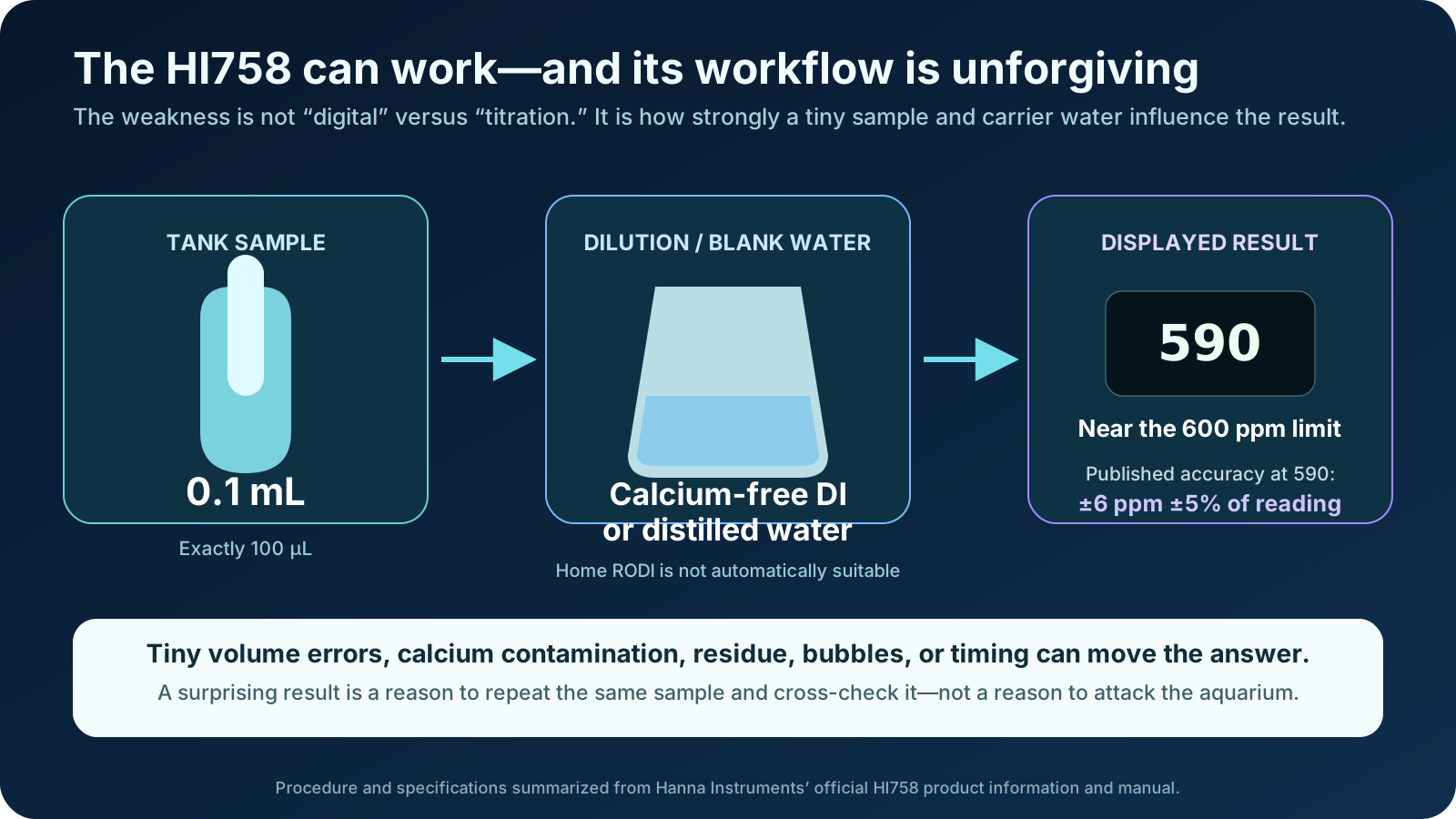
The Hanna HI758 Marine Calcium Checker uses a 100-to-1 dilution and only 0.1 mL, or 100 microliters, of aquarium sample. Hanna states that it requires deionized or distilled water absent of calcium because calcium in the dilution water can cause a false-high result. The company also notes that many hobby RODI systems may not remove calcium adequately for this particular method, even when the water seems suitable for normal aquarium use.
That design explains the reputation. Exactly 100 microliters is a tiny amount to transfer at a kitchen counter. Sample left inside or outside the tip, calcium residue in a vial, unsuitable dilution water, incomplete powder transfer, bubbles, fingerprints, and timing all matter. The published range is 200 to 600 ppm, and the stated accuracy at 25 °C is ±6 ppm ±5% of the reading. A displayed 590 is therefore both near the top of the method range and less exact than its one-ppm display resolution suggests.
This does not prove that every HI758 result is wrong. It says that a 590 reading should earn a careful repeat with verified calcium-free water, the correct volumetric pipette, clean dedicated glassware, fresh in-date reagent, and an independent method before anyone changes the aquarium. A product can perform within its specification under the documented procedure and still be a poor fit for a hobbyist who reasonably expects ordinary well-maintained RODI and less fragile handling.
What about the Hanna magnesium checker?
The HI783 is a different test and should not be criticized by borrowing the HI758 calcium method’s exact weaknesses. Hanna lists a range of 1000 to 1800 ppm and accuracy of ±5% of the reading at 25 °C. At a displayed 1550 ppm, five percent is about 78 ppm before considering mistakes in sample handling. That is enough uncertainty to matter when someone treats 1550 as an exact fact rather than a result that may plausibly sit tens of ppm away.
The same broad rule applies: follow the correct syringe and reagent sequence, inspect expiration and lot information, repeat the same water sample, and compare against a second method or reference when the result would change dosing. It is fair to say a workflow is finicky. It is more accurate and more useful than declaring that all Hanna checkers are alike. The alkalinity, phosphate, calcium, and magnesium products use different chemistries and have different handling risks.
Check salinity before blaming exotic chemistry
Salinity is the concentration control for the whole salt mix. If evaporation is not fully replaced, a refractometer is miscalibrated, a conductivity probe is fouled, or new saltwater is mixed stronger than believed, calcium, magnesium, and alkalinity can all read high together. This is one of the few simple explanations that can move all three in the same direction without three independent dosing accidents.
Verify salinity with a clean instrument and an appropriate seawater reference standard, not only pure water. Test a freshly mixed batch of the same salt at the verified salinity. If the display and new water both show the same suspicious bias with one kit, the method becomes a stronger suspect. If multiple independent methods agree that salinity and all three chemistry values are high, the aquarium really was pushed high and should be allowed to come down carefully.
A retest protocol that prevents a measurement error from becoming a dosing error
Use one collected water sample for the immediate comparisons so the aquarium is not changing between tests. Do not dose between repeat measurements. Record the raw results, method, reagent lot, and time instead of averaging away an uncomfortable answer.
- Pause any nonessential correction dose that is based only on the surprising result; keep life-support equipment running
- Confirm salinity and temperature with cleaned, calibrated equipment and a suitable reference
- Repeat the same test twice from the same mixed sample, following every volume and timing step exactly
- For the HI758, use verified calcium-free DI or distilled water and the correct 100 µL volumetric pipette and tip
- Inspect reagent expiration, lot, storage, vial cleanliness, scratches, residue, bubbles, and fingerprints
- Test a known reference or freshly mixed saltwater at verified salinity
- Cross-check calcium and magnesium with a different method or trusted shop; use ICP when broader elemental confirmation is justified
- Remember that ICP can help confirm calcium and magnesium but does not replace an alkalinity titration
- Only adjust dosing after the repeat data and the tank’s visible evidence tell the same story
What to do if 13 dKH, 590 calcium, and 1550 magnesium are confirmed
Do not try to make three large corrections at once. Stop the source of continued oversupply. Check dosing-pump calibration, programming, siphoning, reservoir contents, water-change salinity, and the actual concentration of every supplement. Separate a maintenance dose from any one-time correction that may have been repeated accidentally.
If animals are not in immediate distress, ordinary calcification and carefully matched water changes can usually move values downward more safely than adding another chemical to force them down. Monitor alkalinity and pH more frequently while the tank returns toward its intended band. Clean scaled pumps and heaters as their manufacturers allow so the deposits do not create a mechanical failure.
A severe milky precipitation event, failing pumps, rapidly changing pH, or distressed livestock is a different situation. Restore circulation and oxygenation, stop the precipitating addition, verify temperature and salinity, and seek qualified aquarium or aquatic-veterinary help. Do not stack improvised acids or more supplements onto water whose measurement history is already uncertain.
The bottom line
The chemistry lesson is not that 13 dKH, 590 ppm calcium, and 1550 ppm magnesium can never appear together. It is that high calcium and alkalinity increase calcium-carbonate supersaturation, high pH and surfaces can accelerate precipitation, and magnesium can delay nucleation without granting the aquarium unlimited capacity.
The testing lesson is even more practical. A result that remains extreme for months while the tank shows no matching trend or physical evidence should be challenged. The HI758 calcium method is especially sensitive because it uses a 100-to-1 dilution, a 100-microliter sample, and calcium-free dilution water. The HI783 magnesium specification is broad enough that 1550 should not be treated as laboratory truth from one run.
Believe repeatable evidence, not the confidence of a digital display. Confirm salinity. Repeat the same sample. Use a reference. Cross-check the method. Inspect the tank. Then make the smallest change supported by all of those facts. The safest reef correction is often the dose you do not make after a bad test.