
The short answer
If I had to choose one chemistry number to watch most closely in a stony-coral reef, I would choose alkalinity. Not because temperature, salinity, oxygen, nutrients, calcium, and pH are optional. They are not. I would choose it because alkalinity sits where coral growth, carbonate chemistry, testing, and supplementation meet, and because a small daily mismatch becomes visible there quickly.
That same sensitivity is why alkalinity is so difficult to maintain. A healthy reef is using it continuously. Corals grow at changing rates. Coralline algae and other calcifiers join the demand. Dosing pumps drift. Kalkwasser delivery follows evaporation. Water changes import a different value. High-pH microzones can turn a portion of the dose into calcium-carbonate scale before an animal ever uses it.
The goal is therefore not to freeze one perfect number. The goal is to choose a defensible band, measure it consistently, replace actual consumption, and recognize when the trend changed before a large correction is needed.
What alkalinity actually measures
Alkalinity is the acid-neutralizing capacity of the water. In seawater, bicarbonate and carbonate make up most of the total, with smaller contributions from borate and other acid-base species. A hobby alkalinity test does not count individual bicarbonate molecules. It uses a known acid and an endpoint to measure the combined capacity of the sample to accept hydrogen ions.
That definition matters because alkalinity is not the same thing as pH. pH describes the hydrogen-ion condition at that moment. Alkalinity describes how much acid the water can neutralize across a titration. Adding or removing carbon dioxide can move pH substantially without directly changing total alkalinity. It changes how inorganic carbon is divided among carbon dioxide, bicarbonate, and carbonate instead.
Reef keepers usually report alkalinity in dKH. The exact conversions are 1 dKH equals about 0.357 meq/L and 17.86 ppm as calcium carbonate. A unit mistake can make a normal result look like an emergency, so record the unit with the value and verify what the instrument actually reports.
Why alkalinity looks louder than calcium
Stony corals, coralline algae, clams, and other calcifiers build calcium carbonate. That process removes calcium and alkalinity in a linked chemical ratio. For each 1 dKH of alkalinity consumed by calcium-carbonate formation, calcium falls by only about 7 ppm.
A 1 dKH change is easy to see with a careful alkalinity test. A 7 ppm calcium change can disappear inside normal hobby-test uncertainty against a calcium concentration near 400 to 450 ppm. The same calcification event therefore looks dramatic on the alkalinity chart and almost flat on the calcium chart.
This is one reason alkalinity becomes the primary feedback signal for two-part dosing and calcium reactors. It does not mean calcium is unimportant. It means alkalinity usually tells you sooner that supply and demand no longer match.
Why the number never truly sits still
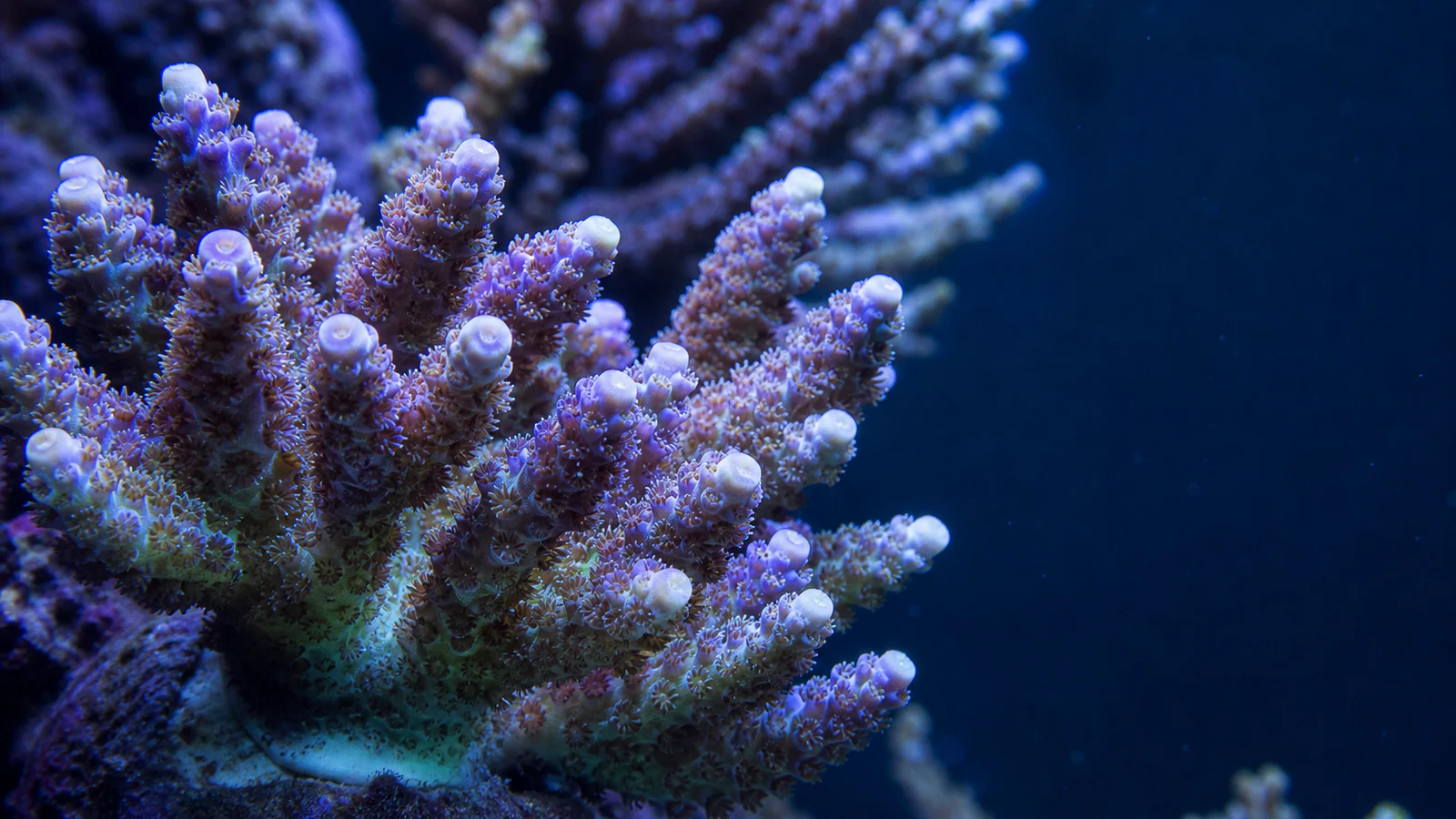
A reef aquarium is not a beaker with a fixed daily withdrawal. Demand changes as colonies add tissue and branches, light and pH move through the day, coralline algae spreads, livestock changes, and pumps or dosing schedules are adjusted. Even a tank that appears visually unchanged can develop a different alkalinity demand over a few weeks.
Some alkalinity also leaves the useful pool without becoming coral skeleton. Calcium carbonate can precipitate on warm heaters, pump impellers, sand, and high-pH dosing zones. Higher alkalinity, higher calcium, and especially higher pH increase that risk. A crusted heater or frequently seized pump may be part of the consumption story, not just a cleaning problem.
Nitrogen processing can move alkalinity too. Converting ammonia to accumulating nitrate consumes alkalinity, while nitrate assimilation or denitrification can return it. The net effect depends on what enters the system and where nitrogen ultimately leaves. This can matter in a cycling tank or after a major change in feeding, filtration, carbon dosing, or nutrient export.
- Biological calcification by coral, coralline algae, clams, tube worms, and other organisms
- Abiotic calcium-carbonate precipitation on equipment, sand, or near concentrated high-pH additives
- A salt mix or water change whose alkalinity and salinity do not match the display
- Dosing-pump calibration drift, worn tubing, air bubbles, clogged lines, or an empty reservoir
- Kalkwasser delivery that rises and falls with seasonal evaporation or top-off behavior
- A change in coral biomass, light, pH, nutrients, feeding, or nitrogen processing
- Test variation caused by sample volume, reagent age, endpoint judgment, vial contamination, or unit conversion
Is alkalinity really the most important reef parameter?
There is no scientifically defensible ranking in which alkalinity beats oxygen during a pump failure, temperature during a heater failure, or salinity after a top-off accident. Those conditions can become lethal before an alkalinity test matters. “Most important” needs an asterisk.
For day-to-day management of a stocked stony-coral reef, however, alkalinity is probably the most useful single chemistry parameter. It is both a required input to calcification and a sensitive accounting signal. It moves fast enough to reveal changing demand, a failed doser, unexpected precipitation, or a mismatched water change while the correction can still be modest.
Field research supports the biological importance of carbonate chemistry without turning one dKH target into a universal coral-growth recipe. In a natural reef experiment, Albright and colleagues increased seawater alkalinity toward estimated preindustrial conditions and measured higher net community calcification. Other work shows that corals and coralline algae can use bicarbonate and carbonate, and that species differ in how they regulate chemistry at the site of calcification.
The practical conclusion is strong but narrow: alkalinity deserves close attention. It does not deserve to be chased in isolation from pH, calcium, magnesium, nutrients, temperature, salinity, flow, light, and the animals themselves.
Choose a range, not a holy number
Randy Holmes-Farley’s broad recommendation of 7 to 11 dKH is a useful operating envelope for reef aquaria. It is deliberately a range, not a claim that every point inside it produces the same result in every tank. Natural surface seawater is commonly lower than many aquarium targets, and many successful reefs operate near either end of the aquarium range.
Choose the target with the whole system in mind. Match the new saltwater closely enough that routine water changes do not create a step. Leave room for test uncertainty and a missed dose without crossing the lower guardrail. Consider whether a high-pH method, very high calcium, or chronic equipment scale is already making precipitation easier.
Higher is not automatically better. A recent 33-day Acropora cervicornis experiment found increased calcification and linear extension under elevated alkalinity treatments, but that result belongs to a specific species, chemistry design, and time window. It does not prove that pushing every mixed reef upward is safer, or that rapid changes are harmless.
A target is useful only when the surrounding operating plan supports it.
| Decision | What to consider | What to avoid |
|---|---|---|
| Target band | The tank’s established history, livestock, test precision, and salt mix | Copying one successful tank’s exact number without its method |
| Lower guardrail | Enough margin for normal demand and a delayed dose | Running so close to depletion that one failure becomes urgent |
| Upper guardrail | Precipitation risk, pH, calcium, and water-change chemistry | Treating extra dKH as stored coral growth |
| Correction speed | The verified result, animal condition, and size of the error | A large automatic correction from one surprising test |
Stability matters, but hobby rules are not universal laws
Reef keeping is full of precise-looking claims about the maximum safe daily alkalinity swing. Controlled evidence for one universal limit across coral species, nutrient states, pH conditions, and time scales is much thinner than those rules imply. Even the effect attributed to an alkalinity swing may include the pH change created by the additive used to cause it.
That uncertainty is not a reason to accept wild movement. Stability remains sound risk management. A steady range keeps carbonate chemistry, supplementation, and calcification conditions more predictable. It also reduces the chance that a correction overshoots or that several interventions are stacked before the first one can be evaluated.
Think in terms of rate, duration, and context. A slow drift across several weeks, a one-hour dosing spike, and a false test result can all display the same two endpoints. The history between them determines the response.
Test as if the result will change a dose
Alkalinity measurement is an acid titration, whether the endpoint is judged by eye or detected by an instrument. That makes sample volume, acid concentration, mixing, endpoint detection, cleanliness, and calibration part of the result. Ocean-chemistry laboratories use reference materials and uncertainty budgets for a reason. A hobby kit is simpler, but the need for repeatable technique remains.
Use the same method, sample location, and approximate time of day when building a trend. Rinse and dry equipment as directed. Measure the sample rather than estimating the meniscus. Respect reagent storage and expiration. If you change kits, overlap the old and new methods for several tests instead of pretending the series is continuous.
When a result is surprising, repeat it before making a large change. Check the unit, salinity, reagent, and a reference or second method when available. Then inspect the tank, reservoir, pump, tubing, recent water change, and maintenance history. Confirmation is not delay for its own sake. It prevents a testing error from becoming a chemistry error.
Why AquaWiz is getting so much attention
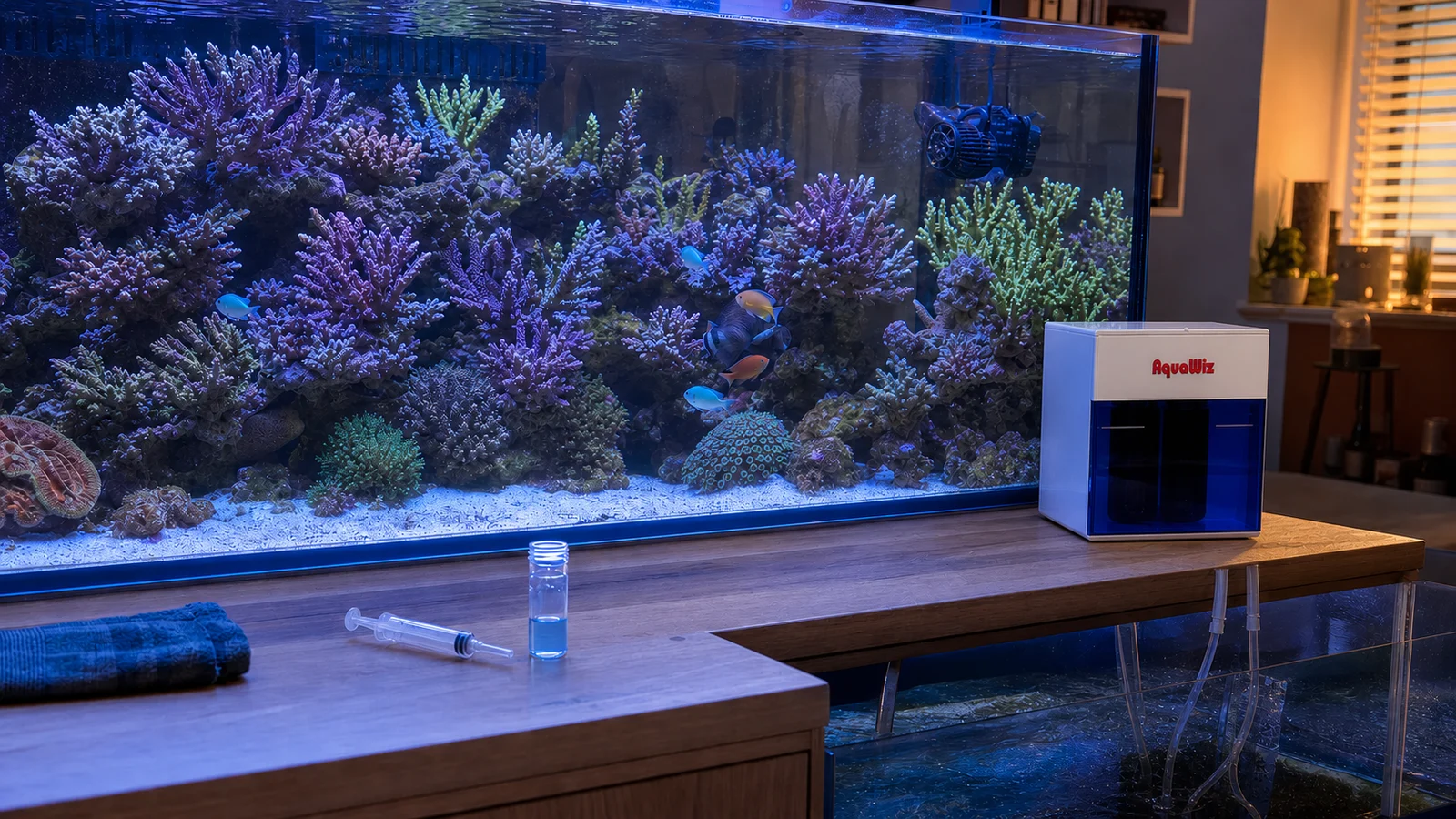
AquaWiz represents the newest version of the idea: measure alkalinity around the clock instead of relying only on occasional manual snapshots. The current KH Controller Gen 5 can be scheduled every one to six hours, so at its fastest setting it can produce an alkalinity result each hour, day and night. That density makes a failed dose, changing demand, or a developing drift visible much sooner.
It is marketed as reagent-free because it does not consume a conventional acid-titration reagent with every test. Instead, it compares tank water with a reusable reference seawater sample through a pH-based method. That can eliminate the routine reagent and wastewater burden of many automatic testers, although the reference, probe, tubing, calibration, and result still need maintenance and periodic validation.
The other reason AquaWiz is hot right now is closed-loop correction. Its built-in dosing function can add an alkalinity solution when the measured KH falls below the selected target. Frequent testing plus small corrections can keep the operating band much tighter than a once-daily test and one large dose.
That is powerful automation, but “completely flat” should remain the goal rather than a guarantee. A controller still measures at intervals, every measurement has uncertainty, and pumps or tubing can fail. Set conservative correction limits, cross-check it periodically with a trusted manual method, and never let one unexpected result trigger an unlimited dose.
- Runs on a schedule around the clock, with a selectable one-to-six-hour test interval
- Uses reusable reference seawater instead of consuming a conventional titration reagent on every test
- Can automatically dose alkalinity solution when KH falls below the selected target
- Provides remote trends and alerts so a changing pattern can be noticed before the next manual test
- Still needs sensible dose limits, calibration, maintenance, and an occasional independent cross-check
Measure demand before changing supply
A dosing system should replace what the reef actually consumes. Start with several alkalinity readings at the same time each day while the normal dose and maintenance routine remain unchanged. Record every dose, water change, additive, calibration, and livestock change that could affect the interval.
If alkalinity trends downward across confirmed readings, the system is under-supplying relative to current demand. If it rises, supply exceeds demand. Use the product’s documented concentration, actual water volume, and measured pump output to make a modest adjustment. Continue testing until the new rate proves itself.
Do not tune from one point. Three to seven consistent readings are far more informative, unless the value is genuinely dangerous or animals are showing distress. A mature high-demand reef may need daily or automated measurement during tuning. A lightly stocked tank can often be checked less frequently once its behavior is established.
- Measure the dosing pump’s real output into a graduated container instead of trusting its nominal rate
- Split a large daily addition into smaller portions when the product and system permit it
- Dose into strong flow where the concentrate disperses before reaching a heater, pump, or another additive
- Keep calcium and magnesium in context, but do not expect them to show daily demand as clearly as alkalinity
- Recalculate after visible coral growth, frag additions, lighting changes, seasonal evaporation changes, or a new supplementation method
Match the supplementation method to the tank
No supplementation method is inherently stable. Each can be stable when its delivery mechanism matches demand and is verified with measurements. Each can also fail in a characteristic way.
Common ways to replace alkalinity and the variable that most often complicates control.
| Method | Where it fits | Main complication |
|---|---|---|
| Water changes | Very low demand or small systems with carefully matched new water | Creates steps when new-water alkalinity or salinity differs from the display |
| Two-part or three-part | Low through high demand with direct pump control | Pump calibration, line condition, salinity creep, and unequal manual adjustments |
| Kalkwasser | Demand that fits within safe top-off or metered delivery | High pH, precipitation risk, and evaporation-dependent delivery when tied directly to top-off |
| Calcium reactor | Sustained moderate to very high demand | Slow feedback, changing effluent flow, probe accuracy, and possible display-pH suppression |
| Balanced one-part | Simple low to moderate demand, depending on product chemistry | Some products have delayed alkalinity availability, so immediate testing can misread the response |
A practical troubleshooting order
When alkalinity changes unexpectedly, work from the measurement outward. This order is intentionally boring. It keeps a simple failure from becoming a five-variable chemistry experiment.
- Repeat the test and verify the unit, sample volume, reagent, and salinity
- Check whether a water change, correction dose, missed dose, or reservoir refill occurred
- Measure actual pump delivery and inspect the tubing for air, leaks, clogs, siphoning, or a worn head
- Look for fresh scale on heaters, pump impellers, sand, and the dosing outlet
- Review pH, especially after starting kalkwasser or sodium carbonate, because higher pH can accelerate precipitation even though carbon dioxide alone does not change total alkalinity
- Review coral additions, visible growth, coralline algae, clams, and other calcifiers
- Review cycling, nitrate movement, carbon dosing, feeding, and nutrient-export changes
- Change one supply variable, document it, and give the trend enough time to reveal the result
What to do when alkalinity is truly high or low
For a confirmed high result, stop the cause before trying to force the number down. Pause or reduce the alkalinity addition as appropriate, verify that no pump is siphoning, and let ordinary consumption lower the value while you monitor the tank. A water change helps only when the new water is lower and the salinity is matched. Adding acid to a live reef is not a routine correction strategy.
For a confirmed low result, separate the one-time correction from the ongoing maintenance dose. Use a documented aquarium product or verified-purity recipe, calculate from actual water volume, and make conservative staged corrections with follow-up tests. Raising the daily maintenance dose alone can hide a delayed overshoot because it keeps adding the correction every day.
There is no one correction rate that is automatically safe for every starting value and animal. When the result is extreme, livestock is distressed, or the dosing history is uncertain, prioritize verification and qualified aquarium or aquatic-veterinary help over an internet formula.
The bottom line
Alkalinity is difficult because a successful reef is supposed to consume it. The demand grows with the animals, changes with the chemistry, and exposes every weakness in the testing and delivery system. You are not maintaining a static ingredient. You are balancing a moving biological budget.
It is probably the most important day-to-day chemistry parameter in a stony-coral reef because it connects so many parts of that budget and reveals mismatches early. The asterisk still matters: alkalinity cannot rescue bad temperature, salinity, oxygen, nutrients, light, or flow.
Choose a range your reef and salt mix can hold. Test the same way at the same time. Replace measured consumption. Confirm surprises. Record changes. The best alkalinity number is not the highest or the most fashionable one. It is the one that stays inside a deliberate band while the reef keeps growing.