The short answer
A successful saltwater predator tank begins as a livestock plan, not a glass-box purchase. Decide which exact species you want, look up adult size and natural diet, estimate the combined waste load, map likely conflicts, and only then choose the aquarium, filtration, rockwork, lid, and maintenance routine.
Some predator tanks can contain coral. Lionfish, many morays, groupers, and hawkfish do not normally eat coral tissue, but that does not make every one of them reef safe. A fish may swallow smaller tankmates, eat shrimp and crabs, knock over colonies, produce enough waste to challenge coral water quality, or make routine coral work unsafe. Puffers, many triggers, and large wrasses add a greater risk of biting corals or consuming mobile invertebrates.
The durable rule is simple: “predator” is not a compatibility category. Species, adult size, mouth size, temperament, feeding ecology, and the individual animal all matter. Build for the adults and assume the most tempting prey item will eventually be tested.
What counts as a predator tank?
Nearly every marine fish eats another animal at some scale. In the hobby, a predator tank usually means a display centered on conspicuous carnivores such as lionfish, scorpionfish, moray eels, groupers, snappers, hawkfish, frogfish, puffers, triggers, or larger wrasses. These fish do not all behave alike, and they should not be mixed from a generic list.
A dwarf lionfish waiting under a ledge, a snowflake moray hunting crustaceans, a grouper swallowing fish, and a trigger crushing hard-shelled prey create different risks. A frogfish may be motionless most of the day but can engulf a fish close to its own length. A trigger may be too large to swallow a tankmate yet still injure it. A moray may ignore fish but remove every shrimp in the aquarium.
Choose a theme narrow enough to research properly: a lionfish-centered display, a moray system, a large aggressive-fish community, or a species tank. “One of everything mean” is not a theme. It is a conflict schedule.
Start with adult size, not the store specimen
Juveniles make large predators look deceptively manageable. FishBase reports a maximum published total length of 45.7 centimeters, about 18 inches, for the red lionfish Pterois volitans. A fish with that body, fins, turning radius, and feeding response needs far more room than its nose-to-tail measurement suggests.
Research the exact scientific name because common names can hide major size differences. Dwarf lionfish and volitans lionfish are not interchangeable. Snowflake, zebra, chainlink, and green morays do not belong in one generic “eel” care box. Groupers range from relatively modest species to animals that outgrow normal home aquariums completely.
Tank-volume recommendations are only screening tools. Footprint, length, turning space, rock displacement, oxygenation, territory, and service access matter too. A tall narrow aquarium can hold many gallons while still being a poor home for a long, heavy fish. If the honest adult plan is beyond the house, budget, or maintenance capacity, choose a smaller species now instead of planning to rehome an animal later.
Compatibility is a mouth-size problem and a behavior problem
The familiar rule that a predator will eat whatever fits in its mouth is useful, but incomplete. Predators can attempt prey that does not fit, injure it, choke, or spit it out after damage is done. Tankmates can also harass a slow predator, bite the fins of a lionfish, compete so aggressively that a shy eel stops feeding, or attack a new arrival before it establishes shelter.
Compare body shape as well as length. A tall-bodied fish may be harder for a gape-limited predator to swallow than a slender fish of equal length. Then consider activity and territory. Ambush predators need quiet feeding opportunities; fast triggers and wrasses may steal every meal. Multiple cave users may fight for the same structure. Similar-looking groupers can regard one another as competitors.
Introduce livestock slowly and keep a real separation plan. A sump compartment is not a permanent home, and a flimsy acclimation box cannot contain a large predator. Before each addition, know which established animal could be moved, where it could go, and how you would catch it without dismantling the entire aquarium.
- Compare maximum adult size, body depth, and mouth size
- Compare natural diet: fish, crustaceans, mollusks, echinoderms, or generalist feeding
- Map cave, ledge, open-water, and sand-space requirements
- Check venomous spines, teeth, defensive behavior, and handling risks
- Avoid adding a new fish that resembles an established animal’s usual prey
- Plan an actual exit route before testing a questionable combination
Aquascape for function, then make it beautiful
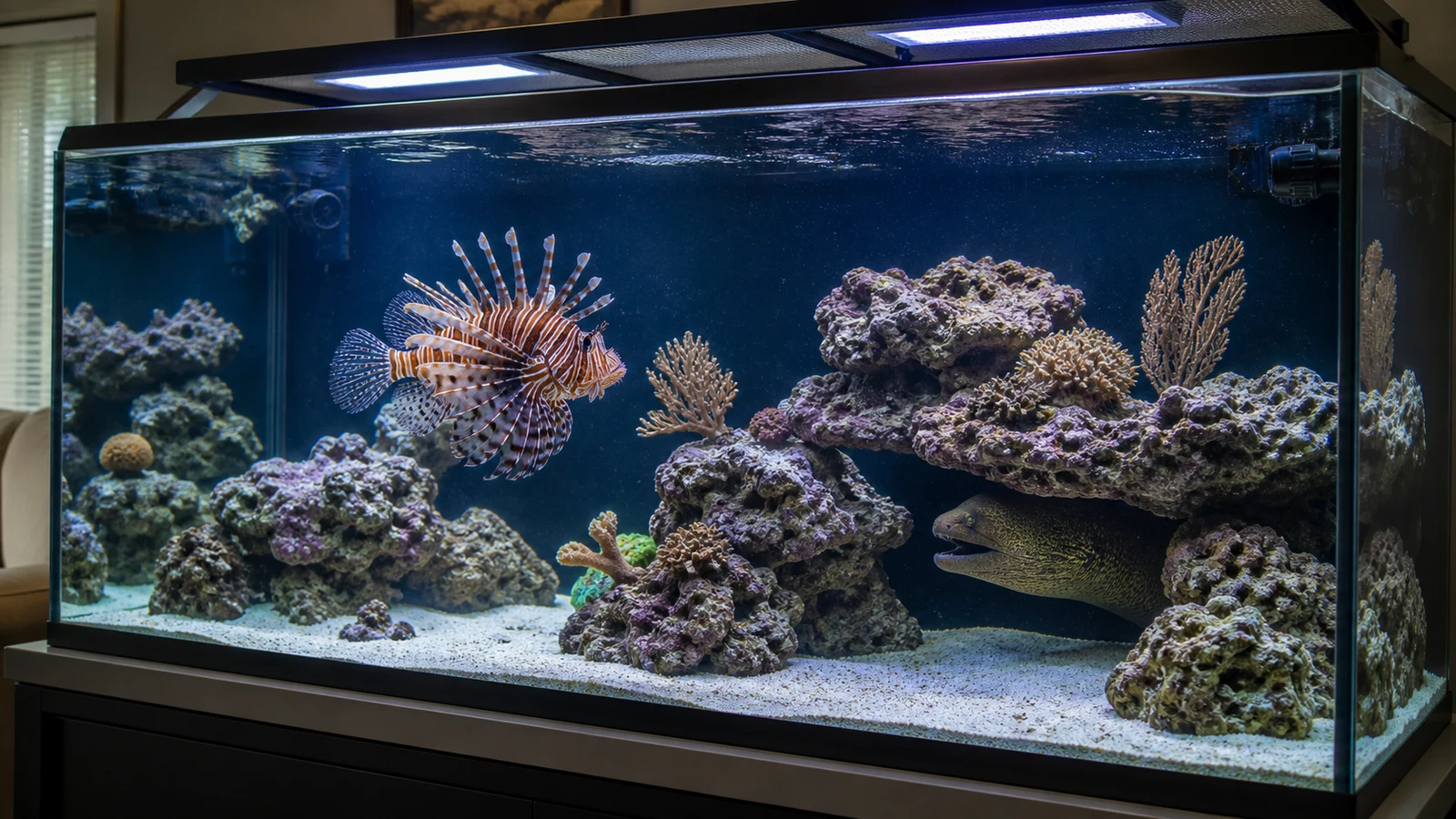
Predator rockwork has to create shelter without consuming the whole tank. Morays need stable caves and passages large enough for the adult body. Lionfish benefit from shaded ledges and clear approaches. Groupers and other cruising predators need open water and turning room. Every structure should remain stable when a heavy fish pushes through it.
Build rock on a stable base before deep sand is added, or otherwise engineer the structure so burrowing and forceful fish cannot undermine it. Avoid narrow traps where a growing fish can wedge itself. Keep enough clearance from pumps, overflows, and the glass to retrieve food and remove waste. A wall of rock that cannot be cleaned behind is a nutrient reservoir, not extra habitat.
The lid is life support. Eels find plumbing gaps, overflows, cable notches, and feeding openings. Other predators jump when startled or during feeding. Cover every opening with a secure, oxygen-friendly solution and inspect it after maintenance. A heavy decorative canopy with one open cable channel is still an open tank.
Filtration must be sized for meals, not labels
Large carnivores eat protein-rich food and return a large nitrogen load to the system. The Merck Veterinary Manual specifically notes that old tank syndrome is common in aquaria with large carnivorous fish because high-protein meals lead to substantial total ammonia nitrogen production and biofiltration consumes alkalinity as it processes that waste.
Use mature biological filtration with enough oxygenated surface area for the real feeding load. Add strong mechanical capture that can be cleaned before trapped food decomposes. A properly sized protein skimmer, accessible filter socks or roller media, vigorous circulation through dead zones, and a water-change plan matter more than a manufacturer’s optimistic gallon rating.
Do not cycle the aquarium with the predator. Establish the biofilter first, confirm that ammonia and nitrite are processed, then add animals gradually. Merck notes that a tropical aquarium biofilter can take up to eight weeks to establish. Even a mature biofilter can be overwhelmed by several large fish and heavy meals added at once.
Track pH and alkalinity as well as ammonia, nitrite, and nitrate. A fish-only tank can look visually fine while accumulating nitrate and losing alkalinity. Good oxygenation is equally important: warm saltwater holds less oxygen than freshwater, while large fish, bacteria, and a heavy nighttime respiration load all consume it.
Feed a complete diet without turning the aquarium into a carcass bin
Research what the species actually eats, then build variety from suitable marine-origin foods. Whole marine items can supply tissues and micronutrients that plain muscle meat lacks. Rotate appropriately sized shrimp, squid, clam, mussel, marine fish, and quality prepared foods according to the animal. Avoid making freshwater feeder fish or mammal meat the routine diet.
Train new animals onto dead prepared food when practical. Feeding tongs, a target stick, or consistent stations let you confirm that shy animals eat and reduce competition. Never hand-feed a moray, trigger, puffer, or lionfish. Hand-feeding teaches the animal to associate fingers with food and removes the distance that protects both fish and keeper.
More food is not automatically better care. Many predators are adapted to large intermittent meals, and obesity can hide behind a dramatic feeding response. Feed to body condition and species needs, remove uneaten pieces quickly, and record refusals. A sudden change in appetite is useful health information, not a cue to dump in five different foods.
Should a predator tank contain coral?
It can, but coral should be treated as a second husbandry program layered onto the predator system. Coral introduces lighting, flow, calcium, alkalinity, placement, pest control, and hands-in-the-tank work that a fish-only display may not otherwise need. The fish introduce waste, physical disturbance, predation on helpers, and safety constraints that a typical reef does not have.
Lionfish and many morays are often described as coral safe because coral is not their food. They may still eat ornamental shrimp, crabs, small fish, and other mobile invertebrates. A large eel can topple unsecured rock or coral while moving through its den. Groupers may leave coral tissue alone but grow large, produce heavy waste, and swallow reef fish. Puffers and triggers can sample stony coral, snails, crabs, urchins, clams, and anything else their teeth can investigate.
If coral is a priority, choose the predator species around that goal rather than adding coral after the fish list is fixed. Start with hardy, well-secured colonies placed away from caves and feeding stations. Keep enough nutrient export and testing capacity to maintain stable reef chemistry. Accept that a conventional cleanup crew may become food and that algae control may rely more on manual removal, refugium harvest, and equipment.
These are planning tendencies, not guarantees. Research the exact species and individual before purchase.
| Predator group | Direct coral risk | Other reef risks |
|---|---|---|
| Lionfish and scorpionfish | Usually low | Eat small fish and crustaceans; venomous spines complicate maintenance |
| Many moray eels | Usually low | Eat fish or crustaceans by species; escape risk; can dislodge rock and coral |
| Groupers | Usually low | Swallow fish, grow large, create heavy waste, may rearrange unsecured pieces |
| Hawkfish | Usually low | Predation on shrimp and small fish; perching can irritate delicate coral |
| Puffers | Variable to high | Strong teeth; likely losses among snails, crabs, clams, urchins, and some coral |
| Triggers | Variable to high | Biting, digging, moving rock, and predation on invertebrates; temperament varies widely |
| Frogfish | Usually low | Extreme ambush predation; can swallow surprisingly large fish and be harassed by active tankmates |
The cleanup crew may be lunch
A standard reef cleanup crew assumes snails, hermit crabs, shrimp, brittle stars, and urchins can work without being eaten. In a predator tank, that assumption may fail immediately or six months later. An invertebrate ignored while the predator is small can become food as the fish grows or as its feeding pattern changes.
Do not solve detritus with disposable animals. Design removable mechanical filtration, siphon-accessible sand, reachable caves, and flow that carries particles toward an intake. Use a refugium or algae scrubber when appropriate, scrape algae manually, and maintain equipment on schedule. A surviving large snail may help; it should not be the nutrient-export plan.
Quarantine, disease, and medication are harder with large fish
Predators still arrive with parasites, bacterial infections, transport damage, and nutritional problems. Their size and feeding behavior make quarantine more expensive, but not less important. A hospital system needs enough volume, oxygenation, shelter, and biofiltration for the actual patient. Venomous or biting species need tools and procedures that avoid direct handling.
Do not medicate a coral display casually. Copper and other treatments can be incompatible with invertebrates and porous reef materials. A separate, appropriately sized treatment system lets you observe feeding, collect samples, and use a veterinarian-directed therapy without exposing the display. Plan this before the first fish arrives, not when a 16-inch animal is already sick.
Safety is part of husbandry
Lionfish and related scorpionfish carry venomous spines. The Aquarium of the Pacific describes the twinspot lionfish’s spines as extremely venomous and capable of a very painful sting. Morays, puffers, triggers, and groupers can bite. None of this makes them bad aquarium animals, but it changes maintenance behavior.
Know where every fish is before reaching into the aquarium. Use long tools, isolate power to pumps before servicing intakes, keep feeding tools separate from cleaning tools, and never work blindly inside a cave. Have a written emergency plan and current medical guidance available for venomous species. Gloves may protect against abrasion, but ordinary aquarium gloves are not reliable armor against spines or teeth.
Electrical and structural safety still apply. Large predator systems often use powerful pumps, heavy lids, large sumps, and substantial water volume. Use ground-fault protection, drip loops, secure plumbing, leak detection, and a floor and stand appropriate to the installed load.
Benefits of a predator tank
The biggest benefit is focus. A well-designed predator tank can contain fewer animals yet hold attention longer than a crowded community. Feeding response, posture, use of shelter, and interactions with the aquascape are highly visible. Because each animal has a large effect on the system, the keeper learns to notice individuals rather than treating fish as moving color.
- A visually focused display built around a few remarkable animals rather than constant stocking
- Natural hunting, sheltering, and feeding behaviors that reward careful observation
- Freedom to use durable fish-only aquascapes and simpler lighting when coral is omitted
- Large, charismatic animals that can become individually recognizable over many years
- A strong reason to learn species ecology, body condition, nutrition, and behavior in depth
Costs and drawbacks
Predator tanks punish optimistic budgeting. The fish may be inexpensive compared with the adult-size aquarium, secure top, food, quarantine system, protein skimmer, water changes, and eventual equipment replacement. A power outage also becomes more urgent when a warm aquarium contains several large oxygen-consuming fish and a heavily loaded biofilter.
- Large aquarium, stand, filtration, saltwater, food, and electricity costs
- Reduced choice of tankmates and frequent loss of ornamental invertebrates
- More waste, more mechanical cleaning, and less tolerance for skipped maintenance
- Potential venom, bites, jumping, and escape hazards
- Difficulty catching, quarantining, transporting, or rehoming a large adult
- Coral compatibility that may be possible but rarely effortless
A responsible setup sequence
Do the irreversible decisions while the tank is still empty.
| Stage | Decision |
|---|---|
| 1. Livestock brief | Exact scientific names, adult size, diet, behavior, conservation and sourcing, long-term number of animals |
| 2. Compatibility map | Predation, aggression, territory, feeding speed, venom or bite risk, coral and invertebrate conflicts |
| 3. System design | Footprint, stand and floor, secure lid, stable caves, open water, sump, oxygenation, service access |
| 4. Waste plan | Mature biofilter, skimmer, mechanical capture, detritus access, water changes, nitrate and alkalinity tracking |
| 5. Quarantine plan | Appropriate volume, shelter, dedicated tools, biofiltration, observation and treatment capacity |
| 6. Feeding plan | Marine-origin variety, target feeding, body-condition checks, food storage, refusal log |
| 7. Emergency plan | Power loss, aeration, escape, bite or sting, separation, transport, and rehoming contacts |
| 8. Slow stocking | Add one compatible animal at a time, observe the new waste load and behavior, then reassess |
Buy the animal you can keep as an adult
Prefer documented captive-bred animals when they are available and suitable. For wild-collected fish, ask the retailer about origin, collection chain, arrival date, feeding history, and current diet. Watch the fish breathe and feed. Avoid buying an emaciated animal as a rescue unless you have the quarantine capacity and expertise to manage the risk.
The ethical test is not whether a predator looks impressive in the store. It is whether the final aquarium, food budget, safety plan, and backup options still make sense at adult size. A restrained list in a purpose-built system is far more impressive than a temporary collection of juveniles headed toward conflict.