TL;DR
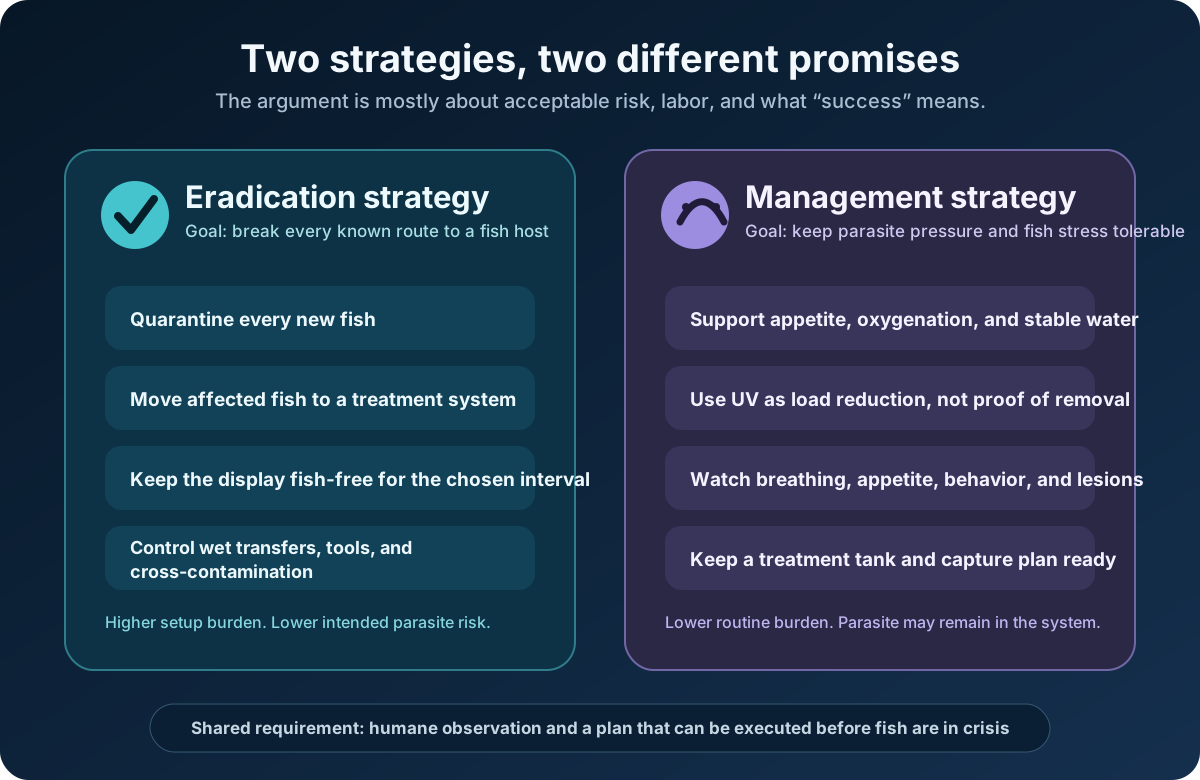
Strict quarantine and eradication are biosecurity strategies. They aim to keep Cryptocaryon irritans out of the display or to interrupt every route back to a fish host after exposure. That normally means a separate observation or treatment system, control of wet transfers, treatment selected for the fish and diagnosis, and a fish-free display interval chosen for the situation.
Ich management is a risk-management strategy. It accepts that the parasite may remain in the system and focuses on reducing parasite pressure, avoiding stress, maintaining oxygenation and appetite, and keeping an executable treatment plan ready. It can produce long stretches without visible disease. It cannot honestly certify that the display is parasite-free.
Neither strategy excuses poor welfare. A quarantine tank that is uncycled, unstable, or medicated blindly can harm fish. A management plan that means “hope the spots go away” is not a plan. The humane choice is the method you can execute correctly, monitor closely, and escalate before fish are in respiratory crisis.
Why this argument becomes personal
A reefer who lost a mature collection to a fast outbreak hears “management” as gambling with animals. A reefer who watched a delicate fish stop eating in a cramped treatment tank hears “quarantine everything” as a protocol that can create its own losses. Both experiences are real, but neither experience by itself settles the biology.
The disagreement also hides different definitions of success. The eradication camp calls success the absence of a known parasite pathway. The management camp may call success years of healthy, feeding fish without a visible outbreak. Those outcomes are not equivalent, even if the display looks identical on an ordinary day.
First, define the parasite correctly
Marine ich is caused by Cryptocaryon irritans, an obligate ciliate parasite of marine fish. It is not the same organism as freshwater ich. The familiar white spots are only one possible sign. Fish may flash, breathe rapidly, become lethargic, hang near the surface or bottom, produce more mucus, or show gill disease without obvious spots on the skin.
A photograph can support a differential diagnosis, but it cannot prove Cryptocaryon. Velvet, flukes, bacterial disease, mucus plugs, lymphocystis, sand, and physical injury can be confused with one another. UF/IFAS recommends microscopic examination of skin, fin, and gill samples when a definitive diagnosis is needed. Rapid breathing and escalating losses deserve expert help, not an internet vote on a blurry image.
The life cycle explains both the treatment problem and the fallow idea
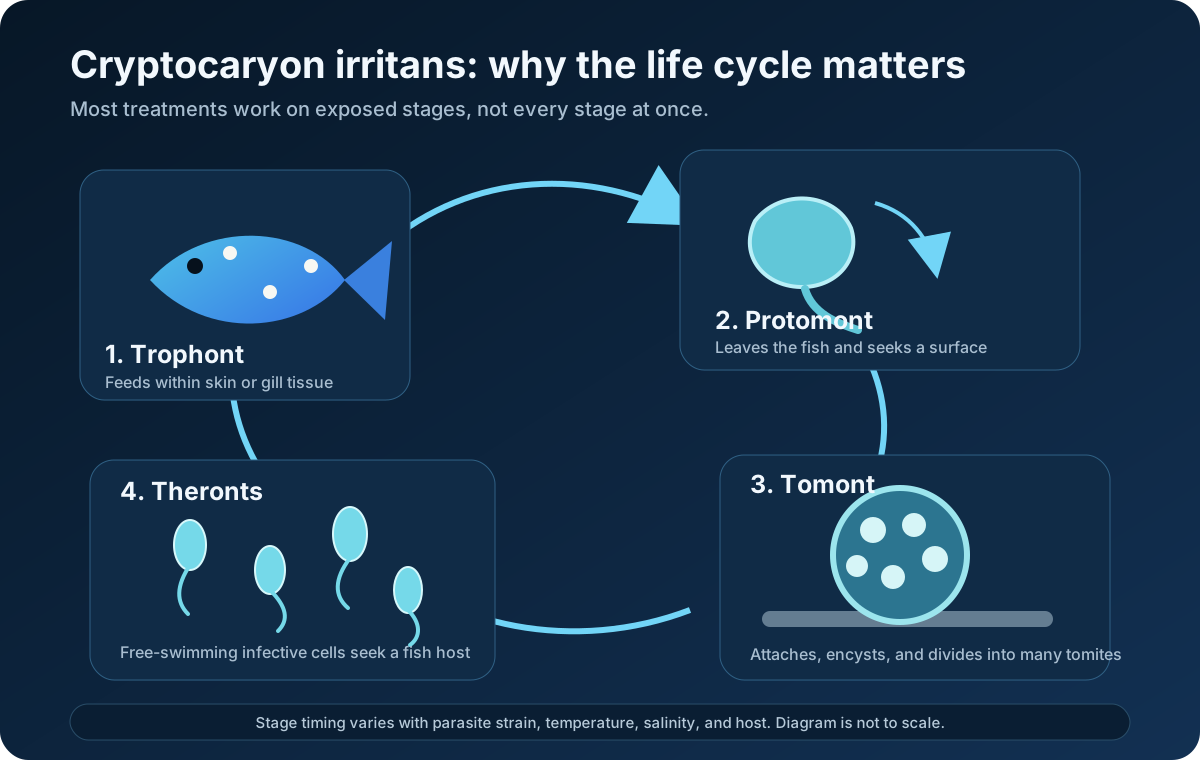
The trophont feeds within the fish’s skin or gill tissue. When it leaves, it becomes a protomont, attaches to a surface, and forms a reproductive tomont. The tomont divides and later releases free-swimming theronts that seek another fish host. The feeding and encysted stages are protected from many interventions. The free-swimming theront is the exposed stage targeted by most waterborne treatments.
That separation in time is why spots can disappear and return. A visible trophont leaving the fish is not the same as the infection being gone. Reproductive stages may still be attached elsewhere in the system, and newly released theronts can begin the next round.
UF/IFAS reports that the complete life cycle commonly averages one to two weeks but has ranged from six days to eleven weeks, largely because tomont development is variable. Temperature, salinity, parasite strain, and host all matter. That evidence supports prolonged quarantine and treatment windows, but it also warns against pretending one calendar number is a biological guarantee in every aquarium.
Observation is valuable, but clean skin is not a clearance test
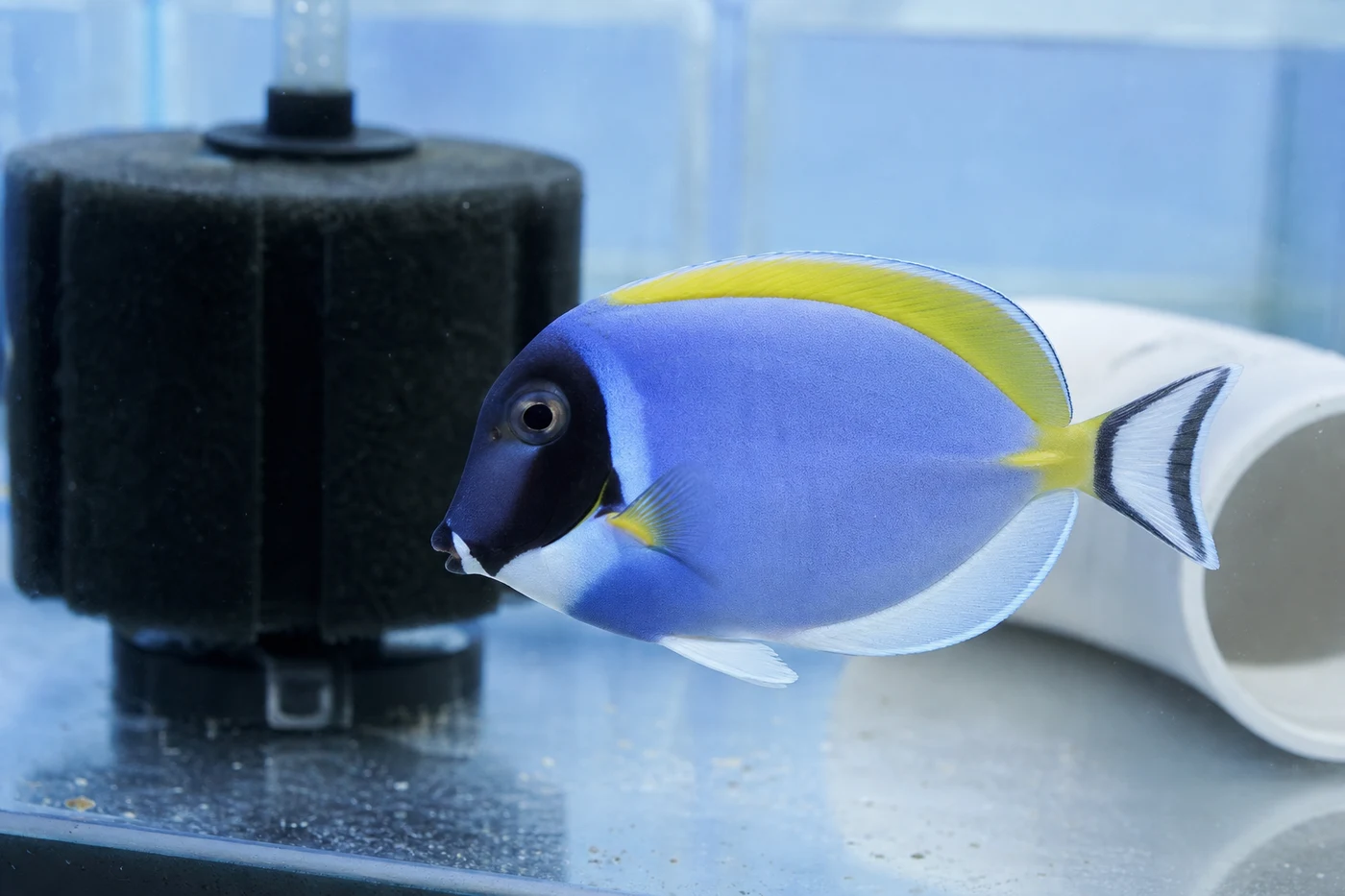
Observation gives a new fish time to recover from transport, establish appetite, reveal behavior, and show problems before joining a display that may be difficult to treat. It also lets the keeper learn what normal breathing, posture, color, and feeding look like for that individual.
The limitation is sensitivity. Gill-only disease may not create obvious spots, a low parasite burden may be missed, and a fish that survived prior exposure may carry parasites without severe visible disease. Research has demonstrated acquired protection after controlled infection in some fish, but full protection was not universal. UF/IFAS also notes that clinically healthy survivors may remain carriers.
This is the crucial distinction: observation reduces uncertainty; it does not prove sterility. Preventive treatment may reduce the chance of a missed infection, but medication also adds species-specific toxicity, measurement, appetite, and water-quality risks. The protocol has to fit the fish, not just the keeper’s ideology.
What a real eradication strategy requires
Eradication is more than putting the newest fish in a spare tank for a few days. It is a chain of biosecurity decisions. If one link is skipped, the keeper should describe the result as risk reduction rather than proof that the display is free of Cryptocaryon.
- A biologically mature, temperature-controlled, oxygenated quarantine or treatment system with secure shelter and a lid
- A plan for ammonia monitoring, water changes, feeding, species compatibility, and capture before the fish arrives
- Observation and diagnosis, with treatment selected for the suspected organism and the tolerance of the fish
- Separation of nets, hoses, algae clips, hands, droplets, and other wet transfers between systems
- A fish-free display interval after confirmed or strongly suspected exposure, chosen with the parasite’s variable life cycle in mind
- Quarantine or fish-free handling of corals, rock, substrate, and other wet materials that could carry attached tomonts from a fish system
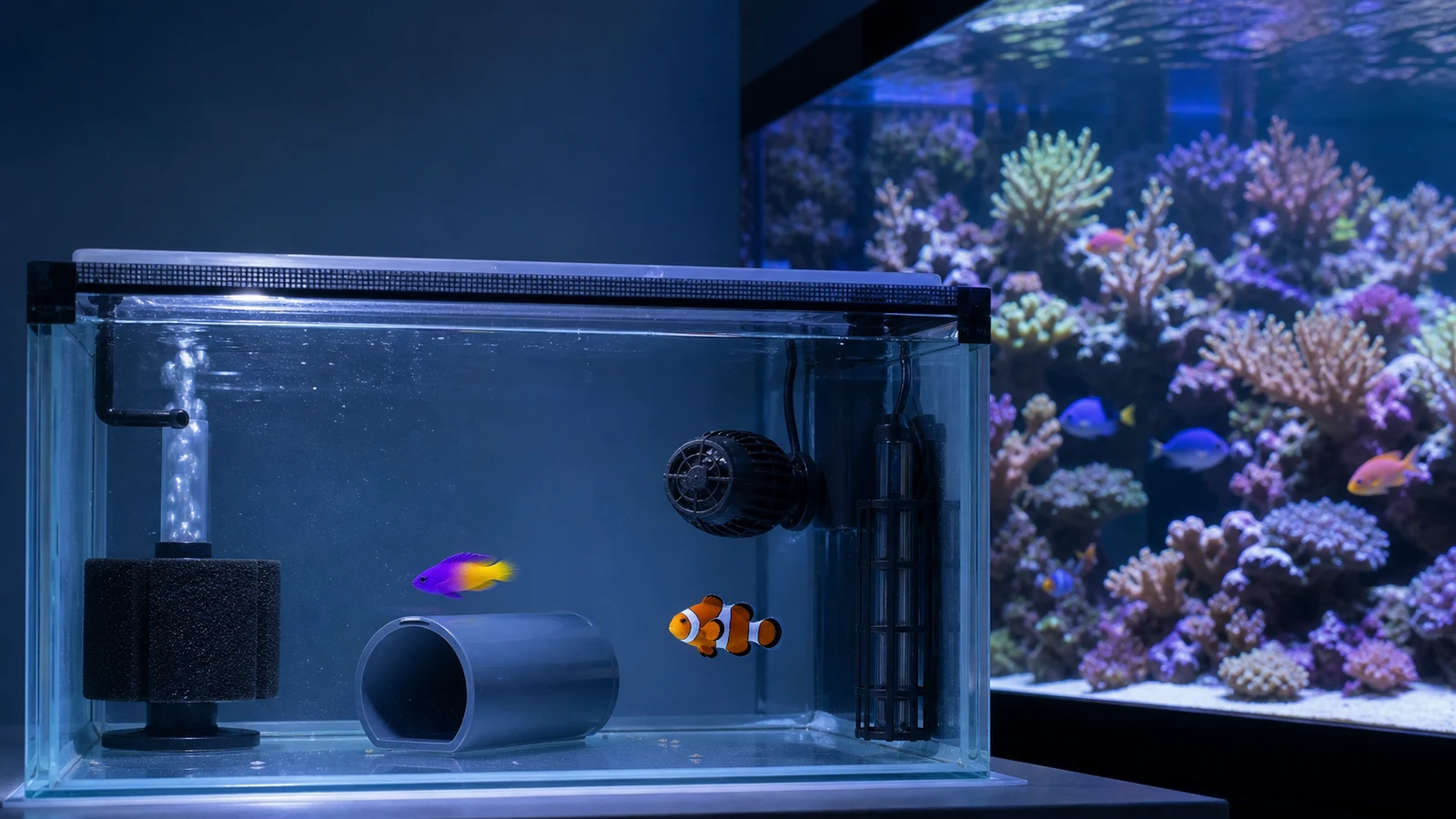
This method is strongest when the collection is valuable, the display is hard to empty, new fish arrive infrequently, and the keeper can maintain a stable second system. Its greatest weakness is execution. A new, undersized, poorly aerated quarantine tank can turn prevention into another welfare problem.
What responsible ich management actually means
Management is not a claim that healthy fish magically make parasites disappear. It is a decision to live with residual uncertainty while controlling factors that influence disease severity. UF/IFAS identifies parasite dose, fish species and age, immune status, prior exposure, temperature, and dissolved oxygen among the factors that affect the course of disease.
A responsible plan prioritizes stable water, strong aeration, adequate and varied nutrition, appropriate stocking, low aggression, and close observation. It may use a correctly sized and operated UV sterilizer to reduce organisms that actually pass through the unit. It also keeps a cycled treatment tank, capture tools, and a threshold for escalation ready before an outbreak.
The honest limitation is that apparent recovery does not prove removal. Fish can develop partial protection and still serve as carriers. A new, stressed, or immunologically naive fish can be the event that reveals a parasite population that had been visually quiet.
UV can reduce exposure, but it does not reach the whole life cycle
UV is one of the most misunderstood points in the debate. Laboratory and aquaculture research shows that sufficient UV exposure can inactivate Cryptocaryon stages. That supports UV as a real control tool, not a placebo.
Plumbing decides what the tool can touch. A theront must pass through the sterilizer at an effective dose. Trophonts inside fish tissue and tomonts attached to rock, sand, plumbing, or other surfaces are not sterilized by a unit sitting in the return line. Flow rate, lamp output, sleeve cleanliness, geometry, and turnover also determine delivered dose.
The defensible claim is that UV can reduce the number of viable waterborne stages that pass through it. The indefensible claim is that a clear display or a large wattage label proves eradication.
Copper and other treatments belong in a controlled treatment system
Copper is effective primarily against exposed infective stages and therefore must be maintained through enough life-cycle turnover to matter. It is also toxic to many invertebrates, can bind to carbonate materials and other surfaces, and has a therapeutic window that depends on the exact product and test method. A reef display containing coral, rock, sand, snails, shrimp, or other invertebrates is not an appropriate place to improvise copper treatment.
Hyposalinity, chloroquine, formalin, tank transfer, and other methods each have limits, species considerations, and operational risks. Some Cryptocaryon strains tolerate lower salinity better than others. Formalin affects oxygen. Transfer methods fail if tanks, tools, timing, or disinfection fail. Product directions, local rules, and aquatic-veterinary guidance matter.
This article intentionally does not provide a universal drug dose. Commercial copper formulations do not all report copper the same way, test kits are not interchangeable, fish sensitivities vary, and a concentration copied from the wrong method can be unsafe.
Where each side has the stronger argument
The best strategy depends on the promise you need and the system you can actually operate.
| Situation | Stronger starting strategy | Reason |
|---|---|---|
| New display with no fish introduced | Quarantine and biosecurity | Prevention is easier before a parasite has access to rock, substrate, and every fish |
| Large established collection after confirmed exposure | Coordinated treatment plus fish-free display | Treating one visibly affected fish leaves other hosts and off-host stages in place |
| Delicate new arrival that is feeding poorly | Stable observation with rapid diagnostic access | Immediate blanket medication may add risk, but the fish still needs separation and a defined escalation threshold |
| Display where removal is currently impossible and fish remain stable | Explicit management plan | Risk can be reduced while capture capacity, treatment space, and monitoring are improved |
| Rapid breathing, widespread signs, or rising losses | Emergency diagnosis and treatment | This is no longer a philosophical debate or a wait-and-see situation |
A practical decision framework
- Choose the promise first. Do you need prevention, attempted eradication, or ongoing risk reduction?
- Inventory the system honestly. Can every fish be caught? Is there stable treatment capacity? Can wet tools stay separate?
- Set welfare guardrails. Define how ammonia, oxygen, appetite, aggression, and drug concentration will be monitored.
- Write the escalation trigger. Rapid breathing, missed meals, spreading lesions, abnormal swimming, or a second affected fish should not depend on a new debate.
- Document arrivals, transfers, symptoms, treatment products, measured concentrations, water changes, and response.
- Do not upgrade the claim. “No spots for months” means no visible spots for months, not laboratory proof that no parasite remains.
The bottom line
The biology favors biosecurity: Cryptocaryon has protected stages, variable timing, and the ability to persist through carriers and attached tomonts. If the goal is the lowest practical chance of introducing it, quarantine and controlled wet transfers are the stronger strategy.
The welfare argument favors competence over slogans. A well-run management system may keep fish healthy for years, but it retains parasite risk. A well-run quarantine system can prevent catastrophic introduction, but only if it is mature, monitored, species-appropriate, and humane.
The most responsible reefer is not the loudest member of either camp. It is the person who names the goal accurately, understands what the method cannot prove, and has the next tank ready before a fish needs it.