
The short answer
Yes, you can build a monster aquarium stand out of steel. Yes, you can build it out of wood. You may also be able to use aluminum, masonry, concrete, or a purpose-designed composite system. None of those material names is a design calculation.
A good stand carries the tank load through a flat support surface, into beams and posts, through connections and bracing, into the floor structure, and finally into a foundation or soil that can accept it. A bad stand interrupts that chain somewhere. It can be made from gorgeous welded steel and still be twisted, under-braced, rusting, or poorly supported. It can be built from enormous timbers and still rack sideways because the connections and bracing are wrong.
This article is not a cut list and it does not certify my house or yours. At the 420-gallon scale, a qualified structural professional should review the aquarium, stand, floor framing, supports, connections, and foundation as one system. The point here is to kill the myth that steel is automatically engineering while wood is automatically a weekend gamble.
The internet loves a material more than a load path
Post a giant aquarium on a wood frame and somebody will zoom in, count the studs they think they see, and announce that the living room is doomed. Put the same tank on a skinny old metal frame and the word steel somehow receives a halo.
That is armchair engineering at its purest. Steel is strong, but it still bends. Welded frames can distort. Long rails can deflect. Slender legs can buckle. Unbraced rectangles can rack. Rust removes material. A weld, bolt group, gusset, foot plate, or connection to the deck can govern the result before the middle of a steel tube comes close to its limit.
Wood has its own failure modes. It moves with moisture, can split, crush perpendicular to grain, decay when kept wet, and lose capacity at poorly detailed fasteners. Big posts do not rescue a beam with the wrong span or a connection hanging from a few screws. The American Wood Council publishes an ANSI-approved structural design standard for wood because wood is an engineering material, not because every pile of lumber is automatically safe.
Why I rejected the steel stand that came with my tank
My current build is a roughly 420-gallon-class acrylic tank. It is about 80 inches long, 24 inches front to back, and 48 inches tall. It has to live on the first floor because the tank is far too large to fit down the basement stairs. Realistically, it never would have fit there in the first place.
The tank came with a metal stand that had apparently supported it for years. That history did not make the stand acceptable to me. The frame was rusted and visibly twisted. When the tank sat on it, the assembly wobbled and the contact did not feel right. The top had only a small number of cross supports across a large acrylic footprint.
I am not claiming that a photograph or a wobble test can calculate the stand capacity. I am saying I was not willing to build a multi-ton saltwater system on a used frame with unknown fabrication, visible corrosion, poor fit, and a geometry I did not trust. “It held before” is not an inspection report, and steel does not become immortal because it survived the last owner.
What I built instead
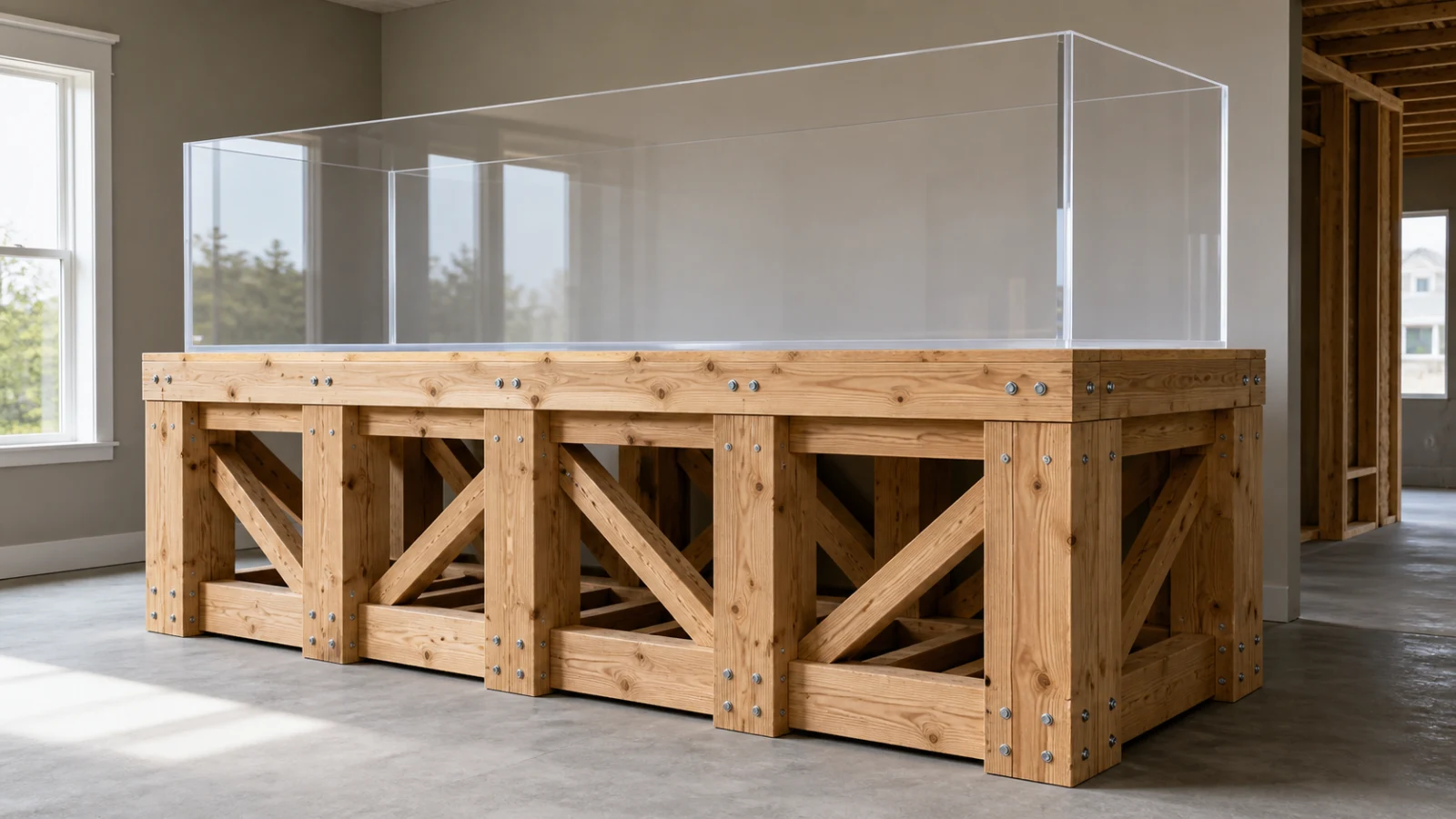
The replacement is intentionally excessive. The frame uses large 4x4 members, substantial 2x6 framing, and closely spaced 2x6 deck members across the footprint so the top support is not relying on one or two lonely crossbars. The final bearing surface still has to be flat and match the acrylic tank manufacturer’s requirements.
Below the first floor, I added posts or pylons intended to continue the load toward the concrete, wall-connected support, and additional members that act alongside the floor framing. The important idea is not that every reader should copy those parts. The important idea is that the aquarium stand does not stop at the carpet. The framing below it is part of the stand whether you planned for it or not.
Is the wood frame bigger than a carefully optimized design might need to be? Absolutely. I am comfortable admitting that. Extra member size can buy stiffness, bearing area, tolerance for small construction imperfections, and peace of mind. It does not replace checking spans, joints, bracing, floor framing, slab capacity, or the actual route to the foundation.
Start with the weight, not the argument
The U.S. Geological Survey uses about 8.34 pounds per U.S. gallon for water. At 420 gallons, the water alone is about 3,503 pounds. The acrylic tank, stand, rock, sand, plumbing, pumps, canopy, and any water in the overflow or connected system sit on top of that number.
That does not mean you can divide the total by the footprint, compare the result with a 40-pound-per-square-foot residential live-load table, and declare victory or disaster. The code table is a minimum uniformly distributed design load for floor use. An aquarium is a long-duration concentrated installation whose effect depends on joist direction, span, spacing, species or system, bearing walls and beams, post locations, connections, tributary area, foundation, and existing condition.
FEMA describes a load path like a chain that transfers force from one building part to the next until it reaches the foundation and supporting soil. That is the useful mental model here: acrylic bottom, bearing deck, stand framing, stand joints, floor sheathing, joists, beams or walls, posts, footing or slab, then soil. Every link matters.
Water-only weight using 8.34 pounds per U.S. gallon. These are starting points, not complete installed loads.
| Water volume | Approximate water weight | Still not included |
|---|---|---|
| 100 gallons | 834 lb | Tank, stand, rock, sand, equipment |
| 420 gallons | 3,503 lb | Tank, stand, rock, sand, equipment |
| 500 gallons | 4,170 lb | Tank, stand, rock, sand, equipment |
Acrylic changes the top of the stand
Tank construction matters as much as stand material. Many framed glass aquariums are designed to bear on their perimeter frame. Acrylic aquariums commonly require full support across the bottom, with adequate framing below that surface. Custom Aquariums makes this distinction directly in its installation guidance.
That means a steel rectangle with two crossbars is not automatically a correct acrylic stand. A flat structural deck, suitable interface material when the manufacturer specifies it, and support that limits deflection across the entire footprint can be more important than whether the frame below is black tube steel or natural lumber.
Follow the instructions for the actual aquarium. Do not add foam, plywood, shims, or perimeter support because a forum said every tank wants the same thing. Framed glass, rimless glass, and acrylic tanks can require different bearing conditions, and warranty requirements vary by manufacturer.
Why wood is a completely legitimate choice
Wood is strong for its weight, widely available, easy to cut and adjust on site, and forgiving for builders who understand ordinary framing. Structural lumber, plywood diaphragms, bolts, screws, straps, and rated connectors give a designer many ways to create direct bearing and lateral stiffness without hiring a welding shop.
A wood frame is also easy to modify around plumbing and sump access. You can add blocking, relocate a noncritical brace under professional direction, fasten a skin that contributes to racking resistance, and repair finishes with common tools. Thick members create broad bearing surfaces and can make the load path visually obvious.
Wood often wins on owner-built cost because the fabrication tools are common and field changes are inexpensive. That comparison changes if premium timber, extensive hardware, finish carpentry, waterproof lining, or professional labor is added. The cheapest pile of studs is not the final price of a durable cabinet.
- Common material and tools, with no welding equipment required
- Easy field adjustment for plumbing, access panels, and equipment
- Large bearing areas and visually direct vertical load paths
- Structural panels can provide both a continuous top and lateral resistance when designed correctly
- Simple to inspect, reinforce, refinish, or repair without moving the frame to a fabrication shop
What wood makes you manage
Water is not a theoretical exposure under a reef tank. There will be salt creep, spills, condensation, wet equipment, and the occasional fitting that behaves perfectly until the room is empty. The USDA Wood Handbook explains that wood exchanges moisture with its environment and that coatings slow moisture change rather than stopping it completely.
A good wood stand therefore needs dry, graded material; sensible grain orientation and bearing; connections that respect edge distance and splitting; a finish or liner appropriate to repeated moisture; ventilation; and access for inspection. End grain, cut edges, fastener penetrations, and the floor contact deserve attention. Standing water must have somewhere visible and safe to go.
Wood can also consume more interior space. A brutally overbuilt 4x4 or 4x6 frame is wonderful until a sump, skimmer cup, filter roller, or plumbing union cannot pass between the posts. Build the service path on paper before celebrating the amount of lumber.
Why steel is an excellent choice too
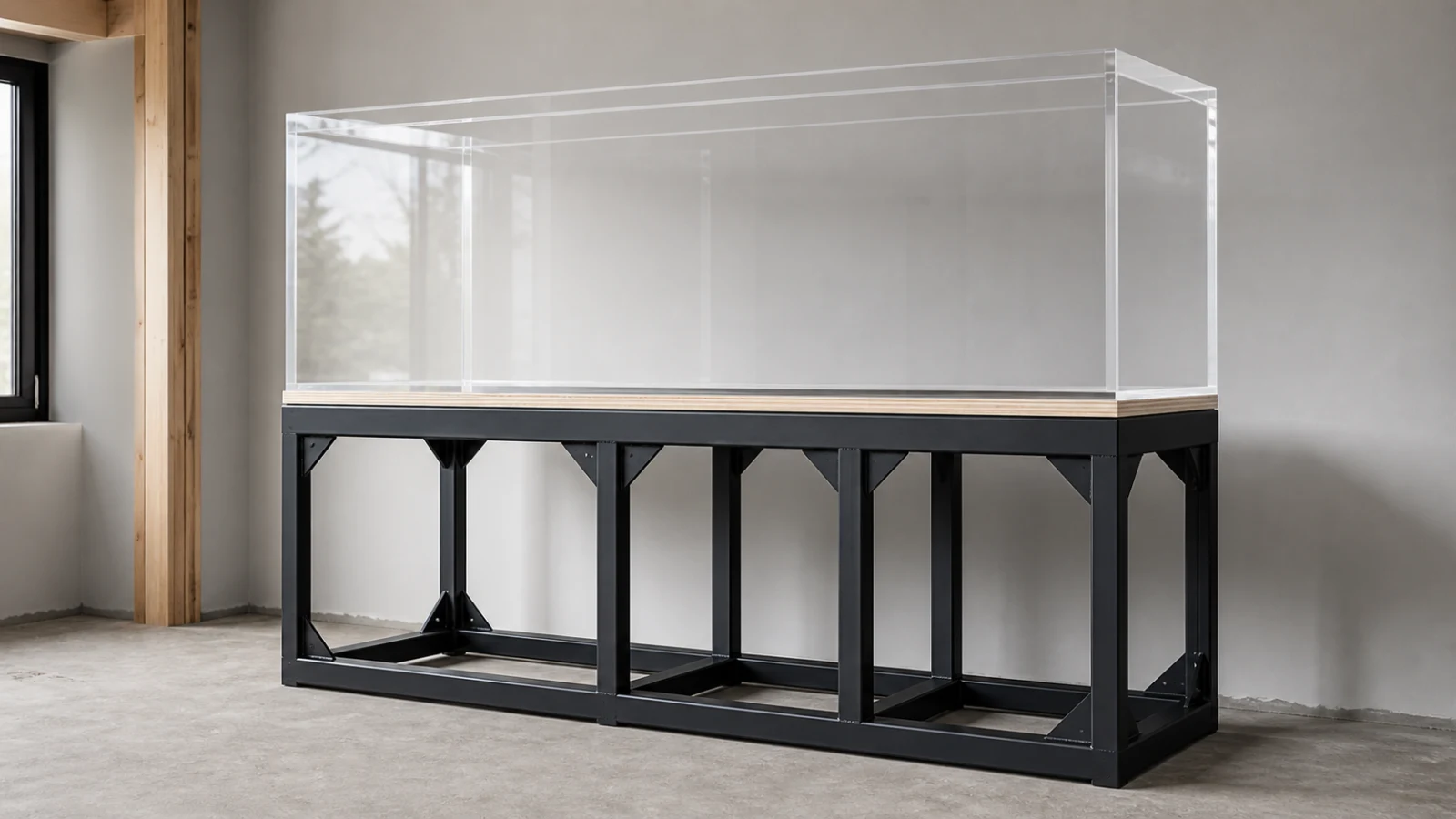
Steel can carry large loads with much slimmer members than a comparable heavy timber frame. That can create open spans for sumps, plumbing, and maintenance. A fabricator can build precise welded or bolted assemblies, add gussets where needed, and integrate removable panels without filling the cabinet with posts.
Steel is dimensionally consistent and lends itself to formal drawings and shop fabrication. When the sections, welds, bolts, bracing, bearing plates, top deck, and corrosion system are all specified together, it can produce an elegant and extremely stiff stand.
The key phrase is “specified together.” A row of square tubes is not a complete design. Neither is a beautiful weld bead. Long-term deflection, lateral stability, heat distortion from welding, contact with dissimilar metals, foot-plate bearing, coating access, and the support required by the tank still have to be resolved.
- High strength and stiffness in relatively compact members
- More open cabinet volume for large sumps and removable equipment
- Shop fabrication can deliver repeatable geometry and integrated brackets
- Bolted sections can be designed for transport into difficult rooms
- A clean frame can accept removable skins without making cabinetry structural by accident
The saltwater problem steel does not get to ignore
Bare structural steel corrodes when the environment provides moisture and oxygen. Salt contamination makes aquarium service especially unforgiving. The American Institute of Steel Construction notes that corrosion protection has to be chosen for the actual exposure, detailed to avoid water-trapping crevices, and maintained over the service life.
Powder coating, paint systems, galvanizing, stainless alloys, and other approaches can all be appropriate in the right design. None is a force field. A scratch, drilled hole, weld repair, unsealed tube end, trapped salt creep, or hidden wet crevice can become the place corrosion starts. Coating choice also affects fabrication sequence and how future repairs are made.
This is where lifecycle cost enters. The steel price is only one line. Surface preparation, welding, transport, powder coating or another corrosion system, deck material, touch-up products, inspection access, and eventual maintenance belong in the budget. Stainless steel can reduce some corrosion concerns, but material and fabrication costs rise and grade selection still matters.
Wood vs. steel cost is not one number
There is no honest universal price winner. Lumber and steel prices move. Skilled welding costs vary by region. A local fabricator with an existing jig may beat a finish carpenter. A DIY wood frame may be inexpensive, while furniture-grade cabinetry around it costs more than the structure. A steel frame shipped in sections may save the move that a giant wood frame makes impossible.
Compare complete systems at the same level of finish and certainty. Include the engineer, drawings, fasteners, deck, coating or waterproofing, cabinetry, delivery, field changes, floor work, and access plan. Leaving the expensive parts out of one column is how material debates become propaganda.
Typical trade-offs. Actual design, labor market, finish, and access can reverse any cost assumption.
| Decision factor | Wood stand | Steel stand |
|---|---|---|
| Raw structure | Often lower for an owner-built frame | Compact, but section and plate costs vary |
| Fabrication | Common saws, drills, clamps, and rated connectors | Skilled welding or a designed bolted system |
| Moisture protection | Sealer, paint, liner, ventilation, inspection | Surface prep, coating system, touch-up, inspection |
| Interior access | Large members and extra posts can crowd equipment | Slim members can leave wide service openings |
| Field changes | Usually simple with common tools | May require drilling, grinding, welding, and coating repair |
| Transport | Can be built in place, but may become bulky | Can be modular, though welded frames may be heavy and awkward |
| Finish cabinetry | Easy to attach directly, but moisture detailing matters | Often uses separate removable panels or clips |
| Professional review | Belongs in the budget | Belongs in the budget |
The particleboard irony
Here is the part that makes the argument funny. The aquarium market has sold manufacturer-designed stands made from heavy fiberboard and water-resistant laminate for years. Aqueon has described stands built that way, and hobbyists routinely put substantial glass tanks on engineered cabinet assemblies without demanding a welded bridge underneath.
That does not mean wet particleboard is secretly invincible. It means material thickness viewed in isolation tells you very little. A thin panel can carry load as part of a tested cabinet with short spans, edge bearing, a solid back, controlled geometry, and a tank it was designed to fit. The same panel with water damage, missing fasteners, a cut-out back, or the wrong footprint may be unacceptable.
So yes, it is a little absurd to accept a factory fiberboard cabinet on sight and then declare that a properly designed frame built from 4x4s, 4x6s, 2x6s, structural panels, and appropriate connections cannot possibly work because it is wood. The logo on the door is not a substitute for understanding the assembly.
Could you use another material?
Possibly. Aluminum extrusion can create a light, corrosion-resistant modular frame, but connection slip, bracing, alloy, section stiffness, galvanic contact, and fastener choices matter. Welded aluminum requires the right process and design assumptions. “It does not rust like steel” is useful, but it is not a capacity check.
Concrete or masonry can provide enormous mass and moisture tolerance for a permanent installation, especially on a slab. It also makes future access, plumbing changes, and removal difficult. Structural composites and fiberglass-reinforced systems can work in wet environments when they are engineered for sustained load, connection behavior, and fire or code requirements.
The same rule survives every material change: define the load, the bearing condition the tank requires, the spans, the vertical and lateral paths, the connections, the environment, the floor and foundation, and the inspection plan. Then choose a material system that solves those jobs.
What overbuilt does and does not mean
“Overbuilt” is useful shorthand, but it is not a calculation. Bigger members can reduce deflection, spread bearing, improve stiffness, and create redundancy. They can also add dead load, hide bad connections, crowd equipment, and make the stand harder to level or move.
The strongest member in the stand does not set the capacity when another link is weaker. A 4x6 post cannot help a rail that is attached to its side with inadequate fasteners instead of bearing directly. A massive steel tube cannot help a frame that racks because every bay is an unbraced rectangle. Ten coats of paint cannot protect a sealed tube that is already rusting from the inside.
The mature version of overbuilt is not “I used the biggest material at the store.” It is “I removed obvious weak links, kept the load path direct, limited movement, protected the material from the environment, and left the whole system inspectable.”
My definitive answer
Can steel make a superb aquarium stand? Yes. Can wood make a superb aquarium stand? Also yes. Can either one make a dangerous stand? Easily.
For my 420-gallon acrylic build, the used steel frame lost the argument because it was twisted, rusted, wobbly, poorly matched to the support condition I wanted, and of unknown history. The new wood frame earned my confidence because I could control the materials, geometry, bearing, connections, deck support, and the work below the floor. That is a decision about two actual systems, not a referendum on every steel or wood stand ever made.
If someone tells you a monster aquarium must be steel, ask about the section sizes, spans, welds, bracing, corrosion system, deck, floor, foundation, and tank support requirements. If someone tells you a pile of 4x4s cannot fail, ask the same questions. The material is one line in the design. It is not the design.
For a first-floor aquarium weighing several thousand pounds, bring the tank drawing, full installed-weight estimate, stand drawing, floor-framing information, and support plan to a licensed structural professional familiar with the local code. An internet article cannot see your joists, foundation, connections, damage, or soil.