TL;DR
Many hobbyists keep more than one kind of aquarium. Reef Trak supports reef tanks, freshwater community tanks, planted tanks, and custom setups, so the same app can hold the history for a reef display, freshwater tank, planted tank, office tank, quarantine tank, or grow-out system.
You do not give anything up on the reef side. Guided dosing, ICP imports, controller imports, reports, photos, dosing history, and livestock tracking are all still there. Freshwater and planted support sit alongside them.
Most aquarium keepers do not stay in one lane
The hobby rarely stays tidy. A reef keeper sets up a quarantine tank, then a freshwater tank for the kids, then a planted nano on the desk, then a frag tank in the garage. A freshwater keeper gets curious about a planted scape, then a shrimp tank.
Each of those tanks has its own history worth keeping, and splitting that history across different apps or scattered notes is how details get lost. The same person ends up tracking three tanks three different ways.
A single app that understands more than one kind of tank solves a real problem: one place, one set of habits, one record for everything you keep.
Why one aquarium app is better than scattered notes
Scattered notes cannot connect to each other. A spreadsheet for the reef, a notes app for the freshwater tank, and photos buried in your camera roll add up to a record you will never actually read back.
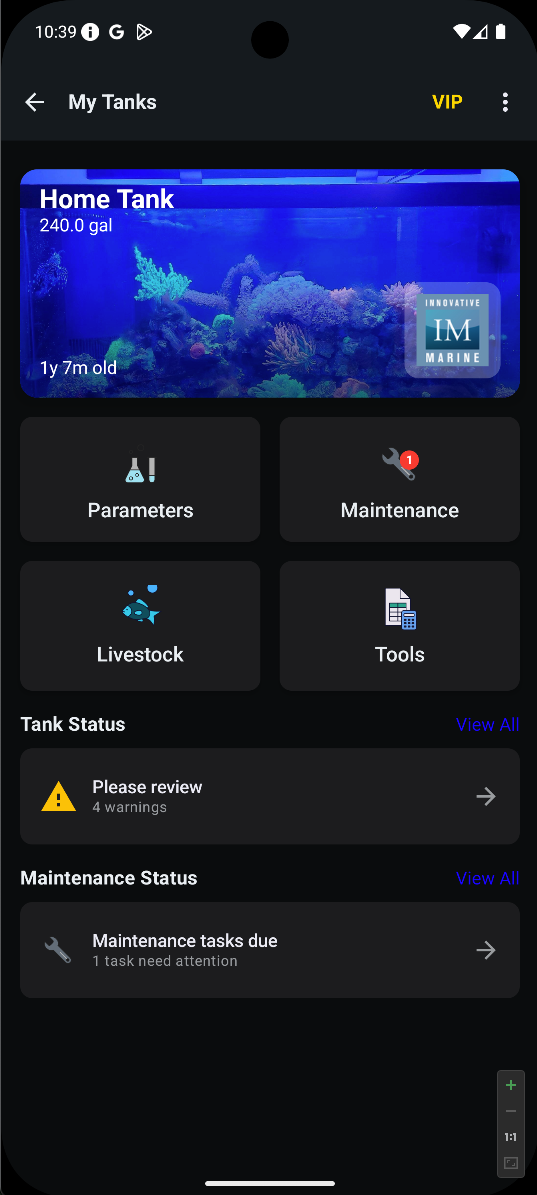
One app gives every tank the same structure: parameters with trends, maintenance with reminders, livestock with dates and photos, and notes that stay attached to the right tank. When you sit down to check on any tank, the history is right there in a form you already know how to read.
It also means your habits transfer. The routine you build for the reef works the same way for the planted tank, which makes you more consistent across all of them.
Reef Trak supported tank styles
Reef Trak now spans saltwater and freshwater. Whatever the tank, it gets a proper home with parameters, maintenance, livestock, photos, and notes tuned to what that tank actually needs.
The tank styles Reef Trak supports, what matters most for each, and what the app helps you track.
| Tank type | What matters most | What Reef Trak helps track |
|---|---|---|
| Reef tank | Alkalinity, calcium, magnesium, nutrients, stability | Parameters, guided dosing, ICP, controller imports, livestock, photos |
| Freshwater community | Ammonia, nitrite, nitrate, pH, temperature | Parameters, water changes, livestock, maintenance, photos |
| Planted tank | Nutrients, CO2, light, plant health | Parameters, dosing and fert logs, maintenance, photo progress |
| Shrimp tank | Stability, GH and KH, nitrate, temperature | Parameters, water changes, livestock notes, photos |
| Quarantine tank | Ammonia, treatments, observation | Parameters, treatment notes, livestock, dated photos |
| Office tank | Low-touch maintenance and reminders | Maintenance schedule, parameters, livestock, photos |
| Frag / grow-out tank | Parameter stability and growth tracking | Parameters, dosing, coral records, photo timeline |
| Custom tank | Whatever your setup needs | Flexible parameters, maintenance, livestock, photos, notes |
Freshwater parameters to track
Freshwater chemistry is different from reef chemistry, and the parameters that matter shift accordingly. For most freshwater and planted tanks the core list is:
- Ammonia and nitrite, especially while a tank is cycling
- Nitrate, the long-term nutrient to manage with water changes
- pH, along with GH and KH for hardness-sensitive livestock
- Temperature, the stability baseline
- For planted tanks, fertilizer dosing and CO2 alongside the above
Reef Trak gives freshwater tanks the same parameter trends, stale-data flags, and maintenance reminders that reef tanks get, tuned to what a freshwater or planted tank actually needs.
Reef parameters to track
On the reef side, nothing changes. The depth that built Reef Trak is still there: alkalinity, calcium, magnesium, nitrate, phosphate, salinity, temperature, pH, and trace elements through ICP.
Reef tanks also keep their full toolkit of dosing logs, ICP imports, read-only controller imports, expense tracking, and a livestock catalog with care info. Adding freshwater support did not water down the reef experience. It extended the app outward.
How guided dosing fits reef tanks specifically
Guided dosing is a reef feature, and it stays focused on reef chemistry. Reef Trak takes your reef parameter results, compares them to recommended target ranges, and helps guide what should be dosed to move them back toward range, connected to your dosing history and the rest of the tank record.
Freshwater and planted tanks get the parameter tracking, maintenance, fertilizer logging, and livestock tools that suit them, while the reef tanks keep the guided dosing built around reef chemistry. Each tank type gets the tools that fit it.
Why freshwater support strengthens Reef Trak
Adding freshwater is not a dilution of the reef focus. It reflects how people actually keep aquariums, with more than one tank and more than one type.
Reef Trak 2.3.0 added major freshwater support, expanded languages, and Web Portal ICP import improvements. The reef tools that serious reefers rely on are intact, and now the same record-keeping discipline reaches every tank in the house.
Why this helps multi-tank hobbyists
If you run several tanks, one app means one set of habits and one place to look. You switch between a reef display, a planted scape, and a quarantine tank without switching tools or hunting for where you wrote something down.
It also makes each tank easier to keep consistent, because the routine is identical across all of them. Consistency is most of what keeps any aquarium healthy, reef or freshwater.
Final recommendation
If you only keep one reef tank, Reef Trak is still built for you, with the deepest reef toolset it has ever had. If you keep more than one kind of tank, the case is even stronger: one app, one history, every tank.
Reef Trak has a free core experience, with an optional one-time lifetime Premium unlock rather than a monthly subscription, so the record for every tank you keep stays yours for the long run. Some people search for it as ReefTrak without the space, and it is the same app. Love your reef. Trak it.