A bridge connects two different jobs
Home Assistant is a smart-home platform. It discovers compatible devices and services, represents their readings and states, preserves history, and supports dashboards and automations. An aquarium management application has a different job: tracking the tank’s parameters, livestock, equipment, dosing, maintenance, notes, photos, and long-term care.
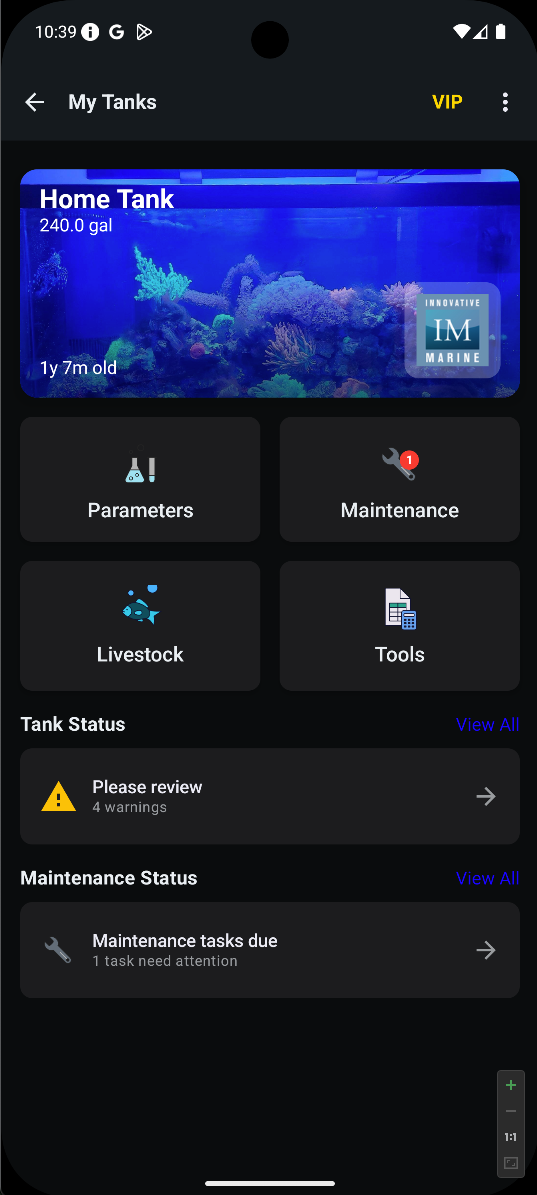
A Home Assistant bridge lets the aquarium application receive selected information from the smart-home system. In Reef Trak, the keeper pairs one tank, selects the relevant Home Assistant devices and readings, and sees those values inside the tank’s management view.
The bridge does not copy the whole house and does not replace the Home Assistant dashboard. It creates a narrow connection for aquarium context.
Each part of the connection keeps a distinct responsibility.
| Part | Responsibility |
|---|---|
| Physical device | Measures or reports equipment behavior |
| Home Assistant integration | Turns supported device data into entities |
| Reef Trak Bridge | Sends selected aquarium readings through an outbound encrypted connection |
| Reef Trak | Displays selected information inside the matching tank record |
| Reef keeper | Chooses devices, interprets evidence, and maintains the system |
Selection is the privacy boundary
A Home Assistant installation can contain locks, cameras, room sensors, people, media players, and hundreds of unrelated household entities. An aquarium app does not need them. During Reef Trak setup, Home Assistant presents the devices and then the readings beneath those devices. The keeper selects what belongs to the tank.
The bridge sends the chosen display name, state or numeric value, unit, availability, timestamps, and limited display details needed for the aquarium card. It does not upload the complete Home Assistant inventory, username, password, unchecked devices, camera images, room names, or location data.
The connection starts outbound from Home Assistant. It does not require opening a listening port or exposing the Home Assistant server directly to the internet.
The bridge is intentionally selective.
| Included for selected aquarium readings | Not included |
|---|---|
| Device display name | Home Assistant username or password |
| State or numeric value and unit | Complete device and entity inventory |
| Availability and timestamps | Unchecked household devices |
| Allowed details such as wattage or target temperature | Camera images, room names, GPS, or location |
| Bridge connection status | Unchecked household devices or arbitrary service calls |
Why not simply open Home Assistant
Home Assistant remains the better place to configure and administer connected devices. Reef Trak is useful when the aquarium information needs to sit beside the reef’s other evidence. A pump power change can be compared with maintenance. A temperature trend can be viewed beside equipment and parameter history. An offline device can be interpreted in the context of one specific tank.
The advantage is not that the same number appears on another screen. The advantage is that the selected number is attached to the aquarium record already used to understand care and change over time.
How Node One adds focused local control
The bridge carries selected Home Assistant information into the tank record. Node One adds a local control surface for compatible switch entities, including supported smart plugs and pumps.
Each on or off request is explicit. Node One confirms the reported result, checks power feedback where available, and does not automatically retry failed commands. Home Assistant remains the place for device setup and owner-configured automations.
The plain-language definition
A Home Assistant bridge for an aquarium app is a connector that lets the keeper choose aquarium-relevant device information in Home Assistant and view it inside the application used to manage the tank.
For Reef Trak, that means selected live values, status information, power readings where provided, recent numeric history, and connection state can appear on iOS, Android, and web beside the reef’s other records. Home Assistant remains the source, and Reef Trak remains the aquarium context layer.