
I've been watching something happen in the reef aquarium community over the past year, and frankly, it's becoming a little ridiculous.
It seems like every week another reef aquarium app shows up. Another developer announces their new platform, another Facebook post promises something revolutionary, and another subscription service wants reef keepers to sign up and start paying.
And almost every time, I find myself looking at the features and thinking, haven't we already done all of this?
Water parameter tracking, livestock management, maintenance reminders, dosing calculators, ICP testing, achievements, AI assistants. The lists are becoming practically interchangeable.
Now, before anyone gets the wrong idea, I have absolutely nothing against competition. I've been developing reef aquarium software for years, and I welcome anyone who has a good idea and wants to contribute something useful to the hobby.
But I do have a question.
Where is the innovation?
Because creating another application with essentially the same features as the last five applications doesn't really move the industry forward.
Do Your Homework Before You Build Something
One of the wonderful things about modern software development is how accessible it has become.
AI development tools have made it possible for people with little traditional programming experience to build functional applications. I use AI-assisted development myself, and I think it's fantastic technology.
But just because you can build something doesn't necessarily mean you've identified a need for it.
Before I started developing new products, I spent considerable time researching what was already available. What were other companies doing? What problems had they solved? Where were the gaps? Was there something meaningful I could offer that didn't already exist?
That's basic research.
Yet I keep seeing new reefing applications appear that seem to have skipped that step entirely.
The developer builds a parameter tracker, adds a livestock list, throws in an AI chatbot, and announces it as something completely new.
Meanwhile, several existing applications have offered nearly identical functionality for years.
I'm not suggesting those developers shouldn't build their applications. Everyone has to start somewhere.
But wouldn't it make more sense to identify a problem that hasn't already been solved?
I would genuinely love to see a new developer introduce something that makes me say, "Wow, I never thought of that."
That's what makes competition exciting.
Stop Using Other Developers' Feature Lists as Your Roadmap
This is something I've personally found frustrating.
Over the years, I've invested an enormous amount of time developing ReefTrak. Some features came from my own experiences maintaining reef aquariums. Others came from customers who needed something that wasn't available. And some came from simply sitting down and trying to figure out a better way to solve a problem.
I've maintained a public ReefTrak Innovation Timeline documenting our development history, including when particular features and technologies were introduced.
Part of the reason I created that page was to show what an independent developer could accomplish by continuously looking for ways to improve the hobby.
But there's another reason.
I've watched competing applications introduce features remarkably similar to things we've already developed. Sometimes the timing is interesting. Sometimes the similarities extend beyond individual features into entire groups of functionality.
An achievement system appears. Another app announces achievements. Business management gets introduced. Another platform announces business management. Similar things happen with integrations, parameter tracking, and various other features.
After seeing this happen repeatedly, it becomes frustrating.
Look, nobody owns the concept of an achievement system or an ICP test importer. These are software features, and there's nothing wrong with different applications offering similar capabilities.
But when your entire roadmap appears to consist of watching what somebody else releases and reproducing it, I have to wonder what you're actually contributing.
We need people developing new ideas, not everybody racing to reproduce the same ones.
And yes, I understand that there's only so much you can do with an aquarium tracking application. We're all working with the same water chemistry, the same basic maintenance requirements, and many of the same equipment manufacturers.
That's exactly why creativity matters.
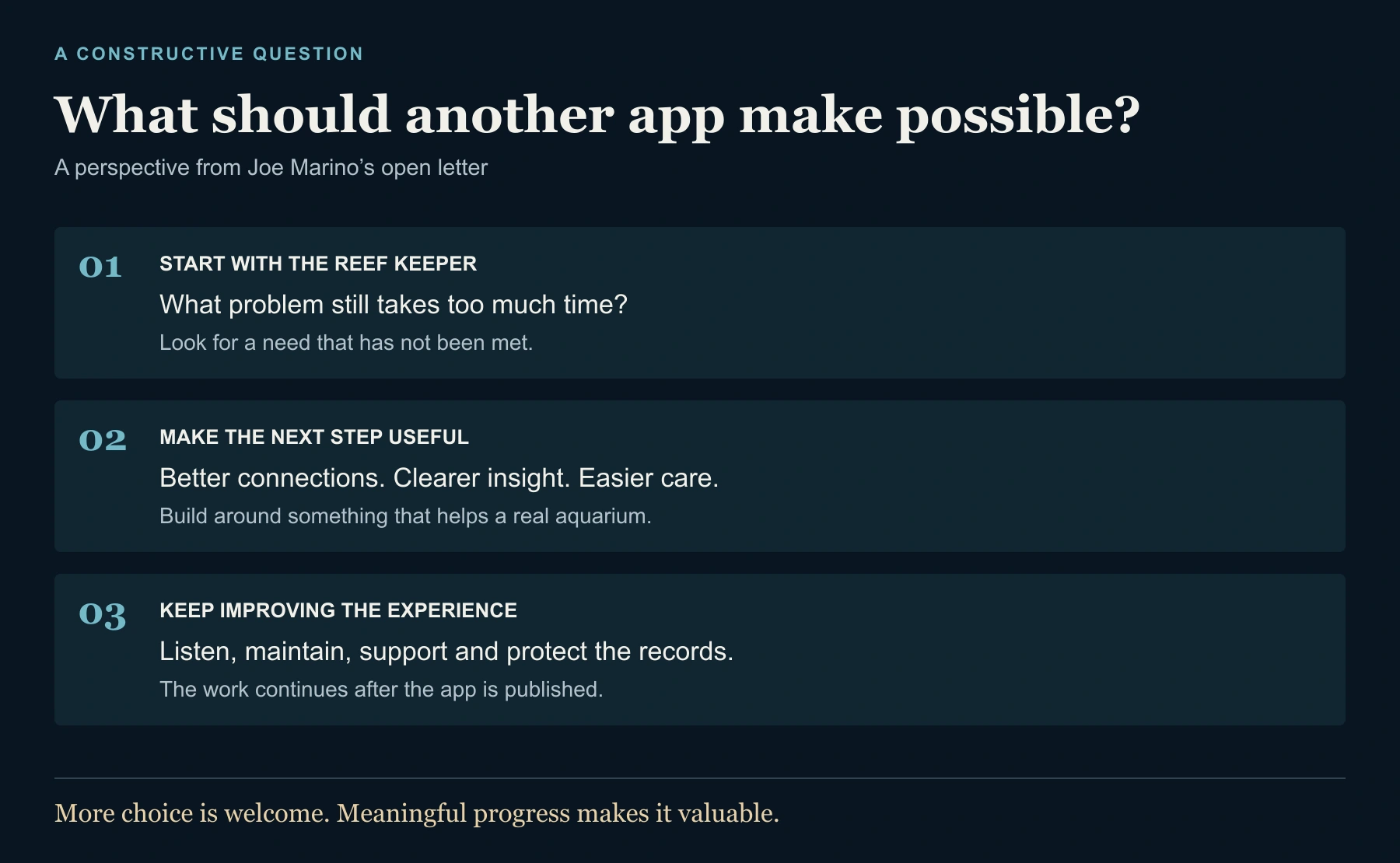
If every application eventually has the same features, what reason does a customer have to choose one over another?
That brings me to something I think many new developers are overlooking.
Your Customers Matter More Than Your Feature List
I've received negative reviews. I've had customers complain about missing features, broken functionality, and things that didn't work the way they expected.
Sometimes those complaints were justified.
Sometimes they were about something I could correct in an afternoon.
I've had people leave one-star reviews, and rather than getting into an argument, I looked into the problem, corrected it, and explained what I had done.
In one case, a customer actually went back and changed their one-star review to five stars after I addressed the issue. They even updated their review to explain why they'd changed their opinion.
That means something to me.
Here's someone who was genuinely unhappy with what they'd purchased. They complained, I listened, and we worked it out.
That's how you earn someone's trust.
And I think some of the newer developers entering this industry could learn something from that.
A Facebook Exchange I Couldn't Believe
I recently witnessed something in a reef-keeping Facebook group that genuinely bothered me.
A developer was criticized publicly over the subscription price of their application. I was following the discussion myself. Someone commented that the subscription seemed rather expensive for what the app offered.
I eventually left the discussion, but later received a Facebook notification that brought me back to the thread.
What I saw absolutely floored me.
The developer had gone to the customer's personal Facebook page, found a photograph of his car, and posted it in the discussion, essentially arguing that someone who could afford that car shouldn't complain about the price of his application.
The customer was understandably upset and questioned why the developer was bringing his personal property into a discussion about software pricing.
I watched this exchange myself. This wasn't something somebody told me about.
And frankly, I thought the developer's behavior was completely unacceptable.
What somebody drives, where they live, or how much money they earn has absolutely nothing to do with whether they believe your software is worth its asking price.
They're entitled to that opinion.
If your response to legitimate criticism is to investigate someone's personal life and use it against them publicly, you've got a much bigger problem than your subscription pricing.
Customers should never have to worry that criticizing an application will make them the target of its developer.
Let's Talk About Subscriptions
Here's another subject that's probably going to irritate a few developers.
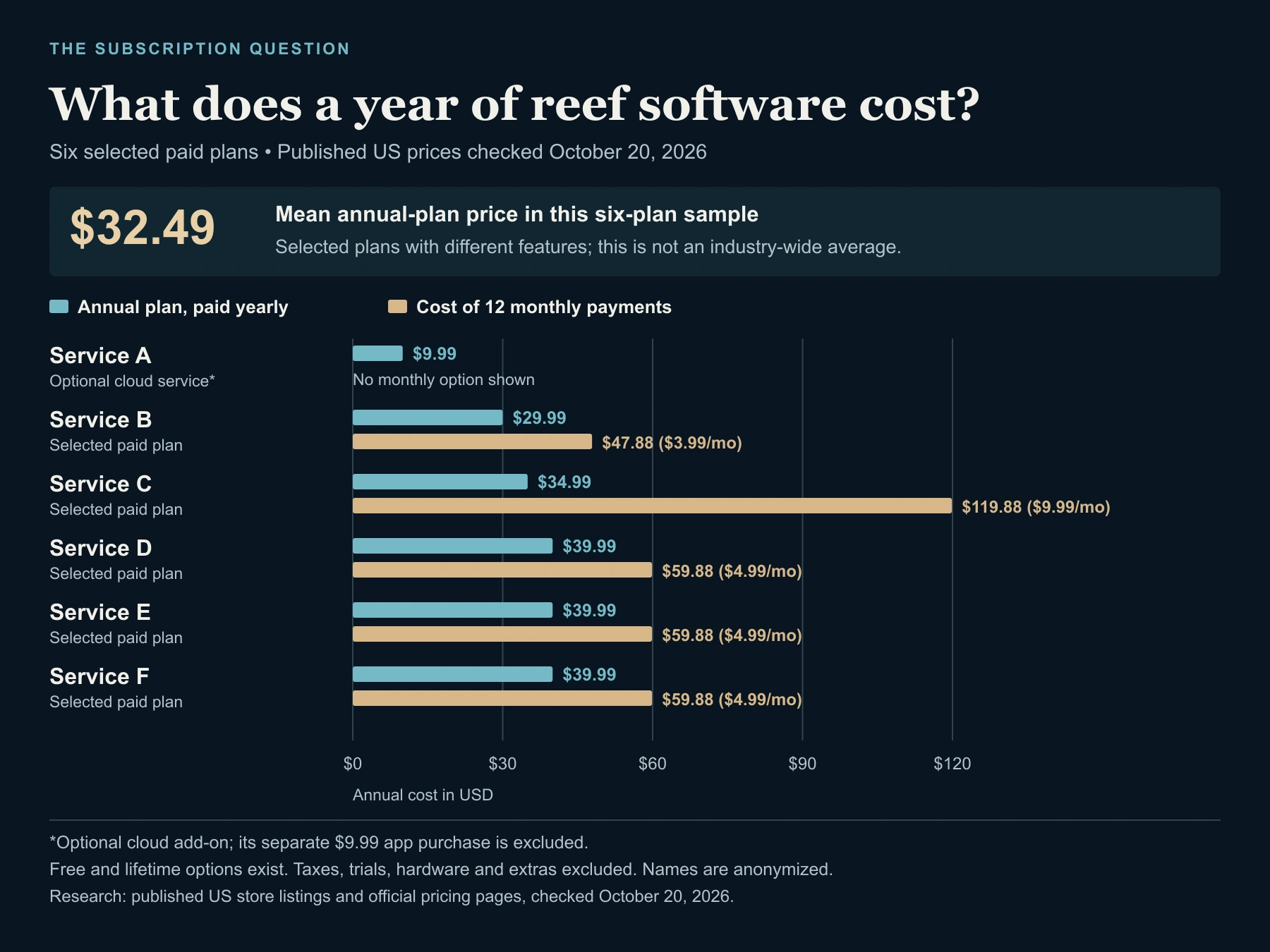
I'm watching new reefing applications launch with subscriptions costing $6.99 a month, $10 a month, or $70 or more a year.
And I have to wonder what exactly justifies those prices.
I currently have more than 5,500 ReefTrak users, and my backend infrastructure costs me only a few dollars a month for the services and usage patterns I've built around.
Now, before someone jumps on that statement, I understand that every application is different. Hosting, bandwidth, storage, AI processing, development, support, and other operating expenses all vary.
I'm certainly not suggesting software development is free. I've invested thousands of hours into my own products.
But I think consumers have every right to question whether another recurring subscription represents good value.
If you're charging $70 a year for water parameter logging, livestock tracking, reminders, and access to an AI assistant, customers are going to compare that against applications that offer similar functionality for significantly less.
And they should.
Some developers seem to have built their applications almost entirely around an AI service. That's fine if it's what they want to create, but connecting a chatbot to aquarium-related information doesn't automatically justify an expensive subscription.
If AI processing is driving your operating costs, perhaps consider making those features optional rather than requiring every customer to subsidize them.
I deliberately chose a lifetime purchase model for ReefTrak because I wanted people to buy the application and continue using it without another recurring bill.
That model works for my business. It may not work for everyone, and I respect that.
But reef keeping is already an expensive hobby. Salt, equipment, livestock, food, supplements, electricity, and maintenance supplies aren't getting cheaper.
The last thing we need is a growing collection of nearly identical applications, each asking for another monthly payment.
Developers are free to set their prices. Customers are equally free to question them.
And developers need to be prepared to hear those questions without taking them personally.
Facebook Groups Aren't Your Personal Advertising Platform
This is another thing I've been noticing more and more.
Someone develops a new application, joins a dozen reef aquarium Facebook groups, and immediately starts advertising it everywhere.
Sometimes they've never participated in the group before. They've never answered a question, helped another hobbyist, or contributed anything to the community.
Their first interaction is essentially, "Hey everybody, here's my new app. Sign up!"
And then they repeat the same post across every group they can find.
Some groups only permit promotional posts on Fridays. Others have strict rules against advertising, and some moderators expect developers to establish themselves as contributing members before promoting a product.
Those rules deserve to be respected.
If you're entering a community because you want its members to become your customers, perhaps start by becoming part of that community.
Help somebody with an aquarium problem. Share your experience. Answer questions. Participate in conversations that have absolutely nothing to do with selling your product.
Let people get to know you.
I've seen moderators remove promotional posts from developers who appear out of nowhere, and I completely understand why.
A Facebook group isn't a free advertising service. It's a community of people who share an interest in reef keeping.
Treat it that way.
AI Makes Building Apps Easier. It Doesn't Make Running a Business Easier.
I suspect we're only seeing the beginning of this trend.
As AI development tools improve, we're going to see more and more people building applications in increasingly specialized markets.
Some of those people will create excellent products.
Others will discover that getting an application published is only the beginning.
You still have to maintain it. You still have to troubleshoot problems, answer questions, fix bugs, test updates, and support customers who may rely on your software for years.
In reef keeping, that responsibility is especially important.
If your application is providing dosing advice, interpreting water chemistry, or making recommendations that affect living animals, you need to understand what the software is doing.
AI can help write your code, but you're still responsible for the results.
And if your customers are trusting you to preserve years of aquarium history, you'd better have a plan for keeping that information safe.
These are things that matter far more than how impressive your latest feature announcement sounds.
A Challenge to New Developers
Despite everything I've written here, I genuinely want new people to enter this industry.
I want to see developers come up with ideas that none of us have considered. I want better equipment integration, smarter analysis, more accessible tools, and entirely new approaches to helping people maintain successful aquariums.
There's still plenty of opportunity.
But before launching another application, I'd encourage developers to ask themselves a few questions.
Have I actually researched what's already available?
Am I solving a problem, or simply reproducing existing functionality?
What makes my application worth someone's time and money?
Am I prepared to listen when a customer tells me something isn't working?
And perhaps most importantly, am I genuinely interested in contributing to this hobby?
I've spent years developing software for reef keepers, and I'm still learning. I don't have all the answers, and my own applications certainly aren't perfect.
But I'm committed to improving them, listening to the people who use them, and finding ways to make them genuinely useful.
That's what I hope to see from other developers as well.
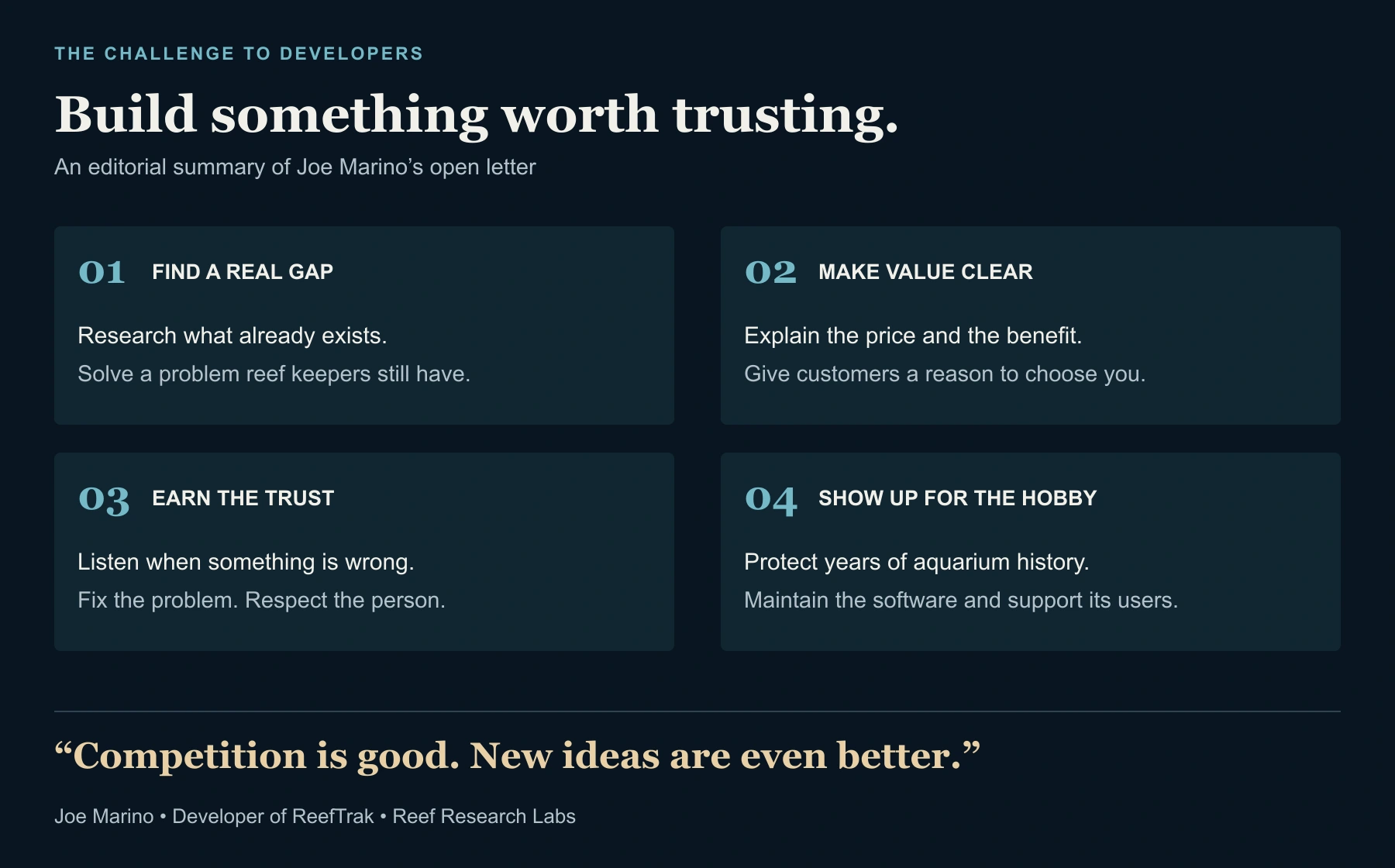
Competition is good. New ideas are even better.
There's absolutely room for more developers in this industry, especially those who bring something genuinely different to the table.
But we need to stop treating somebody else's feature list as a substitute for innovation.
And we need to remember that the people we're trying to serve are fellow hobbyists, not just another subscription payment.
At the end of the day, we're all supposed to be helping people enjoy their aquariums.
I think we can do a better job of that.
Joe Marino
Founder, Reef Research Labs
Developer of ReefTrak